Titanium Dioxide Regulation
You have probably heard that titanium dioxide was banned. You may also have read that it is perfectly legal, FDA-approved, and used in everything from doughnut glaze to sunscreen. Both statements circulate widely, and both are quoted with confidence. The reason they coexist is simple: they describe different jurisdictions and different uses of the same substance, and almost nobody says so out loud.
Here is the short version. Titanium dioxide is not banned globally. The European Union removed it from its list of permitted food additives in 2022 — that is E171, and that decision is real and binding. The United States has not followed. In the US it remains a listed colour additive for food, an approved cosmetic colorant including for the eye area, and an active ingredient in over-the-counter sunscreen. And in paints, plastics, paper and coatings — which consume the overwhelming majority of the world's TiO2 — nothing has changed anywhere.
If you are formulating a product, writing a label, answering a customer email, or simply trying to work out whether the ingredient list on your packaging is a problem, the question you actually need answered is narrower than "is it banned?" It is: banned where, for what, and under which instrument? That is a question with precise answers, and every one of them has a named regulation, court judgment or expert opinion behind it.
What follows is written to be checked, not believed. Each legal statement is tied to the instrument that creates it. Where a matter is genuinely unsettled — and one significant US proceeding is — it is labelled as unsettled rather than resolved in either direction. This page reflects the position as of August 2026.
Table of Contents
- Is Titanium Dioxide Banned? Status at a Glance
- United States: FDA Status of Titanium Dioxide
- European Union: The E171 Food Ban and Its Boundaries
- The Annulled EU CLP Carcinogen Classification (History)
- EFSA vs JECFA: The Scientific Split Behind the Regulatory Split
- US State Law: A Patchwork Beyond the Federal Rules
- Compliance Summary by Use Case
- FAQ
Is Titanium Dioxide Banned? Status at a Glance
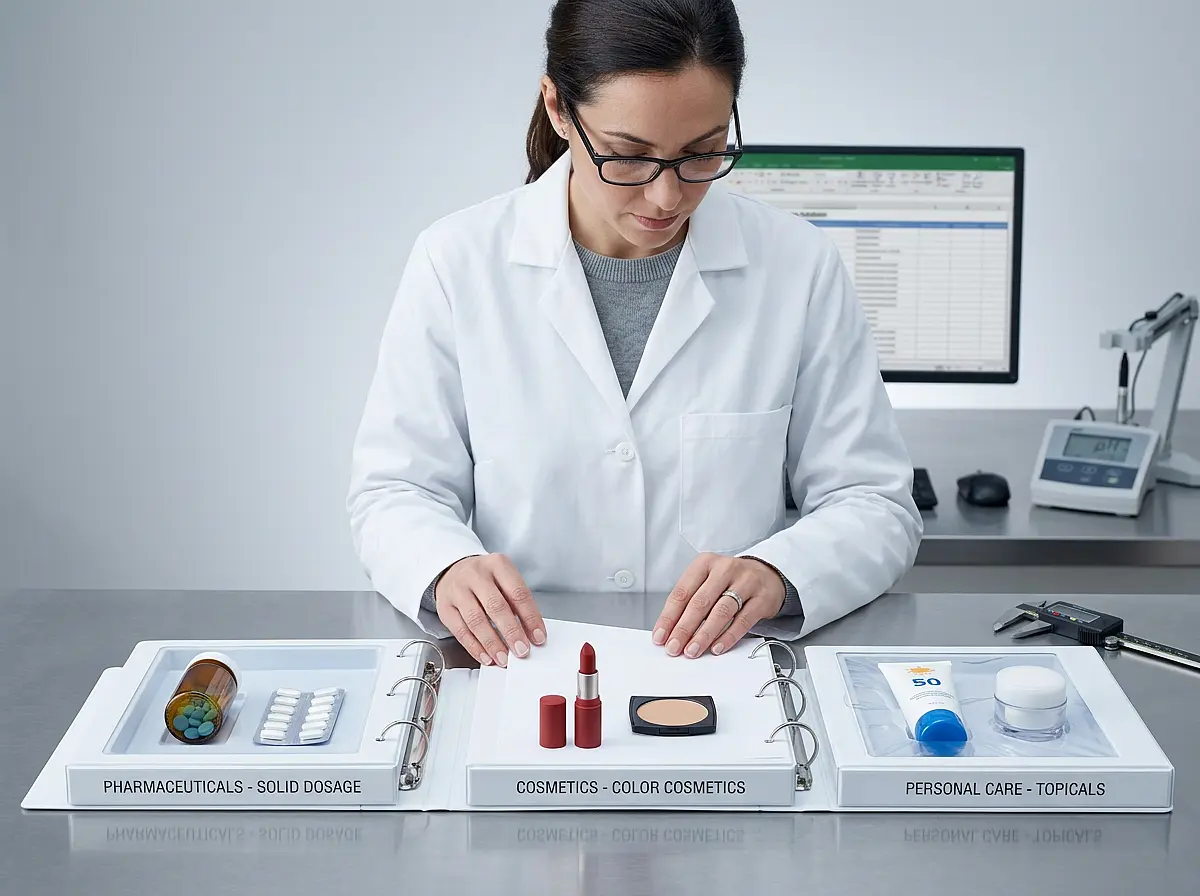
The question is titanium dioxide banned cannot be answered with a single yes or no, because the regulatory position of TiO2 is determined far more by use case than by chemistry. The identical white pigment can be prohibited in a confectionery coating, permitted in a tablet coating, permitted at high concentration in a pressed face powder, sharply restricted in a spray version of that same powder, and entirely unaffected in a can of exterior paint. Nothing about the substance changes across those five products; what changes is the exposure route, the population exposed, and the law that applies. To read anything on this page accurately, you therefore need to hold three variables in mind simultaneously: the use case, the jurisdiction, and the specific legal instrument that governs it.
Two symmetrical rules govern the whole page, and they are worth carrying into every section that follows. First, an EU withdrawal of an authorisation does not prove harm. Second, a US authorisation does not prove safety. Both are administrative decisions, taken by different bodies under different legal tests, with different burdens of proof and different default treatments of scientific uncertainty. Reading either outcome as a verdict on toxicology is the most common analytical error on this topic, and it produces confident conclusions in both directions that the underlying documents do not support.
The divergence between the US and EU positions is not arbitrary; it has an identifiable scientific and legal explanation, set out in the section comparing the EFSA and JECFA assessments below. The three subsections that follow first establish what is and is not restricted, how the regulatory regimes differ, and how current this information is.
Quick status by use & region
Whether titanium dioxide is “banned” depends on the use case and the jurisdiction — not the chemistry. The same white pigment is banned in one product and untouched in another. Each row links to the full analysis below.
| Use case | European Union | United States | |
|---|---|---|---|
| Food additive (E171) | Banned since Aug 2022 | Permitted ≤1% by weight | Details → |
| Cosmetics | Permitted powder/spray restricted | Permitted | Details → |
| Medicines (excipient) | Permitted retained, no phase-out | Permitted | Details → |
| Carcinogen classification (inhalation) | Not classified annulled 2025 | Not classified NIOSH: potential carcinogen | Details → |
| Workplace exposure | No EU-wide limit national limits apply | OSHA / NIOSH / ACGIH limits | Details → |
| Industrial use (paint, plastics, paper) | Unaffected | Unaffected | — |
An EU withdrawal does not prove harm; a US authorisation does not prove safety — both are administrative decisions under different legal tests. Last reviewed: August 2026.
What Is Actually Prohibited, and Everything That Is Not
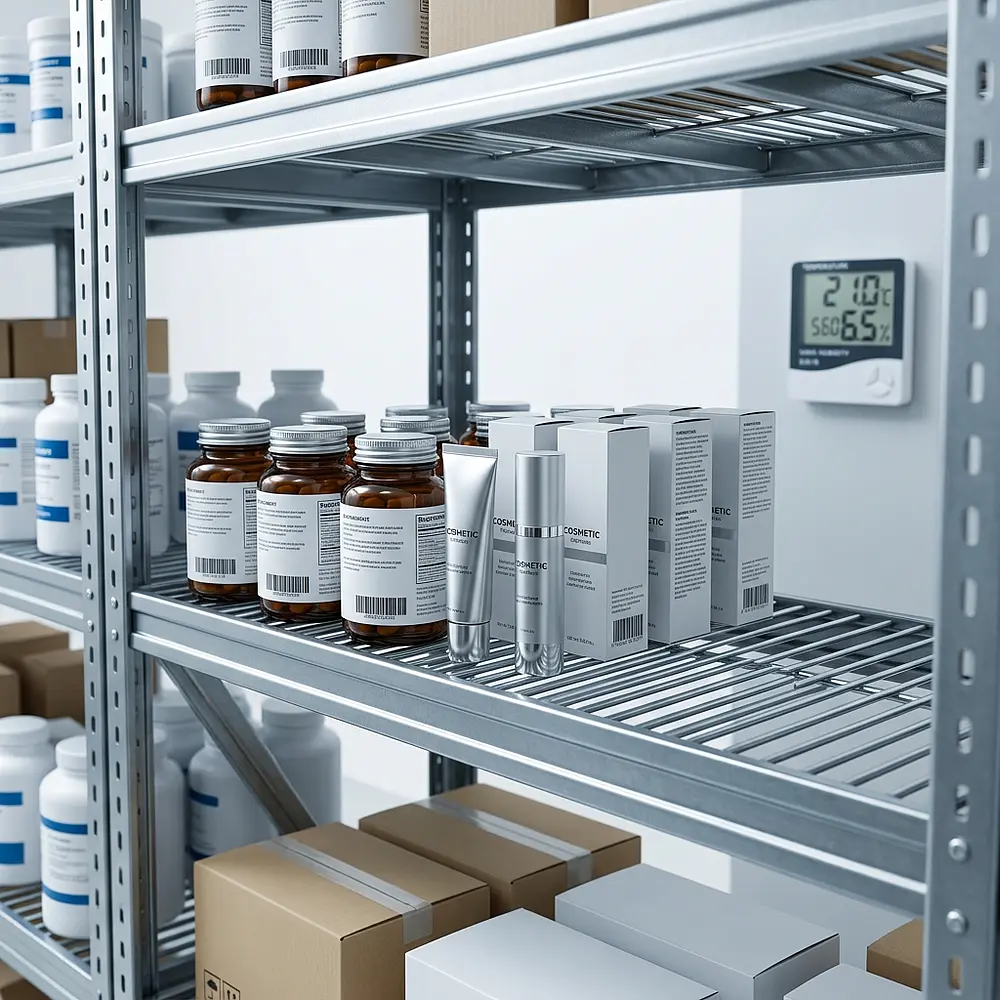
Exactly one genuine prohibition exists anywhere in the world, and it is narrow. Titanium dioxide as the food additive E171 may not be used in food manufactured or placed on the EU market since 7 August 2022, under Commission Regulation (EU) 2022/63. That is the entire inventory of bans — one substance, one use, one jurisdiction.
Set against that single withdrawal, the following uses all remain lawful as of August 2026: cosmetics and mineral sunscreens in the EU under Regulation (EC) 1223/2009; human and veterinary medicinal products in the EU; food in the United States; cosmetics in the United States; polymers intended for food contact in the United States; over-the-counter sunscreen in the United States; and industrial applications in every major jurisdiction — paints, coatings, plastics, paper, printing inks, rubber, construction materials, glass and ceramics. By volume, these industrial uses account for the overwhelming majority of all titanium dioxide consumed, and none of them is touched by the food-additive question.
The misconception follows directly from the imbalance. Reporting that says Europe banned titanium dioxide compresses a narrowly drawn food-additive withdrawal into a general prohibition, and that compression is the origin of most of the confusion among readers who ask whether titanium dioxide is banned. The practical test is simple: the same physical pigment, from the same production line, is lawful in the EU today on the shelf as a paint tin, inside a coated tablet, and in a mineral sunscreen — while being unlawful in a sweet.
The reasoning and transition periods behind the E171 decision are covered in the EU section below and in full at titanium dioxide in food.
Three Separate Legal Regimes That Reach Different Conclusions
Much of the apparent contradiction in the titanium dioxide legal status disappears once you separate three bodies of law that ask entirely different questions. Food additive authorisation law is permissive by default only in the negative sense: a substance may be used because a regulator has positively concluded it is safe for that purpose, and when that conclusion can no longer be supported, the authorisation is withdrawn — withdrawal reflects an inability to establish safety, not a finding of harm. Chemical hazard classification law does something quite different: it assigns hazard statements that travel on labels and safety data sheets so that professional users know what they are handling. It communicates; it does not authorise, restrict or prohibit any use. Occupational exposure law is different again, managing dust and aerosol exposure in workplaces through limit values, ventilation, closed systems and personal protective equipment, and it operates on its own terms regardless of what a food regulator or a classification decision says.
A parallel distinction runs through product categories. The same pigment is a colour additive under food law, an excipient or colorant in medicinal products, a listed cosmetic colorant, and a UV filter — each with a separate listing, separate maximum concentrations and separate conditions of use, sometimes differing by application form within a single category.
For formulators the operative rule is short and unforgiving: authorisation in one category never implies authorisation in another, and a decision reached under one regime is not evidence about any other. The specific instruments behind each of these regimes are cited jurisdiction by jurisdiction below.
Currency, Pending Proceedings and How to Verify
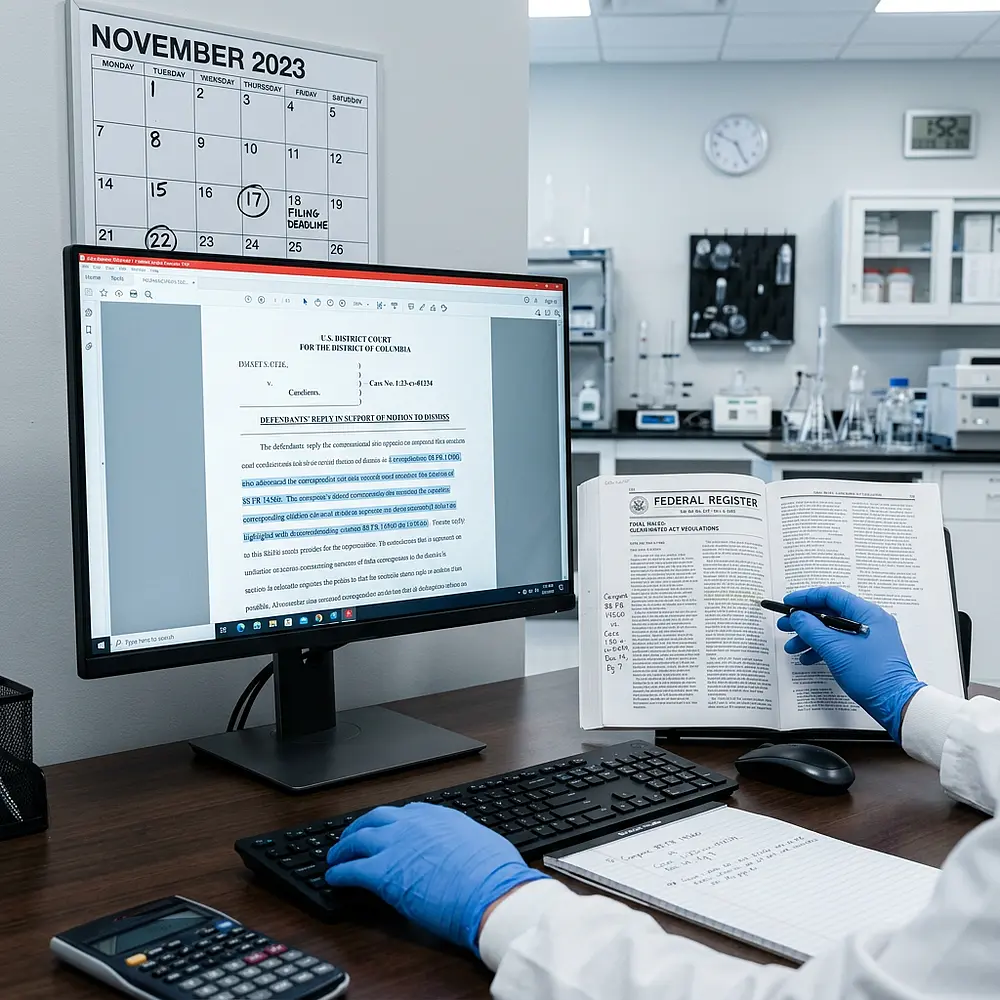
Reading any summary of titanium dioxide regulation accurately requires distinguishing three legal states that are routinely conflated. An instrument may be in force: 21 CFR 73.575 is current law, and food manufacturers in the United States rely on it today. A proceeding may be pending: the colour additive petition docketed as CAP 3C0325 has been filed and accepted, but nothing about it changes the legal position until FDA acts on it. And a measure may be annulled: the former harmonised carcinogen entry for certain TiO2 powders under EU classification law was struck down by the courts and is no longer law, which means it cannot be cited, applied or written in the present tense. A filed petition is not a restriction; an annulled measure is not a weakened one.
Three things on this page move faster than the rest and should be re-checked before you rely on them. The FDA petition remains undecided. US state food-additive legislation changed rapidly through 2025 and continues to differ from state to state, so there is no national state-level rule to assume. And administrative follow-through after the EU classification annulment — corrected safety data sheets, labels and supplier documentation moving through supply chains — lags the legal position, so documents in circulation may still carry withdrawn wording.
Treat this page as a map to the primary sources, not a substitute for them. Before any labelling or reformulation decision, confirm the current text of the relevant CFR section, EU regulation or state statute directly. The position described here reflects the law as of August 2026.
United States: FDA Status of Titanium Dioxide
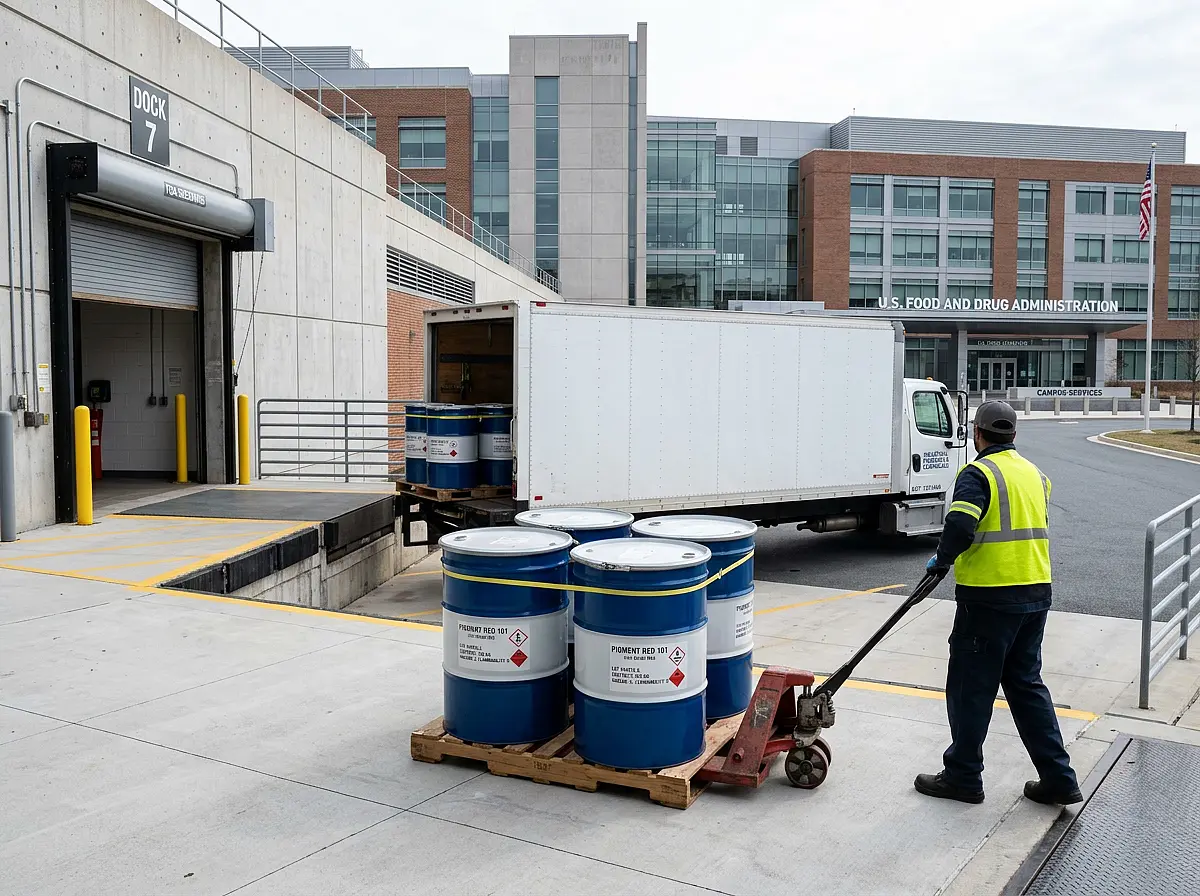
For readers whose primary market is the United States, the position is straightforward to state and easy to misread. TiO2 is authorised here through several parallel and largely independent federal pathways rather than a single approval. It is listed as a colour additive exempt from certification — meaning individual batches need not be submitted to FDA for testing — for use in food, in cosmetics, and as a colorant in polymers intended to contact food. Separately, and under an entirely different body of law, it is recognised as an active drug ingredient in over-the-counter sunscreen, where it functions as a physical UV filter rather than a pigment. These are distinct authorisations resting on distinct statutory tests; none depends on the others.
The headline is plain: every one of these authorisations is in force as of August 2026, and no federal action has removed any of them. The colour additive listings share two standing conditions — the material must meet the specified identity and purity specifications, and it must be used in accordance with good manufacturing practice, which in practice means no more than the quantity needed to achieve the intended effect. Instrument-level detail for each pathway follows in the subsections below, with the food application covered at titanium dioxide in food and the sunscreen use at titanium dioxide sunscreen.
Continued titanium dioxide FDA approval rests on an evidentiary record that differs from the one EFSA assessed, and that difference — including the National Toxicology Program carcinogenicity studies FDA references — is the substantive explanation for the transatlantic divergence. It is analysed in full in the EFSA and JECFA comparison section rather than restated here.
Food, Cosmetics and Food-Contact Listings Under 21 CFR
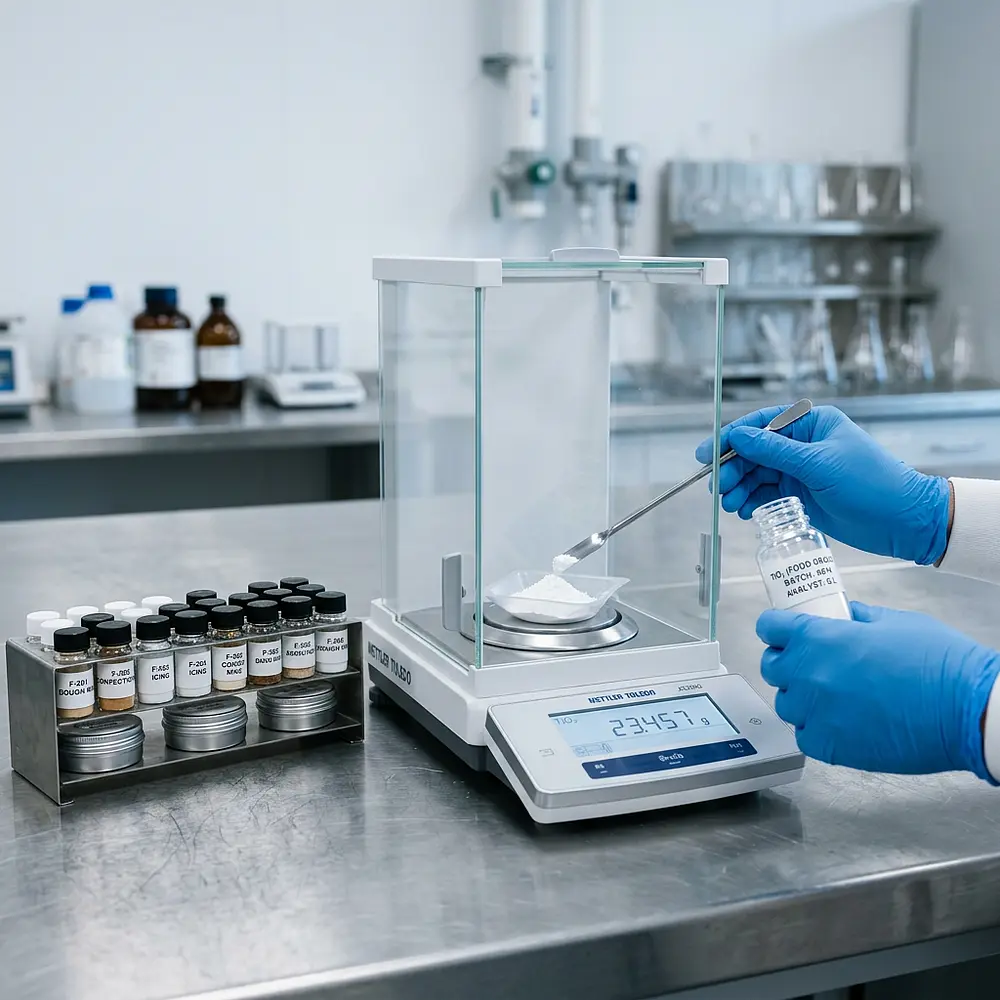
The food listing at 21 CFR 73.575 permits titanium dioxide as a colour additive in food, with the quantity not to exceed 1 percent by weight of the food. That figure is a hard compositional ceiling written into the regulation itself, not a guidance value or a recommendation — a food exceeding it is not a food using a permitted additive at an unusual level, it is a food containing an unlisted colour additive. In practice the cap constrains the applications where opacity and whiteness matter most: confectionery panning and coatings, bakery decoration, icings, white sauces and similar products. The structural contrast with the EU is worth stating precisely. Under 21 CFR 73.575 titanium dioxide use is a question of how much; in the EU, where the additive has been delisted entirely, no concentration is lawful at all. One regime sets a limit, the other removed the entry.
Cosmetics are covered separately by 21 CFR 73.2575, which permits titanium dioxide as a colour additive in cosmetics generally, including products intended for use in the area of the eye, subject to good manufacturing practice rather than a numerical maximum. Eye-area clearance is a meaningful distinction, because many listed colour additives are expressly excluded from that use.
Food-contact materials fall under 21 CFR 178.3297, which lists titanium dioxide among the colorants permitted in polymers contacting food — pigmented packaging films, closures, containers, and components of processing equipment. Application-level formulation detail for food use is set out at titanium dioxide in food.
Sunscreen: OTC Drug Active Under Monograph M020
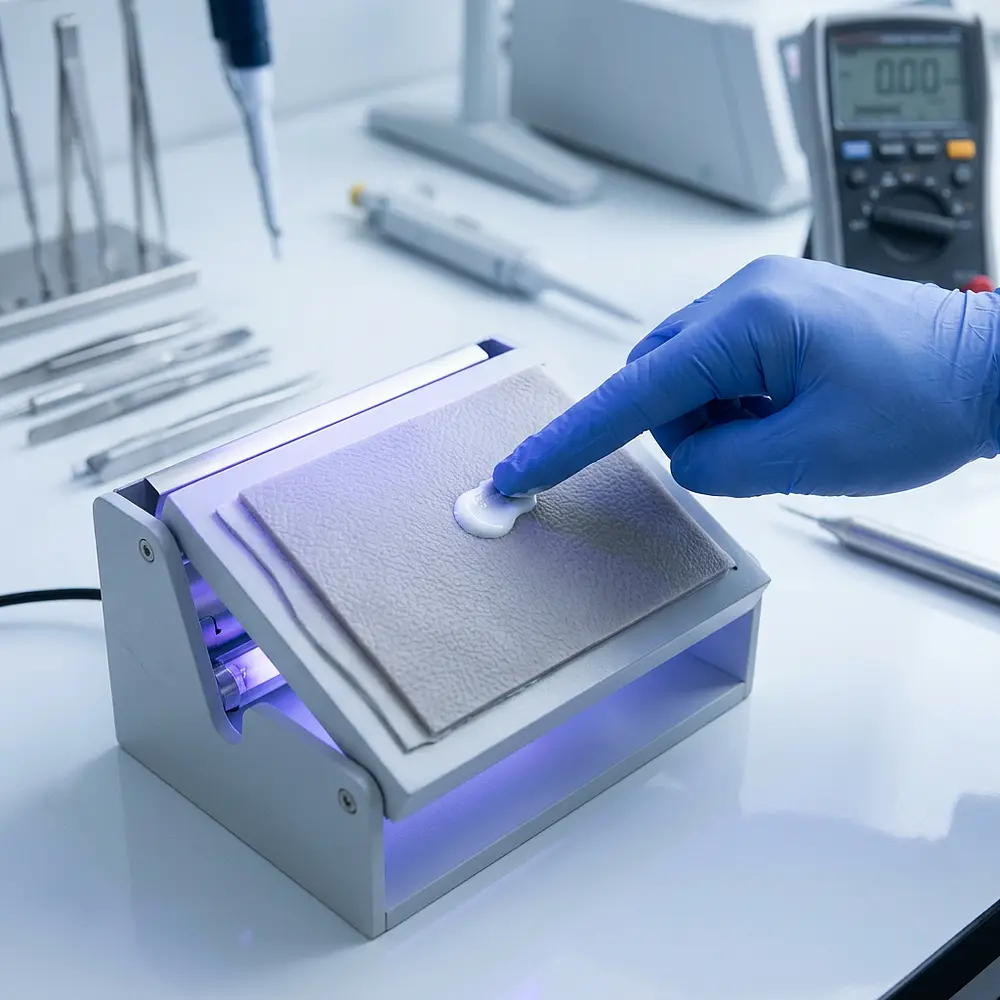
Sun protection is the one US pathway that sits outside colour additive law entirely. When titanium dioxide performs a UV-filtering function rather than a colouring one, it is regulated as an active drug ingredient, listed in FDA OTC Monograph M020 at section M020.10(n) at concentrations up to 25 percent. That ceiling is identical to the one zinc oxide receives at M020.10(p), which is useful context for formulators comparing mineral filter systems: neither of the two permitted inorganic filters is advantaged over the other on maximum use level, so the choice between them turns on optics, dispersion, texture and SPF efficiency rather than on any regulatory headroom.
Monograph status has a specific operational meaning. A sunscreen formulated within the conditions of the monograph — permitted actives, permitted concentrations, prescribed labelling, and the required testing for SPF, broad spectrum and, where claimed, water resistance — may be marketed without individual pre-market approval. The manufacturer does not file for clearance of the product; it takes responsibility for conformity with the monograph.
The transatlantic point resolves a persistent confusion. In the EU, the same ingredient serves the same function as a cosmetic UV filter under Annex VI entry 27 of Regulation (EC) 1223/2009. Mineral sunscreens are therefore lawful on both sides of the Atlantic, but they occupy different legal categories: a drug in the United States, a cosmetic in the EU. Anyone searching for titanium dioxide sunscreen FDA guidance is reading drug law, not cosmetic law. That categorisation difference — not any disagreement about safety — is what explains why approval routes, evidentiary requirements and timelines diverge. Formulation and product detail is covered at titanium dioxide sunscreen.
The Pending Colour Additive Petition CAP 3C0325

One federal proceeding is currently open on the food listing, and its status is frequently overstated in both directions. On 14 April 2023 the Environmental Defense Fund, the Center for Environmental Health, the Center for Food Safety, the Center for Science in the Public Interest and the Environmental Working Group jointly submitted a colour additive petition asking FDA to repeal 21 CFR 73.575, the listing that permits titanium dioxide in food. FDA assigned it the docket number CAP 3C0325 and published a filing notice in the Federal Register on 3 May 2023.
It is worth being exact about what that notice does. A filing notice confirms that a petition contains the information required for FDA to begin substantive review and that the agency has accepted it into the review process. It is a procedural acknowledgement. It does not signal that FDA endorses the petitioners' analysis, that the agency has reached any preliminary view, or that repeal is more or less likely. Publication opens the docket to public comment; it changes nothing in the Code of Federal Regulations.
As of August 2026, FDA has not issued a decision on the FDA titanium dioxide petition. 21 CFR 73.575 therefore remains in force, and use in food within the 1 percent ceiling remains lawful in the United States.
The scope is also narrower than commonly assumed. The petition addresses the food listing only. The cosmetic listing at 21 CFR 73.2575, the food-contact clearance at 21 CFR 178.3297 and the sunscreen monograph are not the subject of this petition. Teams tracking the file should monitor the docket directly rather than rely on secondary reporting.
European Union: The E171 Food Ban and Its Boundaries

The Union's position on titanium dioxide in food rests on a single instrument. Commission Regulation (EU) 2022/63, adopted on 14 January 2022, amended the Union list of permitted food additives to remove E171 from it. The mechanism matters: the entry was deleted rather than restricted, which is why no permitted concentration exists in EU food today and why the comparison with a numerical ceiling elsewhere is not a comparison of stringency but of legal form.
The trigger was the scientific opinion published by the European Food Safety Authority on 6 May 2021 (EFSA Journal 2021;19(5):6585), which concluded that a concern for genotoxicity could not be ruled out and that E171 could consequently no longer be considered safe when used as a food additive. One clarification belongs here before anything else, because it is the most frequently repeated error in coverage of this file: EFSA did not conclude that titanium dioxide causes cancer. An unresolved genotoxicity concern and a positive carcinogenicity finding are different scientific statements with different evidentiary thresholds, and treating them as interchangeable misstates what the opinion says. Why EFSA reached that position, and why other expert bodies reading overlapping evidence did not, is examined in the EFSA and JECFA comparison further down; the carcinogenicity question itself is treated at titanium dioxide and cancer.
The scope of the withdrawal is equally important. The E171 ban reaches food and nothing else: medicinal products, cosmetics, sunscreen and every industrial application remain governed by their own instruments and remain authorised, as the subsections below set out. Timing, transition and product-level detail are covered at titanium dioxide in food.
Timeline, Transition and Market Consequences of Regulation (EU) 2022/63
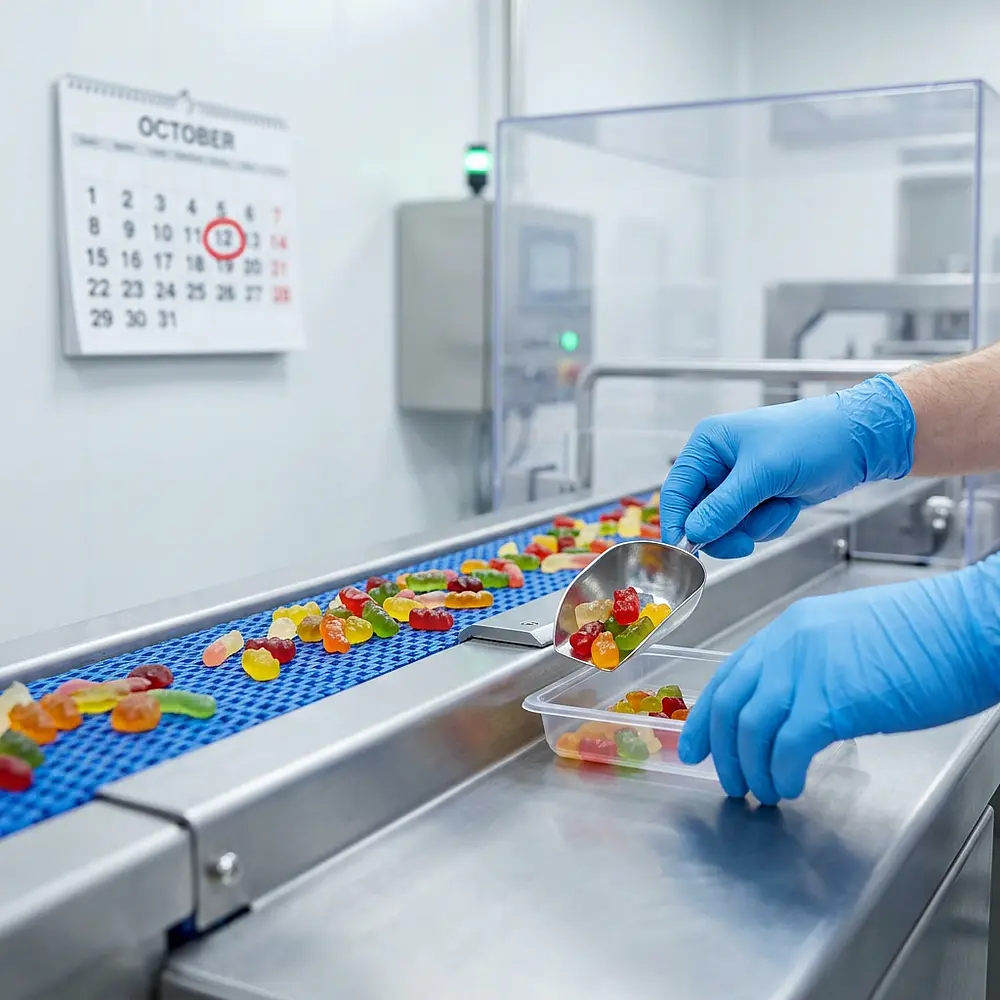
The chronology is short and worth stating exactly. The instrument was adopted on 14 January 2022 and entered into force on 7 February 2022, followed by a six-month transitional window. From 7 August 2022, food containing E171 could no longer be manufactured in, or placed on, the EU market. The transition was designed to absorb goods already moving through the supply chain: product lawfully produced before the cut-off could continue to be sold to the end of its date of minimum durability or use-by date, so existing stock was drawn down commercially rather than withdrawn overnight. That window closed years ago; as of August 2026 no residual transitional relief remains anywhere in the chain.
What removal from the Union list means in enforcement terms deserves precision. Because the entry was deleted, a food containing the additive is non-compliant regardless of concentration — there is no threshold to fall below and no de minimis defence. This is structurally unlike a numerical cap, where compliance is a measurement question; here it is a listing question, and any detectable intentional use makes the product an unauthorised-additive case.
The categories affected in practice were confectionery, chewing gum, bakery decoration, sauces, soups, food supplements and coatings. The trade consequence follows directly under Commission Regulation (EU) 2022/63: product lawfully manufactured with TiO2 in the United States or elsewhere cannot be placed on the EU market, a recurring obstacle for US exporters and for co-manufactured private-label lines running a single global specification. Reformulation alternatives are covered at reformulation alternatives.
Medicines: Why the EU Kept Titanium Dioxide in Pharmaceuticals
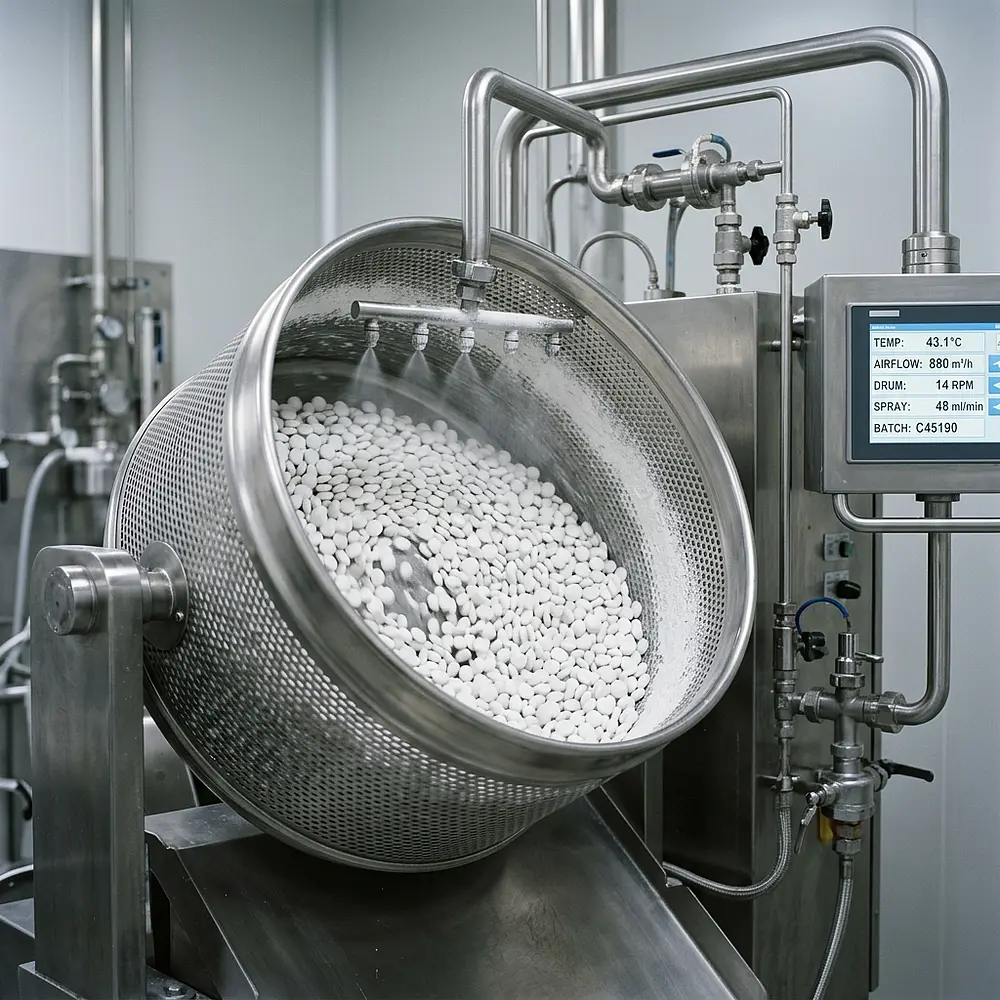
The exemption for medicinal products was deliberate, not an oversight. When E171 was removed from the Union list of food additives, titanium dioxide remained permitted as a colorant in both human and veterinary medicines, and that position has since been tested and confirmed rather than quietly carried over. The European Medicines Agency conducted a review of possible replacements, reported in April 2024, and the Commission reaffirmed the carve-out on 6 August 2025. The stated grounds were practical: no feasible alternative currently exists across the range of affected formulations, and forcing substitution would put supply at risk for roughly 91,000 human and 1,600 veterinary medicinal products.
The technical difficulty is specific to solid dosage forms. In tablet coatings and capsule shells, TiO2 delivers full opacity at very low loading, shields light-sensitive active substances from photodegradation, provides the uniform white surface that printing and identification coding require, and does so without destabilising the coating film itself. No single substitute reproduces all four properties at once, and changing a coating means revalidating stability, dissolution and, in many cases, the marketing authorisation.
Readers who see the split as a contradiction are comparing two legal regimes that ask different questions. EU food additive law and EU medicinal product law apply different tests: the latter weighs availability of the product and its therapeutic benefit against the identified concern, a calculation that has no equivalent in food law, where the additive serves no health function. The same substance can therefore be withdrawn under one framework and retained under the other without inconsistency. The position on titanium dioxide in medicines in the EU is current and in force as of August 2026.
Cosmetics and UV Filters: Annex IV, Annex VI and the SCCS Spray Limits
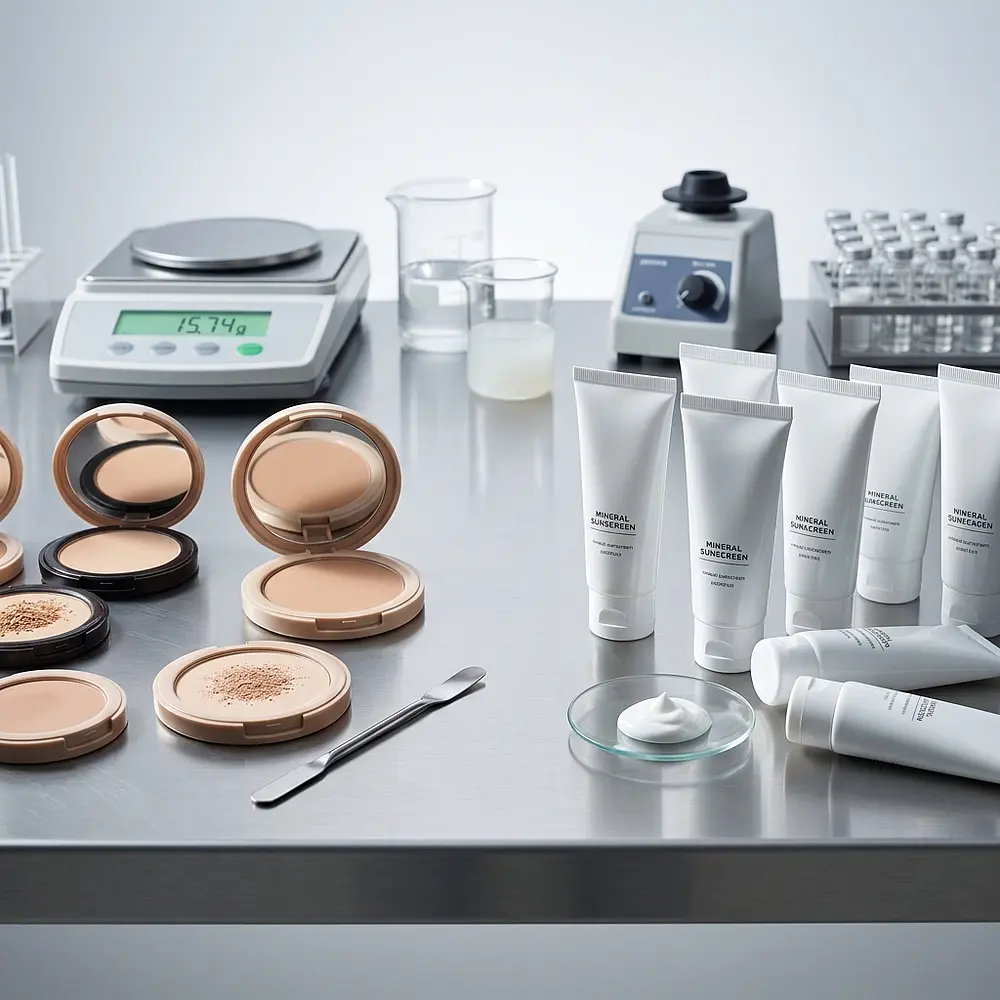
Two separate listings under Regulation (EC) 1223/2009 govern the ingredient in personal care products, and they sit side by side: non-nano titanium dioxide is authorised as a colorant under Annex IV entry 143 and as a UV filter under Annex VI entry 27. Pigmented make-up, foundations, pressed powders and mineral sunscreens therefore remain lawful across the Union, and this part of the titanium dioxide cosmetics EU regulation was never affected by the food-additive withdrawal.
The conditions attached to that authorisation are where the analytical interest lies. In its opinion SCCS/1617/20 of 6 October 2020, the Scientific Committee on Consumer Safety considered concentrations of up to 25 percent safe in face make-up and in loose powder products, but only 1.4 percent in face-make-up sprays and 1.1 percent in loose-powder sprays. The limiting factor is inhalation of aerosolised particles, not dermal contact. That is why the same pigment is generously permitted in a cream or a pressed powder and tightly capped in a pump spray: the restriction is route-specific, not substance-wide, and reading it as a judgement on the pigment itself misses the mechanism entirely.
For formulators the consequences are concrete. Aerosol and pump-spray formats cannot simply inherit the pigment loading of their non-spray counterparts; opacity, coverage and SPF contribution must be rebuilt around a far smaller inorganic fraction, or the format reconsidered. Two checks belong in every specification review: confirm whether the grade supplied is nano or non-nano, since the applicable conditions differ, and ensure the ingredient list carries the required "nano" designation where relevant. Sunscreen-specific formulation guidance is set out at titanium dioxide sunscreen.
The Annulled EU CLP Carcinogen Classification (History)
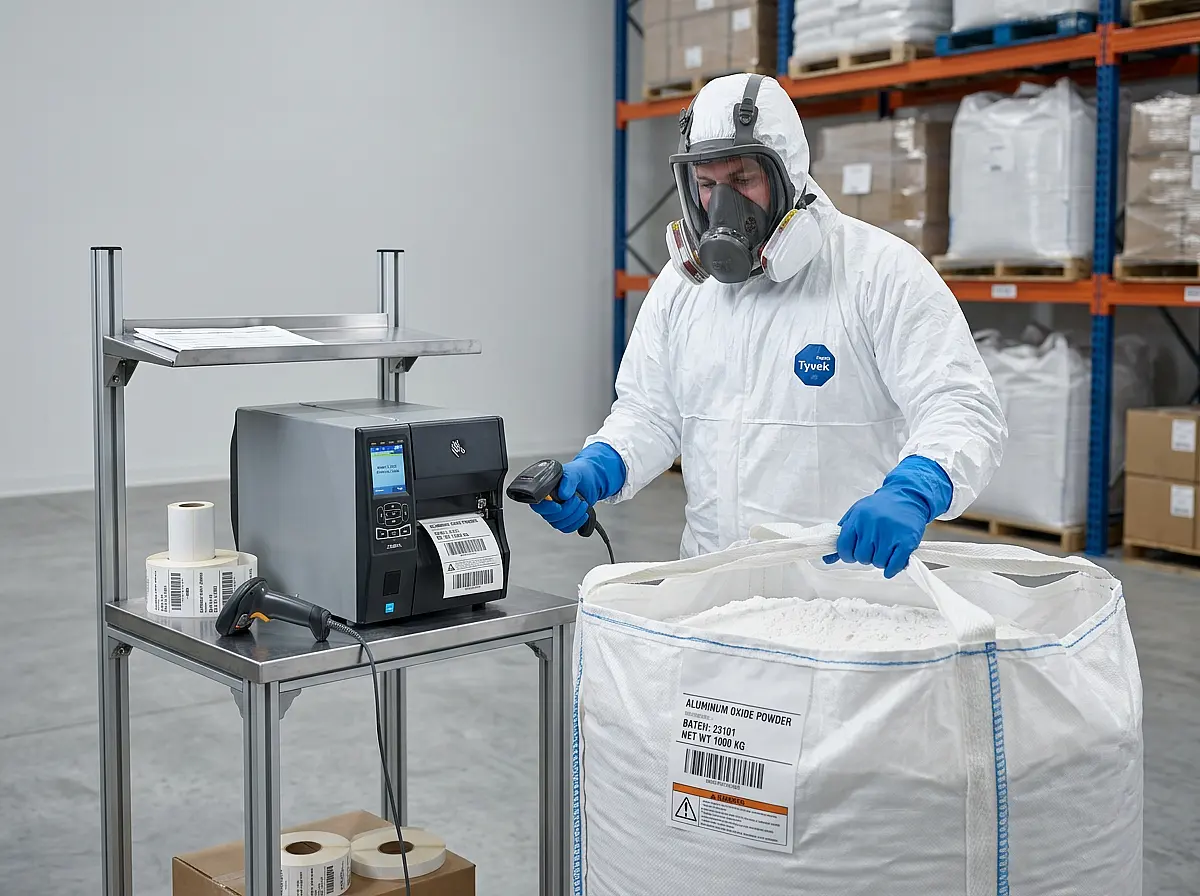
Everything in this section is written in the past tense, and deliberately so. As of August 2026 titanium dioxide carries no harmonised EU carcinogen classification, and the EUH211 and EUH212 labelling statements no longer apply to it. Any source that states otherwise — however recently published — is describing law that has been removed.
Three reasons make this history worth setting out rather than simply deleting. First, EU chemical hazard law, the CLP Regulation on classification, labelling and packaging, is an entirely separate regime from food additive law; the two are constantly conflated, and a reader who has heard that "Europe classified titanium dioxide as a carcinogen" is usually mixing this file with the E171 file. Second, a harmonised classification communicates hazard to professional users through labels and safety data sheets — it never banned the substance or restricted any use, so even while it applied it did not do what most summaries claimed. Third, a very large volume of secondary material online, including supplier documentation still circulating in supply chains, describes the withdrawn entry in the present tense.
In one sentence, what existed and no longer does: Delegated Regulation (EU) 2020/217 had introduced a harmonised classification of certain powder forms of titanium dioxide as Carc. 2, H351 — suspected of causing cancer by inhalation — together with the EUH211 and EUH212 statements for liquid and solid mixtures respectively. The litigation that removed the titanium dioxide CLP classification, from the General Court through to the final appeal judgment and the formal deletion from Annex VI, is traced in the first subsection below; what the outcome means in practice for labelling, self-classification and workplace dust control follows in the second.
From Delegated Regulation 2020/217 to the Court of Justice: The Timeline

Four dates carry this entire file, and any document a reader encounters can be placed against them. 2020: Delegated Regulation (EU) 2020/217 introduced the harmonised Carc. 2 / H351 entry for certain powder forms of titanium dioxide.
23 November 2022: the General Court of the European Union annulled that classification. It held that the Commission had committed a manifest error of assessment — the Commission and the ECHA Risk Assessment Committee had relied on the Heinrich et al. 1991 study without adequately verifying its reliability, and the carcinogenicity observed did not follow from an intrinsic property of the substance. France and the Commission each brought an appeal, so the position remained open until those appeals were decided.
1 August 2025: the Court of Justice dismissed both appeals in Joined Cases C-71/23 P and C-82/23 P. With no further avenue available, the annulment became definitive on that date, and the harmonised entry ceased to have any legal effect.
10 December 2025: an Official Journal notice formalised the removal from the list of harmonised classifications, completing the administrative step that follows a judgment. ECHA has since removed the harmonised entry from the C&L Inventory, so the public database now reflects the position established by the courts.
Dating a source is therefore mechanical. Commentary published before 1 August 2025 cannot reflect the final titanium dioxide court ruling on the classification; material published before 10 December 2025 predates the formal deletion and may still show the entry as listed. Anything written after both dates should describe the entry as removed.
What the Annulment Does and Does Not Mean in Practice
One inference must not be drawn from the outcome. Neither court examined whether inhaling titanium dioxide dust is safe, and neither concluded that it is. The General Court found a manifest error of assessment in how the classification had been arrived at, and the Court of Justice confirmed that finding on appeal. That the titanium dioxide carcinogen classification was annulled is therefore a legal and procedural conclusion about the quality of an administrative decision, not a toxicological clearance, and citing the judgments as evidence of safety misrepresents them. The underlying scientific questions remain open and are discussed at is titanium dioxide safe and, specifically on carcinogenicity, at titanium dioxide and cancer.
What changes operationally is limited but concrete. There is no harmonised carcinogen classification to apply; EUH211 and EUH212 no longer apply to titanium dioxide; and any safety data sheet, label, product information or poison centre notification still carrying the withdrawn entry needs review and correction, since documents in circulation frequently lag the legal position.
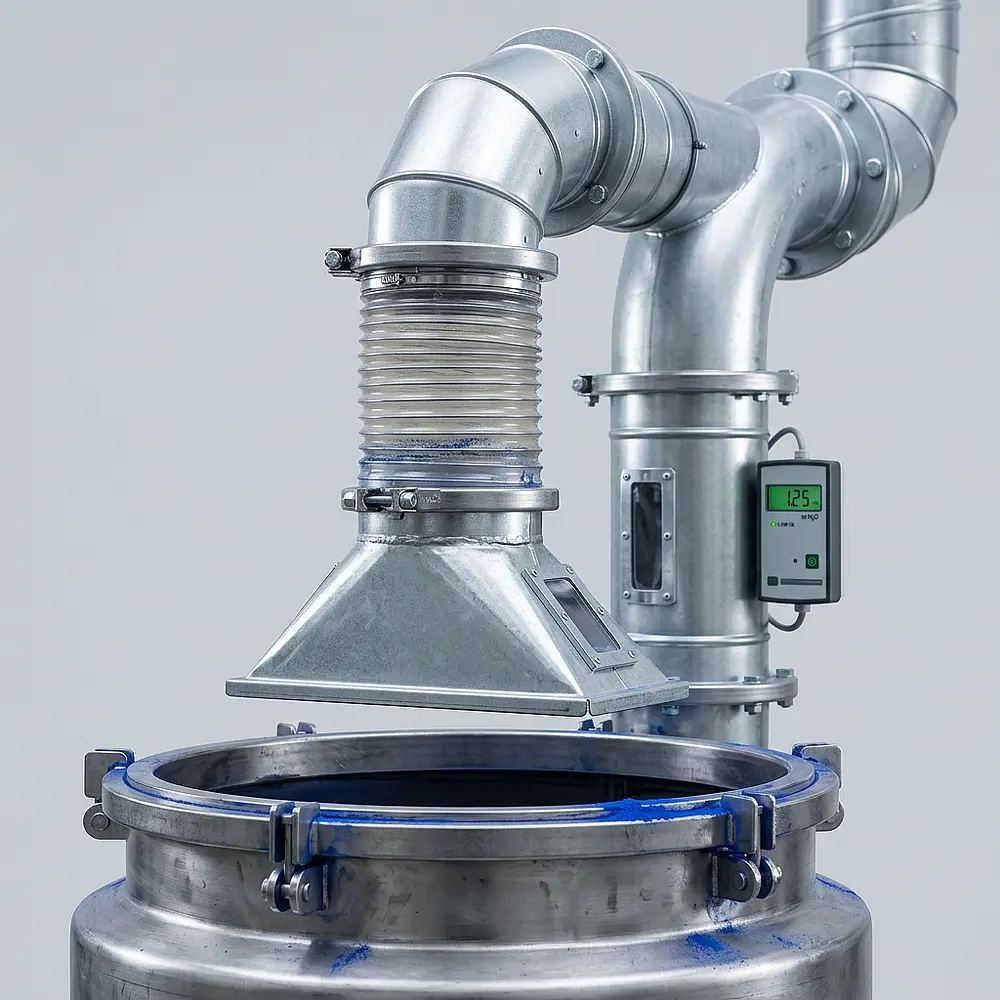
What does not change is broader. Self-classification duties under the CLP Regulation continue to apply, so a company holding its own data may still classify the substance or a mixture accordingly. And occupational exposure limits and dust control obligations are entirely untouched: local exhaust ventilation, enclosed handling and transfer, respiratory protection where required, and general dust minimisation for powder weighing, blending, milling and spray operations apply exactly as they did before. In occupational practice the respirable powder fraction and nanoforms are assessed distinctly from bulk pigment, and that distinction was never before the courts.
EFSA vs JECFA: The Scientific Split Behind the Regulatory Split

Two expert bodies of comparable standing read largely overlapping evidence on the same substance and arrived at opposite regulatory outcomes. That divergence is the question this section sets up rather than settles, and it is worth resisting the two easiest explanations for it. Neither committee was captured by industry, and neither worked carelessly. What separated them was how they weighted particular categories of evidence, and what their respective legal mandates obliged them to do with the uncertainty that remained after the evidence had been read.
Any serious comparison of the EFSA and JECFA titanium dioxide assessments has two fixed reference points. The first is the EFSA opinion of 6 May 2021, which led directly to the removal of E171 from the Union list of permitted food additives. The second is the reassessment by the Joint FAO/WHO Expert Committee on Food Additives at its 97th meeting, whose conclusions were released on 24 November 2023 and which reaffirmed an ADI "not specified" for INS 171. The reasoning behind each position, and the specific points on which the two records part company, are developed in the subsections that follow.
One guardrail governs the whole comparison and applies equally to both bodies: a genotoxicity concern is not a carcinogenicity finding, and no conclusion below should be read as though it were. It is also relevant that FDA's own record references National Toxicology Program carcinogenicity studies in which titanium dioxide did not cause cancer — one concrete reason the US and EU evidentiary records are not identical. This page declares no winner. Both bodies published their reasoning; readers can weigh it against their own risk framework, with the underlying toxicology at the toxicological literature and the cancer question at titanium dioxide and cancer.
EFSA 2021: A Genotoxicity Concern That Could Not Be Ruled Out

Published on 6 May 2021 as EFSA Journal 2021;19(5):6585, the opinion reaches its conclusion in two linked steps. EFSA stated that it could no longer establish a safe level of daily intake for E171, and it gave a single reason: a concern for genotoxicity could not be ruled out. Genotoxicity, in this context, means the potential of a substance to damage genetic material — DNA and chromosomes — whether directly or through indirect mechanisms. Because that possibility remained open, no acceptable daily intake could be derived.
Why that unresolved question was legally decisive follows from the structure of EU food additive law, which requires that safety be positively demonstrated before and while an additive stays on the Union list. The burden does not run the other way: no authority must show that an additive causes harm. Where safety cannot be affirmatively established, the authorisation cannot be maintained. An open uncertainty, not a demonstrated injury, is therefore what produced the withdrawal.
The nanoparticle fraction present in food-grade material is central to that reasoning. E171 is not a uniform powder; a proportion of its particles falls below 100 nm, and EFSA considered that these smaller particles may be absorbed and accumulate in the body. The available studies did not allow the genotoxic potential of that fraction to be characterised or dismissed, and it was this gap — uncertainty about a defined subpopulation of particles — that drove the outcome.
Read carefully, the EFSA titanium dioxide opinion 2021 records a question left open, not a hazard identified. It does not state that titanium dioxide causes cancer, and the E171 withdrawal is accordingly not a finding of harm.
JECFA 2023: ADI 'Not Specified' Reaffirmed for INS 171

Sitting on the other side of that conclusion is the reassessment carried out by the Joint FAO/WHO Expert Committee on Food Additives, which examined INS 171 at its 97th meeting and released its conclusions on 24 November 2023. The Committee reaffirmed the acceptable daily intake "not specified" originally established in 1969. Two elements carried the decision: the very low oral absorption of INS 171 from the gastrointestinal tract, and the absence of an identifiable hazard arising from dietary use. Those findings were weighed against a deliberately conservative high-end intake figure — a P95 dietary exposure estimate of 10 mg per kilogram of body weight per day — selected so that the conclusion would hold even for heavy consumers rather than for average ones.
The phrase itself is routinely misread, so the JECFA titanium dioxide ADI deserves a plain-language gloss. "Not specified" is the least restrictive outcome available within the system: it indicates that, on the data available, no numerical intake limit is considered necessary to protect the consumer. It is not a placeholder for a substance that went unevaluated, and it is not a gap in the record.
The Committee also made a methodological observation that bears directly on the divergence. Many toxicological studies in the published literature used test materials, including nanoparticles, whose size distribution and physico-chemical properties are not comparable to real-world food-grade titanium dioxide. That point matters well beyond Geneva: Codex-aligned jurisdictions outside the EU and the United States frequently follow JECFA conclusions when setting national additive rules, so this assessment underpins continued authorisation of INS 171 across much of Asia, Latin America, Africa and the Middle East.
Three Reasons the Two Assessments Diverged
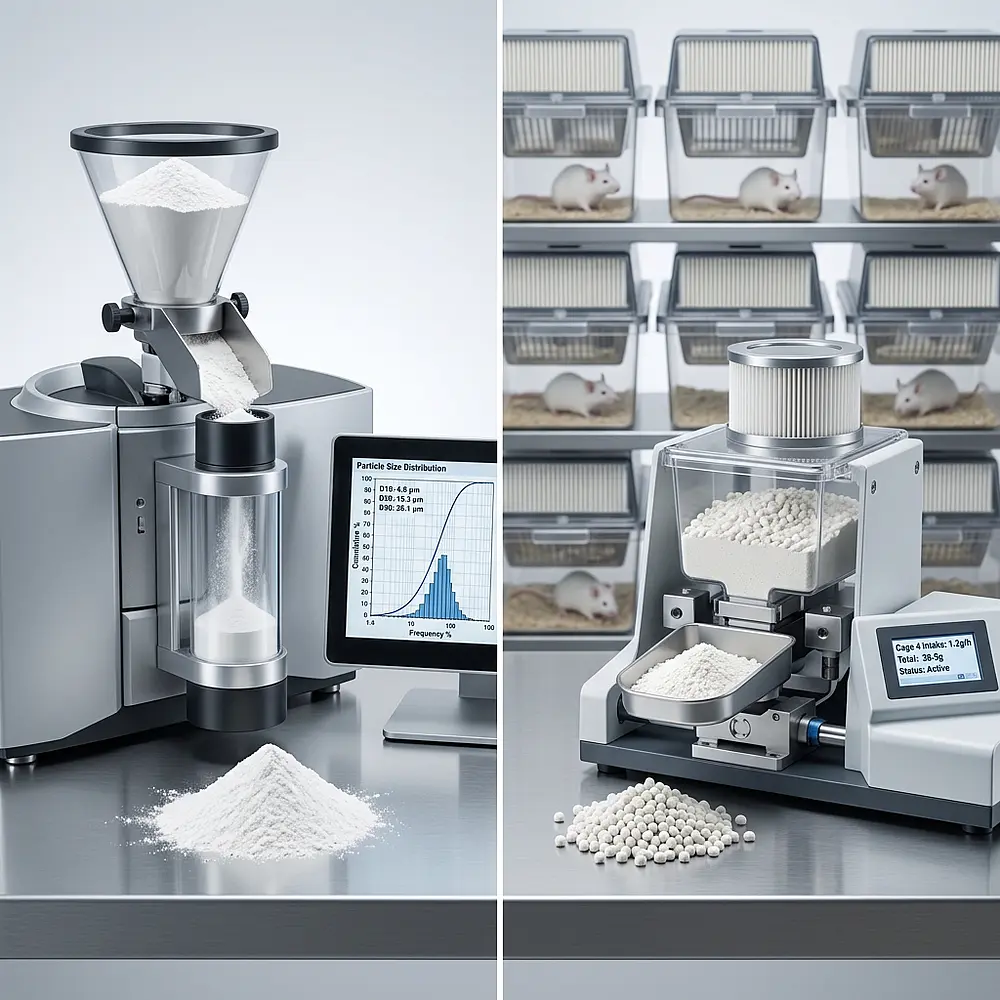
Three drivers account for the gap, and none of them is a disagreement about what the experiments showed. The first is the nanoparticle fraction. Both bodies acknowledged that food-grade material contains particles below 100 nm; they drew opposite operational conclusions from that fact. For EFSA, unresolved uncertainty about how that fraction behaves was itself sufficient reason to say safety could not be established. For JECFA, low oral absorption meant the fraction had limited practical consequence for dietary exposure, and much of the nanoparticle literature was judged to have limited relevance to INS 171 as actually used in food.
The second is a question that precedes toxicology altogether: which studies belong in the dataset. JECFA gave reduced weight to work conducted on test materials whose size distribution and physico-chemical properties do not match commercial food-grade pigment; EFSA retained a wider body of evidence. This is a methodological judgement about admissibility, and it can reverse a conclusion without a single new experiment being run.
The third is legal rather than scientific. The precautionary principle is an explicit test in EU food law, and it pushes unresolved uncertainty toward withdrawal of an authorisation. Frameworks operating without that default generally require a demonstrable hazard before an already authorised additive is restricted — which is much of the answer to why is titanium dioxide banned in Europe but not the US.
Taken together, the divergence is best understood as a difference in evidentiary and legal method, not a factual contradiction between two records. Neither position is endorsed here. Readers who want the primary toxicological literature behind both assessments will find it at is titanium dioxide safe.
US State Law: A Patchwork Beyond the Federal Rules
Federal authorisation no longer describes the whole US compliance position. Since 2023, and accelerating sharply through 2025, food-additive bills have been introduced in dozens of states, most of them aimed at the certified synthetic dyes rather than at pigments generally. The takeaway to carry into the detail below is a narrow one: titanium dioxide does appear in some of these measures, but it has fared differently from the dyes, and its treatment must be verified statute by statute rather than inferred from a headline about state food-additive reform.
Two symmetrical mistakes follow from ignoring that. The first is assuming a state measure covers TiO2 because it covers colour additives — several prominent bills either never included it or dropped it during passage, and a dye provision says nothing about the pigment. The second is assuming that a federal listing under 21 CFR 73.575 forecloses state action; it does not, and states have legislated on additives that remain federally listed. Both errors produce confident answers that the statutory text does not support.
For most manufacturers the commercial dynamic outweighs the legal one. Effective dates differ, and so does product scope: some measures reach general retail sale, others only food served in schools. Because a single national specification is usually cheaper than parallel regional ones, the strictest applicable state can drive a nationwide reformulation decision even where the affected volume is small.
The subsections that follow identify the named statutes that actually mention the pigment, separate them from the dye-only laws, and set out the practical workflow for tracking titanium dioxide state laws across a multi-state portfolio.
California, West Virginia and Arizona: What the Statutes Actually Cover

The single most misreported point in US coverage of this pigment concerns California. Titanium dioxide did appear in early drafts of the California Food Safety Act, but the California Senate removed it before passage. As enacted, the Act prohibits brominated vegetable oil, potassium bromate, propylparaben and Red No. 3 — and not titanium dioxide. Anyone searching for California Food Safety Act titanium dioxide provisions should treat that as settled: there are none, and any source reporting that California banned the pigment in food is describing a draft text that never became law.
West Virginia's 2025 statute is the broadest state action to date on synthetic dyes, reaching a wide set of certified colours across general food sale rather than a single channel. It is nonetheless a dye law, and titanium dioxide is not among the substances it lists. Citing it as a titanium dioxide measure confuses the two categories that this whole section exists to separate.
Arizona is the genuine case. House Bill 2164 does name titanium dioxide, and it applies from the 2026-27 school year. The school-food framing narrows its reach substantially compared with a general retail prohibition: the restriction attaches to food served or sold in schools, not to the same product on a supermarket shelf. A confectionery line containing TiO2 may therefore remain lawful in Arizona retail while being ineligible for supply into a school nutrition programme. For suppliers, scope is defined by sales channel rather than by product identity, which means school-channel specifications can diverge from retail specifications for what is otherwise the same formulation.
Compliance Workflow for Multi-State Distribution

A workable process starts with an inventory: list every SKU that contains the pigment and record its level, expressed against the 1 percent ceiling in 21 CFR 73.575, because lines sitting far below the cap are usually the cheapest to reformulate. Next, map distribution channels, keeping general retail separate from school nutrition and other institutional supply, since scope differs by channel and a product lawful on a supermarket shelf may be ineligible for a cafeteria contract. Third, read the enacted text and the effective date of each relevant state measure directly, rather than relying on bill trackers or press coverage, which frequently describe provisions that were amended out before passage. Fourth, diarise periodic re-checks: state sessions produce new measures every year.
The next decision is commercial rather than legal. Managing titanium dioxide compliance across a multi-state portfolio means choosing between a single reformulated national SKU and state-specific variants, and the arithmetic turns on two figures: label-change lead times — artwork, approval, print runs and depletion of existing label stock — and inventory sell-through measured against the earliest applicable effective date. Where affected volume is small and lead times are long, one national specification usually wins; where volume is large and only one channel is touched, parallel specifications can be justified.
Keep the exposure honestly bounded. These state measures address food; cosmetics, sunscreen and industrial products fall outside them entirely. As of August 2026 no state action alters the federal listings, and CAP 3C0325 runs on a separate track whose outcome should not be assumed in either direction. Reformulation options are set out at titanium dioxide in food.
Compliance Summary by Use Case
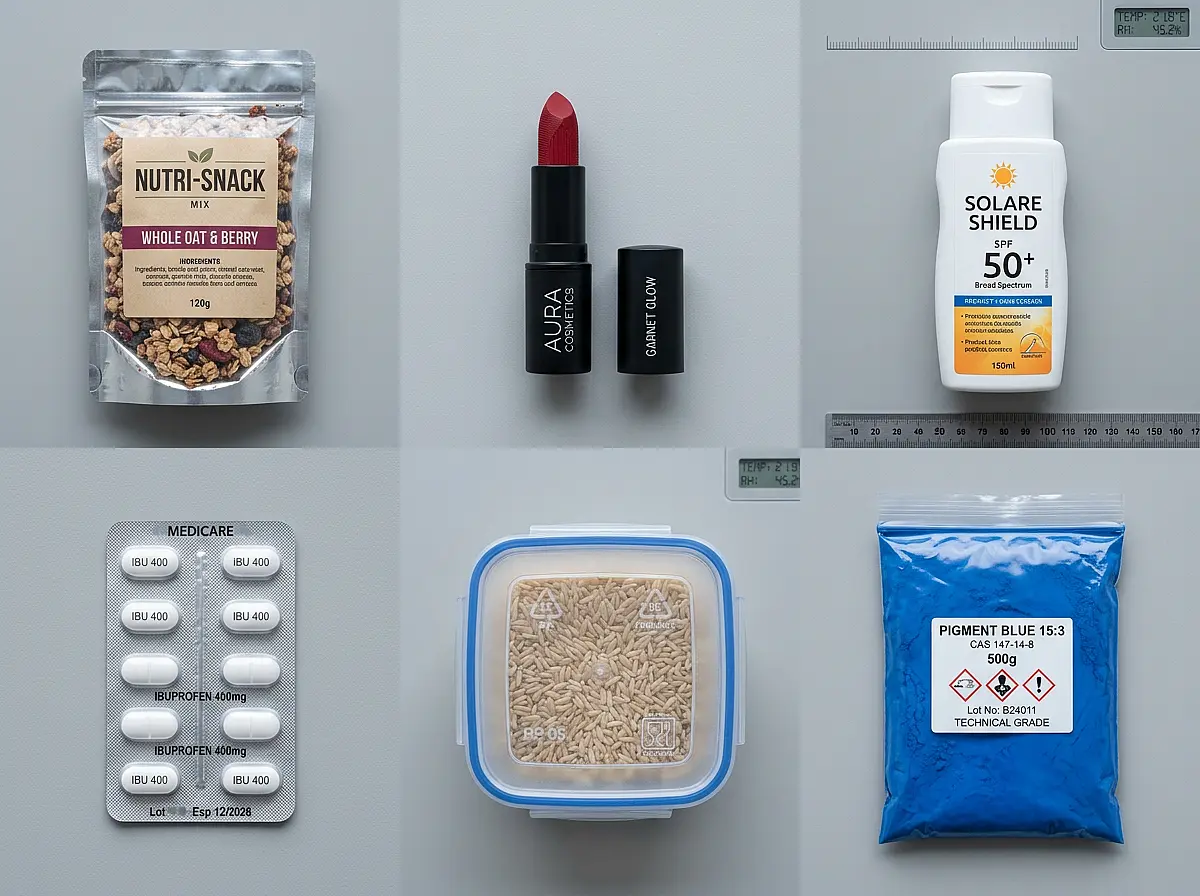
Organised by application rather than by jurisdiction, the position becomes something a formulator can act on at the bench: six use cases, each paired with the governing US instrument, the governing EU instrument and the current status of both. Food is covered by 21 CFR 73.575 in the United States and by Commission Regulation (EU) 2022/63 in the Union; cosmetics by 21 CFR 73.2575 and Annex IV entry 143 of Regulation (EC) 1223/2009; sunscreen by FDA OTC Monograph M020 and Annex VI entry 27 of the same Regulation; medicines by the EU colorant position reaffirmed on 6 August 2025; food-contact plastics by 21 CFR 178.3297; and industrial pigment use by general chemicals law alone. The two subsections below carry the actual entries.
One figure reframes the whole discussion. The applications that consume the overwhelming majority of global titanium dioxide volume — paints, coatings, plastics, paper, printing inks, rubber, construction materials, glass and ceramics — are untouched by any part of the food-additive controversy, and no jurisdiction has restricted them. A dispute about a colour additive in confectionery has, in tonnage terms, almost no bearing on the market for the pigment.
This page states the law as of August 2026. CAP 3C0325 remains pending before FDA, and no prediction is offered here as to how it will be decided. Anyone comparing titanium dioxide regulations by country should read the deeper treatments alongside this summary: the chemical base data, industrial applications, E171 in food, the toxicology, the carcinogenicity question and sun care.
Quick Reference: Food, Cosmetics, Sunscreen and Medicines
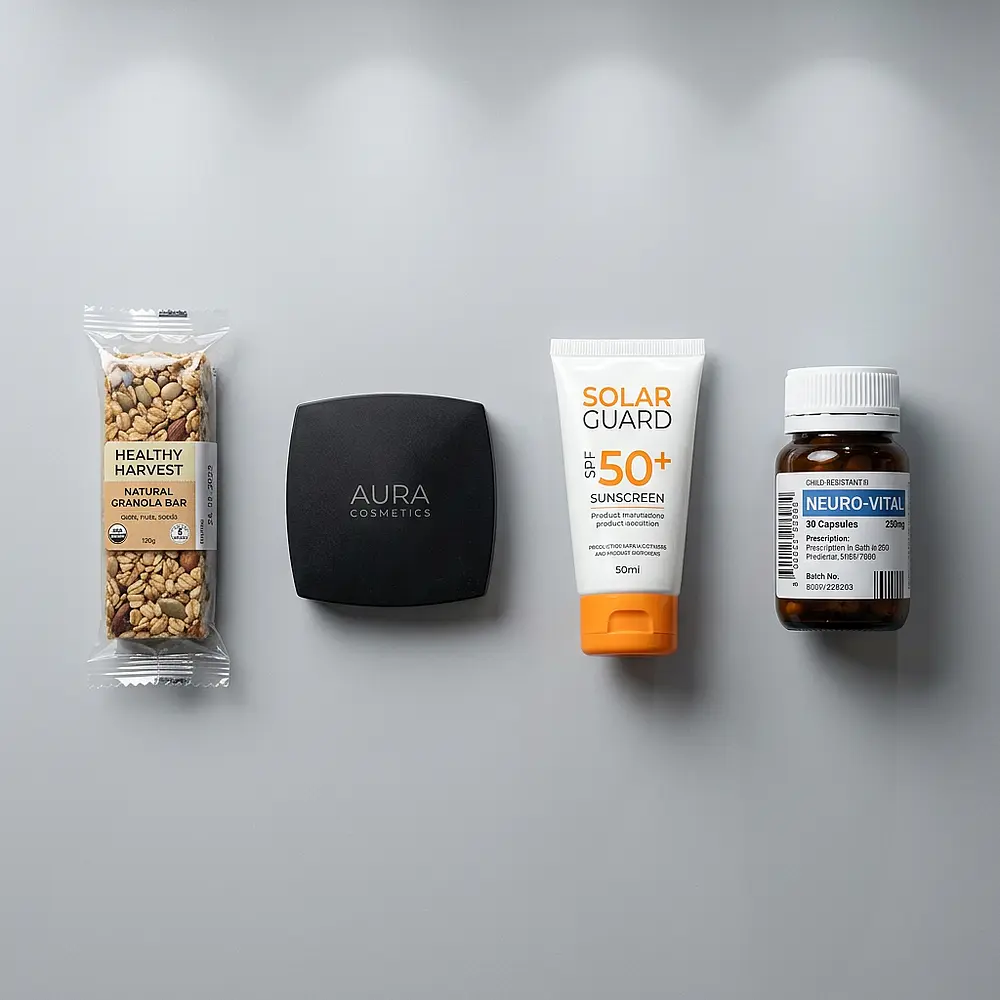
Set out side by side, the four consumer-facing categories show how sharply the titanium dioxide legal status splits by instrument rather than by substance. Each entry below gives only the governing instrument, the applicable limit and the current position as of August 2026 — no new argument, just the reference itself.
Food — United States: authorised under 21 CFR 73.575, up to 1 percent by weight of the food; petition CAP 3C0325 pending before FDA. European Union: prohibited in food placed on the market since 7 August 2022 under Commission Regulation (EU) 2022/63. US state watch item: Arizona House Bill 2164, school food only, applying from the 2026-27 school year.
Cosmetics — United States: authorised under 21 CFR 73.2575, including the area of the eye, subject to good manufacturing practice. European Union: colorant under Annex IV entry 143 of Regulation (EC) 1223/2009, with SCCS/1617/20 limits of 25 percent in face make-up and loose powder, but 1.4 percent and 1.1 percent respectively in the corresponding spray formats.
Sunscreen — United States: over-the-counter drug active under FDA OTC Monograph M020, section M020.10(n), at up to 25 percent. European Union: UV filter under Annex VI entry 27 of Regulation (EC) 1223/2009.
Medicines — European Union: permitted as a colorant in human and veterinary medicinal products, following the EMA review of April 2024 and the Commission position of 6 August 2025.
Read the grid one way only: authorisation is category-specific and never transfers between categories.
Quick Reference: Food-Contact Plastics and Industrial Pigment Uses
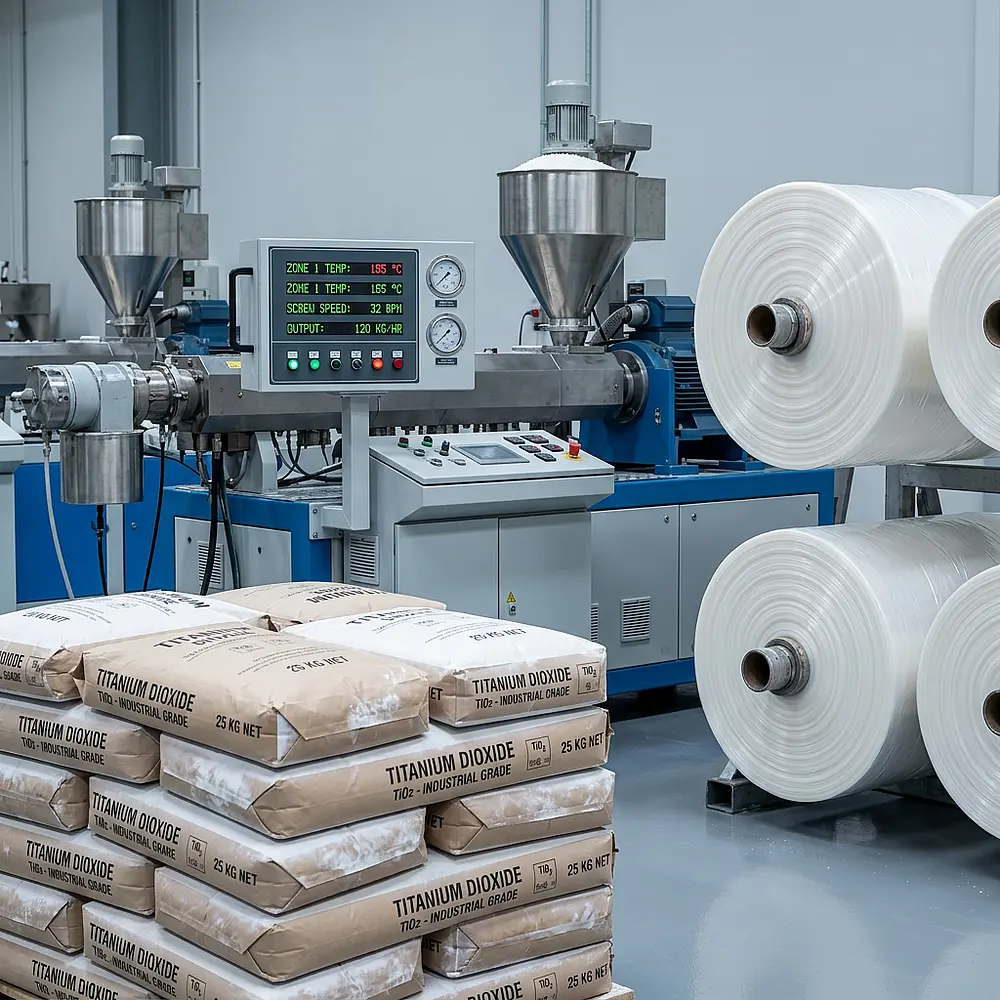
The two categories in this table are the ones a formulator is least likely to need to worry about, and they are worth stating plainly for that reason. Food-contact plastics in the United States are governed by 21 CFR 178.3297, which permits titanium dioxide as a colorant in polymers intended for contact with food. That listing sits outside the scope of the pending colour additive petition and is unaffected by it; a pigmented film, closure or container therefore remains compliant on the same terms as before.
Industrial pigment applications form the second block: architectural and industrial paints and coatings, powder coatings, plastics and masterbatch, paper and board, printing inks, rubber, construction materials, and glass and ceramics. All remain authorised in the European Union, the United States and other major jurisdictions. Neither the withdrawal of E171 from the Union list nor the annulled harmonised classification entry imposes any restriction on them. Any reading of titanium dioxide industrial use regulation that treats the food-additive debate as a constraint on coatings or masterbatch is simply misapplying an instrument from another regime.
Two qualifications belong here. Occupational exposure limits and the controls applied to dust and aerosol during powder handling remain fully in force, entirely independently of the classification annulment — that outcome changed labelling law, not workplace duties. And one housekeeping task is genuinely outstanding for most suppliers and downstream users: review safety data sheets that still reference the withdrawn harmonised classification, since such documents continue to circulate.
Application-level detail on these sectors is set out at titanium dioxide uses, and the underlying chemical and physical data at TiO2 chemical data.
FAQ
What is the difference between 21 CFR 73.575 and 21 CFR 73.2575?
Both provisions authorise titanium dioxide as a colour additive under US law, but they apply to different product categories. 21 CFR 73.575 governs use in food, capping titanium dioxide at 1 percent by weight of the food, a hard compositional ceiling written directly into the regulation. 21 CFR 73.2575, by contrast, governs use in cosmetics generally, including products intended for the area of the eye, and imposes no numerical maximum, requiring only conformity with good manufacturing practice.
The practical distinction for formulators:
- 73.575: food use, 1 percent ceiling, exceeding it makes the product an unlisted-additive case
- 73.2575: cosmetic use, eye-area permitted, governed by good manufacturing practice rather than a fixed limit
Authorisation under one section never implies authorisation under the other.
What is 21 CFR 73.575 and what does it regulate?
21 CFR 73.575 is the United States federal regulation that lists titanium dioxide as a permitted colour additive in food. It sets a hard compositional ceiling of 1 percent by weight of the food, written directly into the regulation rather than expressed as guidance. Use under this provision is generally associated with applications requiring opacity and whiteness, such as confectionery coatings, bakery decoration and icings. As of August 2026, the regulation remains fully in force; no rulemaking has altered it, and the 1 percent authorisation continues to apply unchanged to covered food products.
Is titanium dioxide safe to use in sunscreen?
Yes, titanium dioxide is considered safe for use in sunscreen. In the United States it is recognised as an active drug ingredient under FDA OTC Monograph M020, section M020.10(n), permitted at concentrations up to 25 percent, the same ceiling given to zinc oxide. In the EU it is authorised as a UV filter under Annex VI entry 27 of Regulation (EC) 1223/2009. In both jurisdictions it functions as a physical filter rather than a pigment, reflecting and scattering UV radiation at the skin surface. Its treatment in sunscreen is entirely separate from unrelated regulatory actions affecting other uses of the substance.
Is titanium dioxide (E171) still allowed in cosmetics in the EU?
Yes. The E171 withdrawal applies only to food and has no bearing on cosmetics. Non-nano titanium dioxide remains authorised as a colorant under Annex IV entry 143 of Regulation (EC) 1223/2009 and as a UV filter under Annex VI entry 27 of the same Regulation, so pigmented make-up, foundations, pressed powders and mineral sunscreens stay lawful across the EU. However, use-form matters: the relevant scientific opinion permits up to 25 percent in face make-up and loose powder, but only 1.4 percent in face-make-up sprays and 1.1 percent in loose-powder sprays, since inhalation of aerosolised particles, not dermal contact, is the concern. Formulators should confirm the grade and labelling used.
When did the EU ban titanium dioxide as a food additive?
The EU withdrawal of titanium dioxide (E171) as a permitted food additive took effect on 7 August 2022, under Commission Regulation (EU) 2022/63, adopted on 14 January 2022 and entered into force on 7 February 2022 after a six-month transition period. The regulation followed a scientific opinion identifying an unresolved genotoxicity concern for the nanoparticle fraction of the additive, which meant it could no longer be considered safe under EU food law. Because the entry was deleted from the Union list rather than restricted to a threshold, any detectable use of the additive in food placed on the EU market is non-compliant, irrespective of the amount present.
What does the EU ban on E171 actually cover?
The EU restriction is limited to one legal instrument and one use: Commission Regulation (EU) 2022/63, which removed titanium dioxide as the food additive E171 from the Union list of permitted food additives. Since 7 August 2022, food containing E171 may no longer be manufactured in, or placed on, the EU market, and because the entry was deleted rather than capped, no concentration is lawful regardless of amount. The ban covers food only. It does not touch cosmetics, sunscreen, medicines, or industrial applications such as paints, plastics or coatings, all of which remain governed by separate instruments and remain lawful across the Union.
Is titanium dioxide still FDA-approved?
Yes. In the United States, titanium dioxide remains fully FDA-approved as of August 2026, and no federal action has removed any of its authorizations. It is listed as a color additive exempt from certification under 21 CFR 73.575 for use in food (up to 1 percent by weight), under 21 CFR 73.2575 for cosmetics including the eye area, and under 21 CFR 178.3297 for food-contact polymers. Separately, it is recognized as an active ingredient in over-the-counter sunscreen under FDA OTC Monograph M020. A colour additive petition (CAP 3C0325) seeking repeal of the food listing is pending, but its filing does not change current law; the existing authorizations remain in force.
Are industrial uses of titanium dioxide, such as paints and plastics, affected by the food-additive bans?
No. The E171 food-additive withdrawal in the EU and the pending FDA petition in the United States both concern titanium dioxide's use as a colour additive in food only. They have no bearing on industrial applications such as paints, coatings, plastics, paper, printing inks, rubber, construction materials, glass and ceramics. These uses remain fully authorised in the EU, the US and every other major jurisdiction, and by tonnage they consume the overwhelming majority of global titanium dioxide production. The annulled EU carcinogen classification under CLP law changed labelling and hazard communication, not authorisation, and did not restrict any industrial use either. Occupational exposure limits and dust-control obligations continue to apply to industrial handling, unrelated to the food-additive debate.
Is titanium dioxide still permitted in medicines in the EU?
Yes. Titanium dioxide remains permitted as a colorant in both human and veterinary medicinal products across the EU, separate from the food-additive withdrawal. The European Medicines Agency reviewed possible alternatives and reported in April 2024, after which the European Commission reaffirmed the exemption on 6 August 2025. The rationale is practical: no viable substitute currently exists across affected formulations, and forcing replacement would risk supply for roughly 91,000 human and 1,600 veterinary products. In tablet coatings and capsule shells, the substance provides opacity at low loading, protects light-sensitive actives, and enables the uniform white surface needed for printing and identification, reflecting a benefit-risk test that food law does not apply.
Is titanium dioxide banned in any US states?
No comprehensive US state ban on titanium dioxide in food exists. Titanium dioxide remains federally authorised under 21 CFR 73.575. US state food-additive legislation changed rapidly through 2025 and continues to differ from state to state, so there is no national state-level rule to assume; readers should verify the current statute in their specific state directly rather than rely on any single named example, as state-level measures are moving faster than most other aspects of this topic and require independent verification before any labelling or reformulation decision.
Why do EFSA and JECFA disagree on the safety of titanium dioxide?
The divergence exists because EFSA and JECFA weighted the same body of evidence differently and operated under different legal mandates. EFSA concluded that a concern for genotoxicity of the nanoparticle fraction could not be ruled out, and under EU food additive law that unresolved uncertainty was enough to withdraw authorisation, since safety must be positively demonstrated. JECFA gave reduced weight to studies using test materials unrepresentative of real food-grade titanium dioxide and reaffirmed its long-standing acceptable-daily-intake position based on very low oral absorption. A further factor is legal: the EU's precautionary principle pushes unresolved uncertainty toward withdrawal, a default other frameworks do not apply the same way. The split reflects methodology and mandate, not a factual contradiction.
What did JECFA conclude about titanium dioxide in its 2023 review?
In its reassessment released on 24 November 2023, following the 97th meeting of the Joint FAO/WHO Expert Committee on Food Additives, JECFA reaffirmed an acceptable daily intake "not specified" for INS 171, the position originally set in 1969. This was based on the very low oral absorption of titanium dioxide from the gastrointestinal tract and the absence of an identifiable hazard from dietary use, weighed against a conservative high-end exposure estimate of 10 mg per kilogram of body weight per day. JECFA also noted that many toxicological studies, including those on nanoparticles, used test materials not comparable to real-world food-grade titanium dioxide, limiting their relevance.
Is titanium dioxide still classified as a carcinogen under EU CLP regulation?
No. Titanium dioxide currently carries no harmonised carcinogen classification under the CLP Regulation. The former entry, introduced by Delegated Regulation (EU) 2020/217, classified certain powder forms as Carc. 2, H351 (suspected of causing cancer by inhalation), with accompanying EUH211/EUH212 statements. This entry was annulled by the General Court on 23 November 2022, and the Court of Justice dismissed the final appeals on 1 August 2025, making the annulment definitive. Formal removal from the harmonised classification list followed, and ECHA has since deleted the entry from the C&L Inventory. The annulment reflects a legal finding of a manifest error of assessment, not a toxicological conclusion of safety; self-classification by companies with relevant data remains possible, and occupational dust-control obligations are unaffected.
What did EFSA actually conclude about titanium dioxide in 2021?
The EFSA opinion of 6 May 2021 (EFSA Journal 2021;19(5):6585) concluded that a safe level of daily intake for E171 could no longer be established, because a concern for genotoxicity could not be ruled out. This uncertainty centred on the nanoparticle fraction present in food-grade titanium dioxide, which may be absorbed and accumulate in the body, and for which available studies did not allow the genotoxic potential to be characterised or dismissed.
Importantly, EFSA did not conclude that titanium dioxide causes cancer. A genotoxicity concern and a carcinogenicity finding are distinct scientific statements. It was this unresolved uncertainty, not a demonstrated harm, that led to E171's removal from the EU list of permitted food additives.
Is there a pending FDA petition to ban titanium dioxide?
Yes. On 14 April 2023, the Environmental Defense Fund, Center for Environmental Health, Center for Food Safety, Center for Science in the Public Interest and Environmental Working Group jointly filed a colour additive petition asking FDA to repeal 21 CFR 73.575, the listing that permits titanium dioxide in food. FDA docketed it as CAP 3C0325 and published a filing notice on 3 May 2023, which is a procedural acceptance for review, not any indication of the agency's view. As of August 2026, FDA has not issued a decision, so the food listing stands unchanged. The petition is limited to the food use; it does not concern cosmetics, food-contact clearance or sunscreen.
Primary sources
Each status on this page is traced to a primary source. Last reviewed August 2026.
- Reg (EU) 2022/63 — E171 food ban: eur-lex.europa.eu/eli/reg/2022/63
- EFSA opinion 2021 (E171): doi.org/10.2903/j.efsa.2021.6585
- Del. Reg (EU) 2020/217 — CLP classification: eur-lex.europa.eu/eli/reg_del/2020/217
- General Court, Case T-279/20 (annulment, 2022): CELEX 62020TJ0279
- Court of Justice, C-71/23 P & C-82/23 P (1 Aug 2025): curia.europa.eu (PR 99/25)
- Notice C/2025/6670 — CLP entry annulled (OJ, 10.12.2025): CELEX 52025XC06670
- Reg (EU) 2021/850 — cosmetics (Annex III No. 321): CELEX 32021R0850
- SCCS/1617/20 — cosmetics safety opinion: health.ec.europa.eu
- EMA/94330/2024 — medicines impact assessment: ema.europa.eu
- Commission SWD(2025) 244 — medicines retained (Aug 2025): health.ec.europa.eu
- US 21 CFR 73.575 — food color additive: ecfr.gov
- UK COT statement (food): cot.food.gov.uk
Reference information, not legal advice.