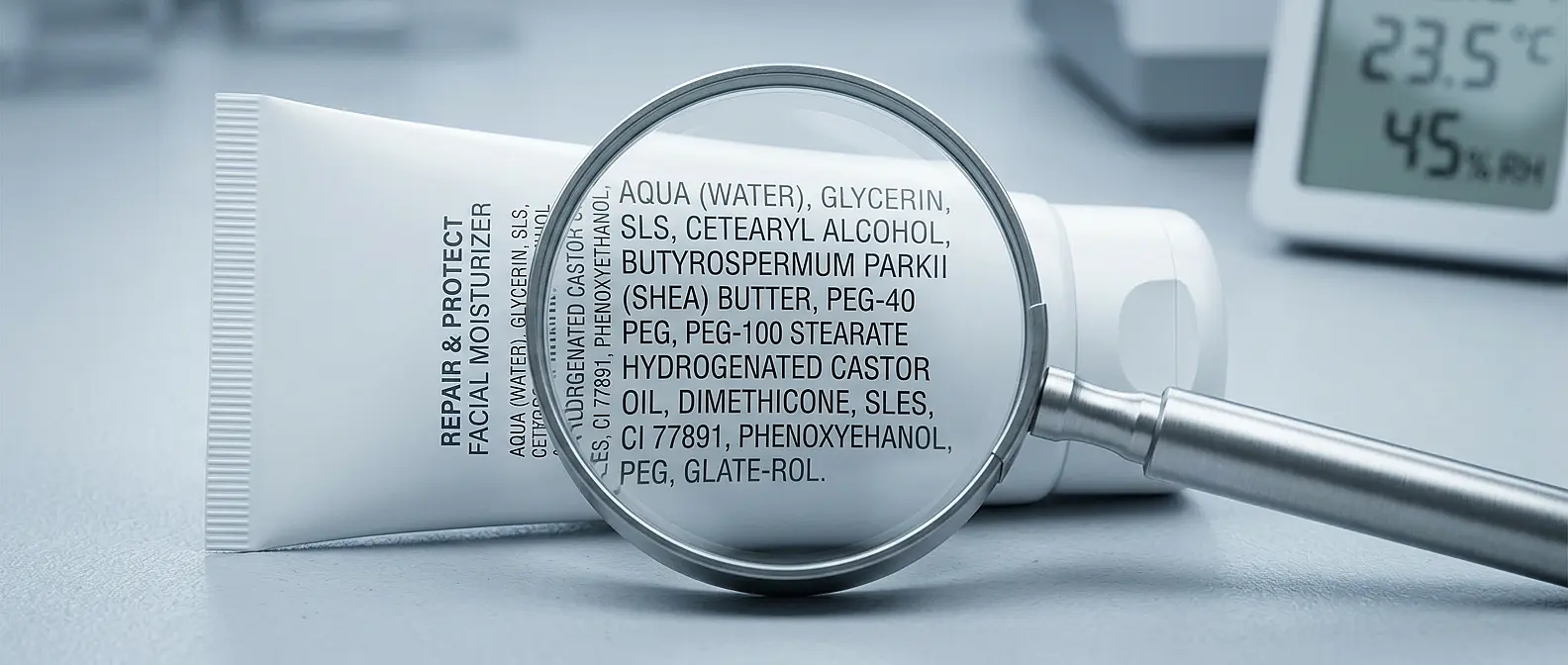
CI 77891
You turned a foundation compact over, read the ingredient list, and found a code that looks like a serial number: CI 77891. No plain-language name, no explanation, just five digits behind two letters. Then you searched for it, found the words "titanium dioxide," and immediately ran into a headline saying Europe banned that substance. So which is it — a routine white pigment, or something a regulator pulled from the market?
Both statements are true, because they belong to two different bodies of law. What the EU withdrew was E 171, titanium dioxide as a food additive. Annex IV, entry 143 of Regulation (EC) No 1223/2009 — the entry that authorizes titanium dioxide with Colour Index number 77891 as a white colorant in cosmetic products — was not amended by that decision and remains in force. CI 77891 is therefore still a lawful declaration on an EU cosmetic label, and the code on your compact is the marker that tells you which of the two tracks you are reading.
Three things make the panel legible: which naming system the number comes from, why the same substance appears as a word on a US label and as a number on an EU one, and what the neighboring codes inside the same bracket are doing there. This page works through those three in order, then hands off the safety and regulatory detail to the pages that cover it in full.
Table of Contents
- Which Naming System the Number Comes From: Colour Index and INCI
- CI 77891 Is Not E 171: Two Separate Regulatory Tracks
- What CI 77891 Does in a Formula
- Permitted Concentrations and Why the Exposure Route Decides
- The Neighbouring CI Numbers in the Same Bracket
- How to Verify the Code Yourself, and What It Cannot Tell You
- FAQ
Which Naming System the Number Comes From: Colour Index and INCI

The letters in the code are not a European abbreviation at all: CI stands for Colour Index, the international naming system for colorants maintained jointly by the Society of Dyers and Colourists and the AATCC. The five digits are a Colour Index Constitution Number, and 77891 is the number assigned to titanium dioxide; the same pigment carries the industrial designation Pigment White 6. Two consequences follow. A Colour Index number is not an EU invention — EU cosmetics law merely refers to a register it does not own. And the number is an identifier, not a permission: it says which substance is present, never whether that substance may be used.
Regulation (EC) No 1223/2009 allows colorants to be declared by their Colour Index number, which is why EU ingredient lists print the code where other markets spell out the substance. One material therefore travels under six parallel names: Colour Index number 77891 (colorant nomenclature); the INCI name Titanium Dioxide (cosmetic ingredient nomenclature); CAS 13463-67-7 (chemical registry); EC 236-675-5 (EU substance inventory); E 171 (EU food additive numbering); and Pigment White 6 (industrial pigment index). A seventh layer sits outside cosmetics entirely: ISO 591-1:2000 is the international standard designation for titanium dioxide pigments for paints, and a technical data sheet quoting that standard is describing a coatings grade, not a cosmetic declaration.
Behind all these designations sits a single, simple compound: titanium dioxide, formula TiO2, molar mass 79.87 g/mol, recorded under CAS 13463-67-7 in PubChem CID 26042 and in the NIST WebBook. Crystal structure, particle size and surface treatment vary widely between commercial grades, and those distinctions are set out with the chemical and physical base data. One formal detail belongs to the naming layer and is picked up below: Annex IV, entry 143 borrows its purity criteria from Commission Directive 95/45/EC, the E 171 food specification, which is where the two numbering systems visibly touch.
Where the Code Sits in the Ingredient List, EU Versus US
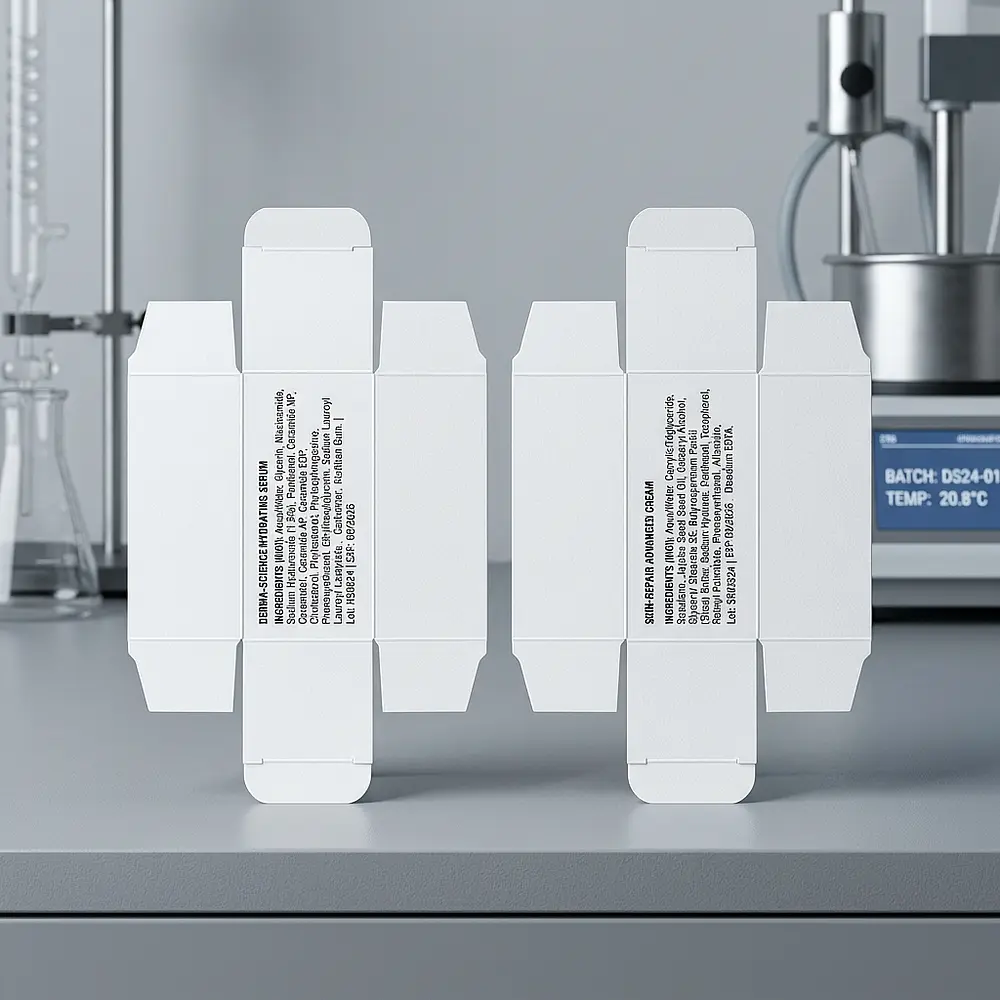
The code sits at the bottom of the panel, and that position is itself information. INCI ordering rules place colorants last irrespective of quantity, so a pigment present at a fraction of a percent and one present at twenty percent are printed in the same place — the position carries no concentration information whatsoever. On complexion products the code usually appears inside a bracketed may-contain group, the notation used when one formula is filled into several shades; that bracket is decoded code by code further down.
US labels handle the same substance differently: they declare it by name as Titanium Dioxide and do not use the Colour Index form at all, which is why searching a US ingredient list for CI 77891 normally returns nothing. The listing that stands behind that name is set out in the US cosmetic listing below.
One label element does carry physical information, and it is the only one that does. Where the pigment is present as a nanomaterial, EU labeling rules require the ingredient name to be followed by the word "nano" in brackets — the declaration then reads Titanium Dioxide (nano) rather than CI 77891. Two readings follow. The suffix appears with the INCI word form, so a bracketed nano designation and a bare CI number are not interchangeable ways of writing the same thing. And the absence of the suffix tells you only that the material is not declared as a nanoform; it says nothing about grade, coating or crystal type.
CI 77891 Is Not E 171: Two Separate Regulatory Tracks
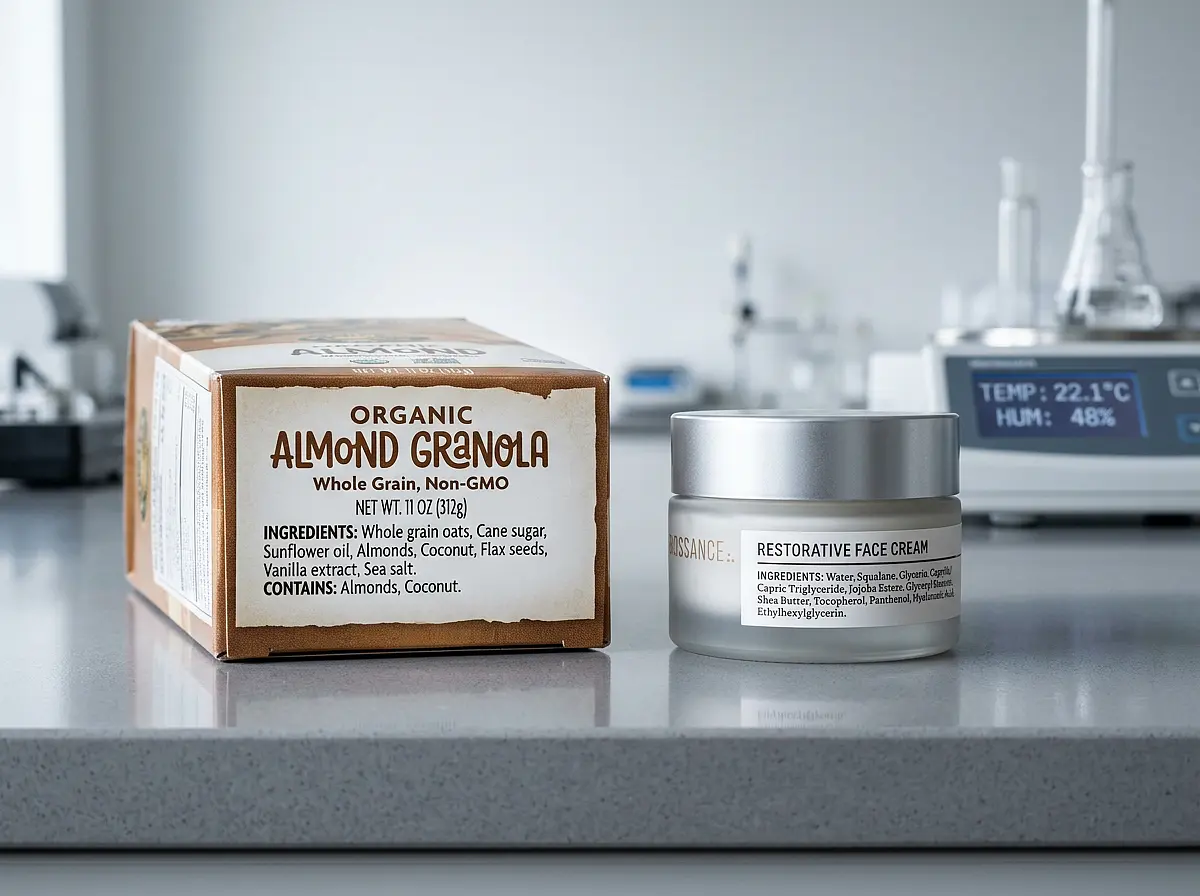
CI 77891 and E 171 differ as legal systems, not as substances. The Colour Index number comes from the international colorant register described above, to which EU cosmetics law only refers; E 171 is a genuine EU numbering, created by food additive law for the same chemical.
When the EU withdrew E 171 from the list of permitted food additives following the EFSA re-evaluation published on 6 May 2021, the decision addressed ingestion as a food additive. It left the cosmetics instrument untouched, and titanium dioxide with Colour Index number 77891 continues to be authorized as a white cosmetic colorant. A reader who finds the code in a lipstick and recalls headlines about a European ban is merging two instruments: identical substance identity does not produce identical authorization across product sectors.
The purity cross-reference does not bridge that gap either, and this is the point most database entries miss. What Annex IV, entry 143 borrows from Commission Directive 95/45/EC are specifications — identity and purity criteria, the analytical description of an acceptable material. A specification is not an authorization. It states what the pigment must be, not where it may be used. Deleting E 171 from the food additive list therefore removed a food permission and left the borrowed analytical criteria in place, which is precisely why the cosmetics entry kept working unchanged after the food decision.
The United States splits the same substance across two separate listings, one for food and one for cosmetics, described in the next section; both tracks with their current status appear in the full EU and US regulatory picture.
What US Law Currently Says, Including the Pending Food Petition
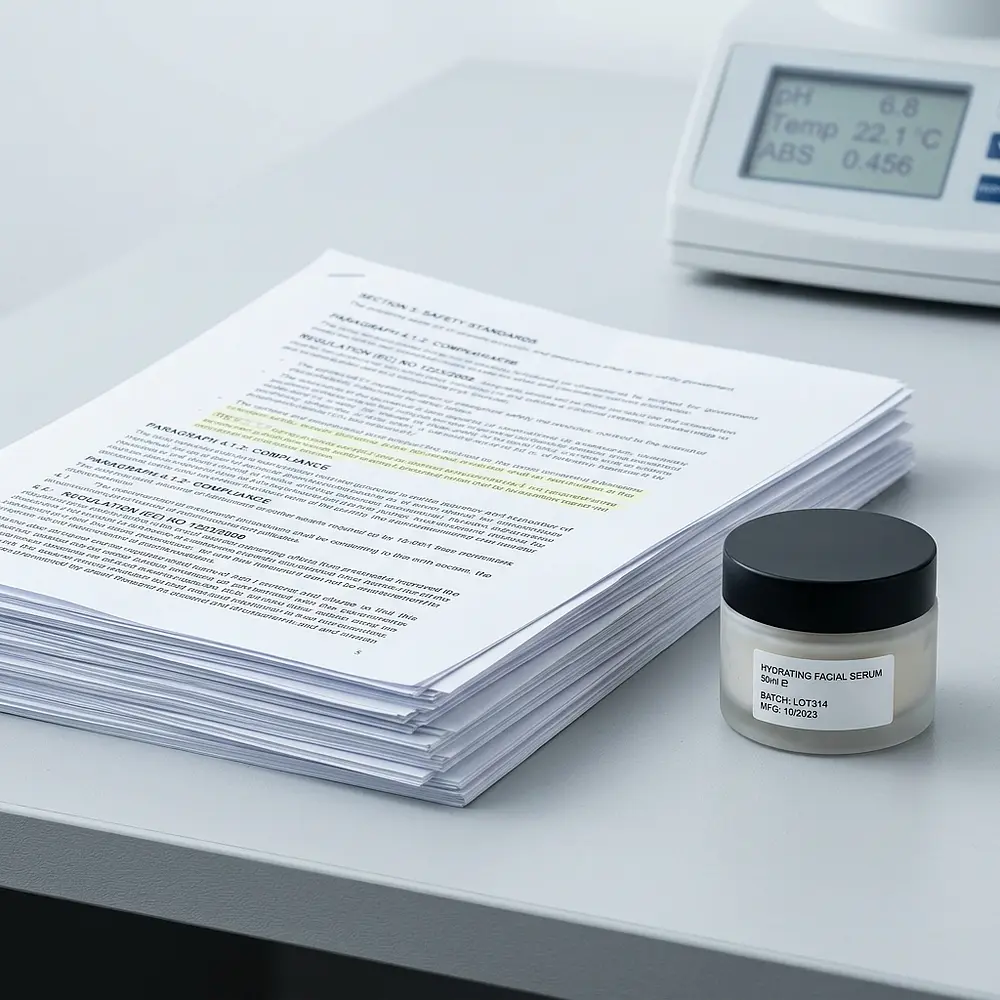
The cosmetic listing is short and permissive. Under 21 CFR 73.2575, titanium dioxide may be safely used in cosmetics, including cosmetics intended for use in the area of the eye, in amounts consistent with good manufacturing practice. Identity and specifications are taken from 21 CFR 73.575(a)(1) and (b), and batches are exempt from certification. There is no numerical percentage ceiling in that provision, and no restriction limiting it to rinse-off or leave-on categories.
The food listing is the separate one. 21 CFR 73.575 permits titanium dioxide as a color additive in food at not more than 1 percent by weight — a ceiling that exists only on the food side and has no counterpart in the cosmetic provision.
A proceeding against that food listing is open and undecided. On 14 April 2023 a color additive petition was filed by the Environmental Defense Fund, the Center for Environmental Health, the Center for Food Safety, the Center for Science in the Public Interest and the Environmental Working Group, asking the FDA to revoke 21 CFR 73.575; the filing was announced in the Federal Register on 3 May 2023. As of August 2026 the FDA has published no decision, so nothing in US law has changed. The petition addresses food use only, does not concern 21 CFR 73.2575, and therefore has no bearing on CI 77891 on a cosmetic label.
What CI 77891 Does in a Formula
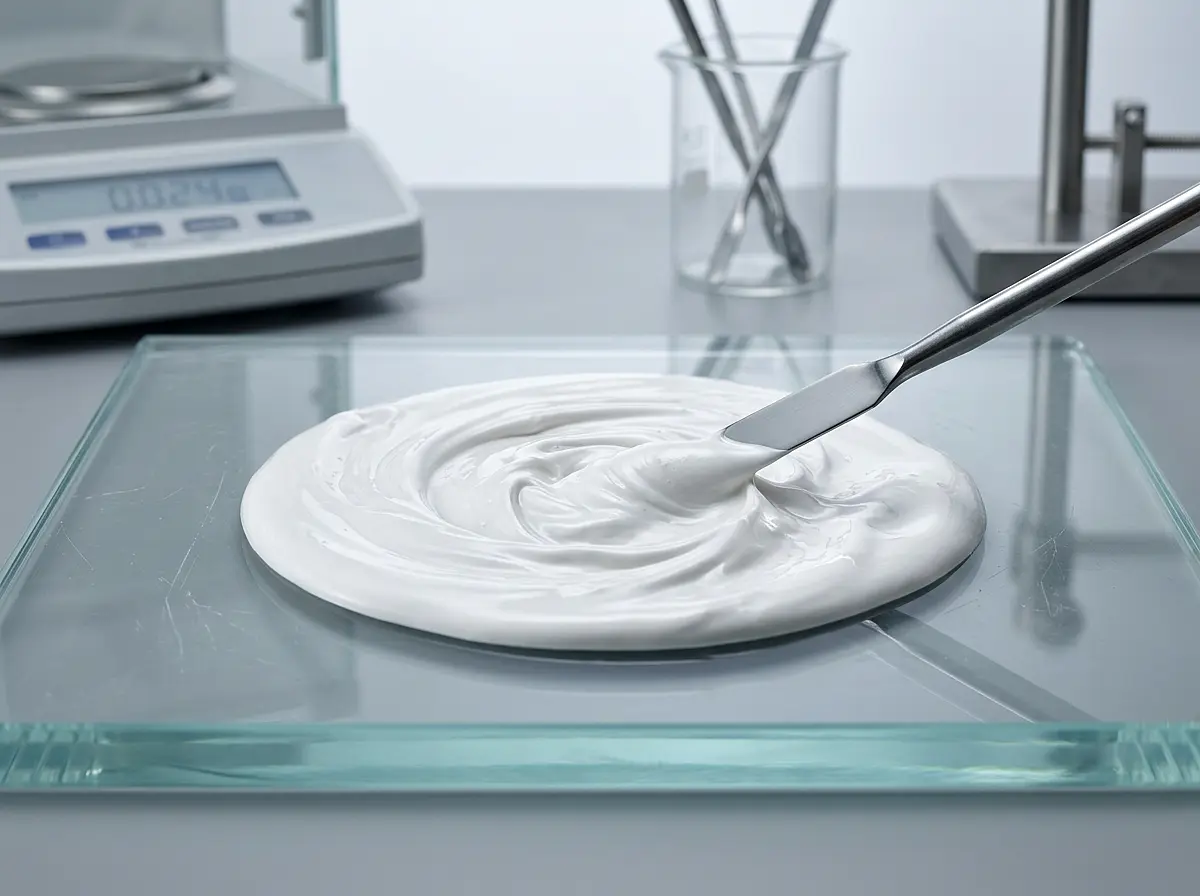
Titanium dioxide has one of the highest refractive indices of any white pigment, which means it scatters visible light very strongly rather than absorbing it. On a label, that single physical property translates into whiteness, opacity and coverage: the pigment hides what lies beneath the film, lifts a formula's brightness, and lightens or mutes any shade it is mixed into.
That is why the code turns up across such different product types — foundation and concealer, pressed and loose powder, eyeshadow, lipstick, toothpaste, whitened soap bases. Its behavior in complexion products is described in more detail in its use in foundation, powder and color cosmetics.
One precision point competing pages miss: in sunscreen the same substance additionally works as a physical UV filter, which is a separate regulatory function from its role as a colorant. That second function has its own EU permission with its own ceiling — titanium dioxide is authorized as a UV filter at a maximum concentration of 25 % in cosmetic products, whereas the colorant entry in Annex IV carries no numerical figure at all. The consequence for label reading is direct: the code in an ingredient list does not by itself indicate any UV protection, and in most color cosmetics the pigment is purely decorative. The filter role is covered under its function as a mineral UV filter.
The Soap and Rinse-Off Case
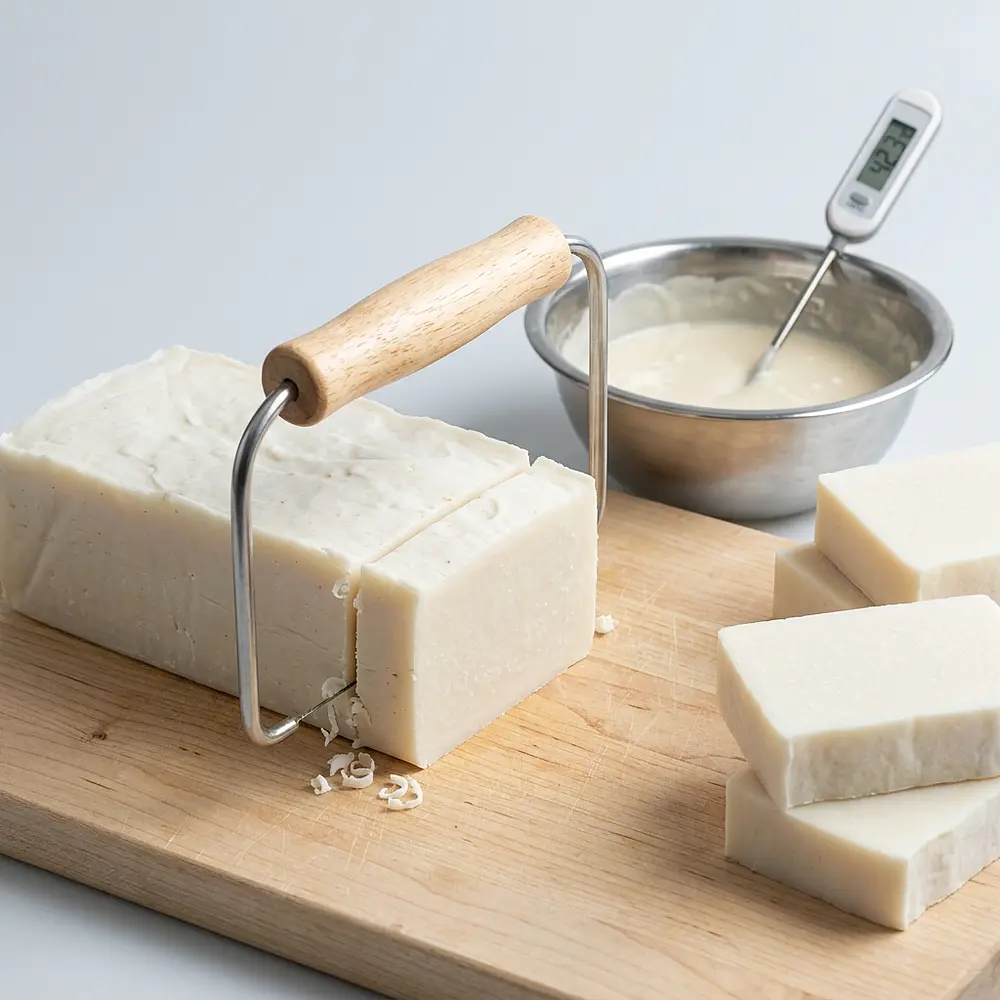
In cold-process and melt-and-pour soap making the pigment plays a narrower part than it does in color cosmetics. Its purpose is to produce an opaque white base, or to lighten a batch before micas, clays or other pigments are dispersed into it. It cleanses nothing, conditions nothing and takes no part in saponification: the pigment is not consumed in the reaction but stays suspended in the finished bar, which is why a rinse-off product still declares it in the ingredient list even though the bar leaves the skin within seconds.
The handling point concerns makers rather than users. The pigment is supplied as a dry powder, and the exposure route that matters is inhalation rather than skin contact — the reason for that is explained with the concentration limits below; a cured bar releases nothing. The hazard summary sheet of the New Jersey Department of Health rates the raw material HEALTH 2, FLAMMABILITY 0 and REACTIVITY 0, where 2 on that key means moderate and 0 means no rating for that endpoint: a nuisance-dust profile, not a fire or reactivity problem in the workroom. Standard first aid follows the same logic — if airborne powder reaches the eyes, flush them with water for at least 15 minutes, and in the United States Poison Control is reachable at 1-800-222-1222 for exposure advice. Batch practice is covered under titanium dioxide in soap making, including dispersion methods, typical craft dosage ranges and why the pigment can produce glycerin rivers.
Permitted Concentrations and Why the Exposure Route Decides
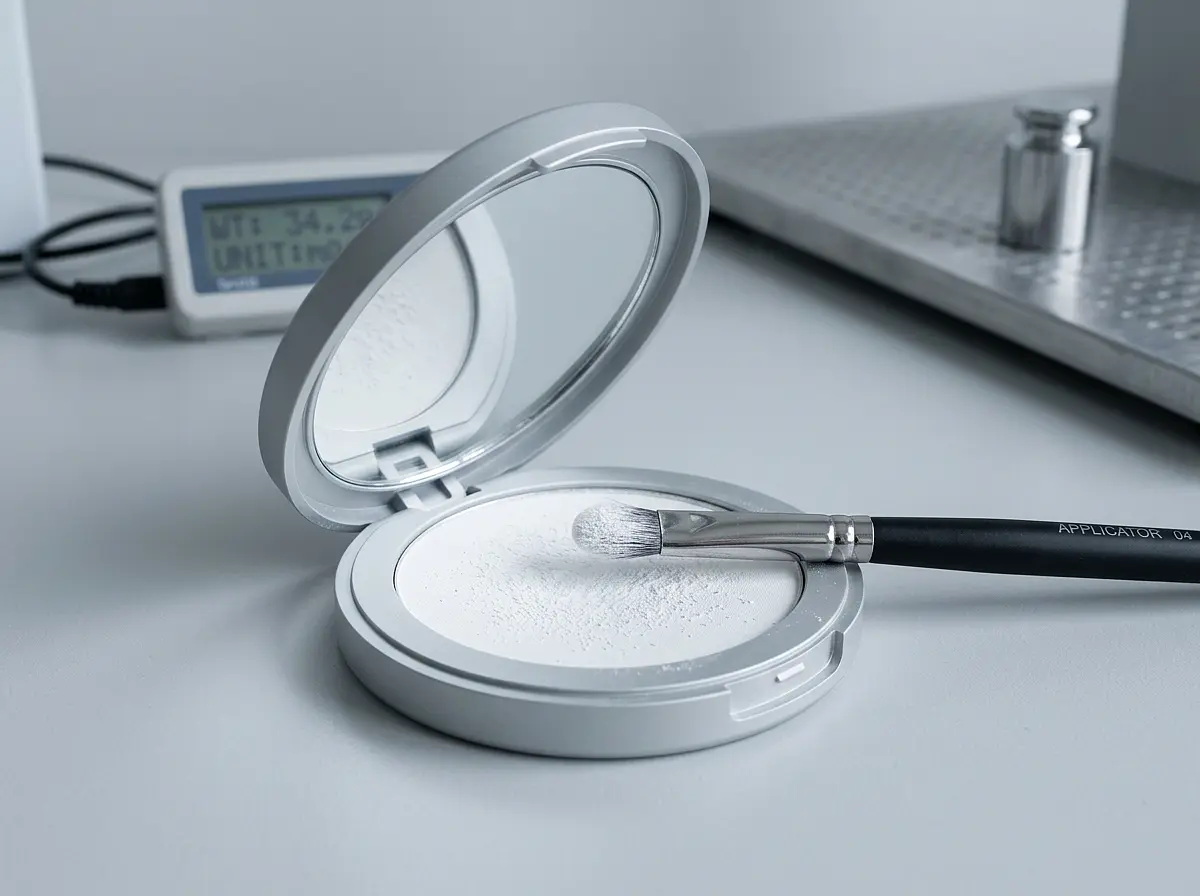
The concentration figures come from SCCS Opinion SCCS/1617/20, adopted by written procedure on 6 October 2020, and they only make sense when read together with a product form. For pigmentary, non-nano titanium dioxide the SCCS considers the material safe for use as a colorant in cosmetic products. It further considers it safe up to 25 % in face make-up products and up to 25 % in loose powder products. In sprays the same assessment yields far lower values: a maximum of 1.4 % for general consumers and 1.1 % for professional users such as hairdressers.
One mechanism explains that eighteen-fold gap, and it is the key to almost every alarming story told about this substance. On skin, the pigment sits on the surface of the film; uptake through healthy, intact skin is described in SCCS/1617/20 as negligible. In a spray — and equally in a cloud of raw powder during weighing — the material becomes airborne, and the relevant exposure route changes to inhalation of respirable droplets or particles. The toxicological question for titanium dioxide has always been what poorly soluble dust does after it reaches the lung, not what an opaque pigment does on the stratum corneum.
The workplace figures are set in air concentrations, not in percentages, and they show how differently the two settings are governed. OSHA's permissible exposure limit for titanium dioxide is 15 mg/m³ as an 8-hour average, the ACGIH threshold limit value is 10 mg/m³ over 8 hours, and NIOSH recommends 2.4 mg/m³ as a 10-hour average for fine titanium dioxide and 0.3 mg/m³ as a 10-hour average for the ultrafine material — the tighter value tracking particle size, not chemistry.
Two consequences for label reading follow. A percentage figure for this pigment is meaningless unless the product form is stated alongside it, because the same number can be well within an assessed range for a pressed powder and far above it for an aerosol. And a finished cream, stick or bar does not reproduce the inhalation scenario at all, which is why those air-borne guidance values for the raw powder belong to an entirely different order of magnitude from cosmetic use levels.
Classification Status: IARC Group 2B and the Annulled EU Carc. 2 Entry
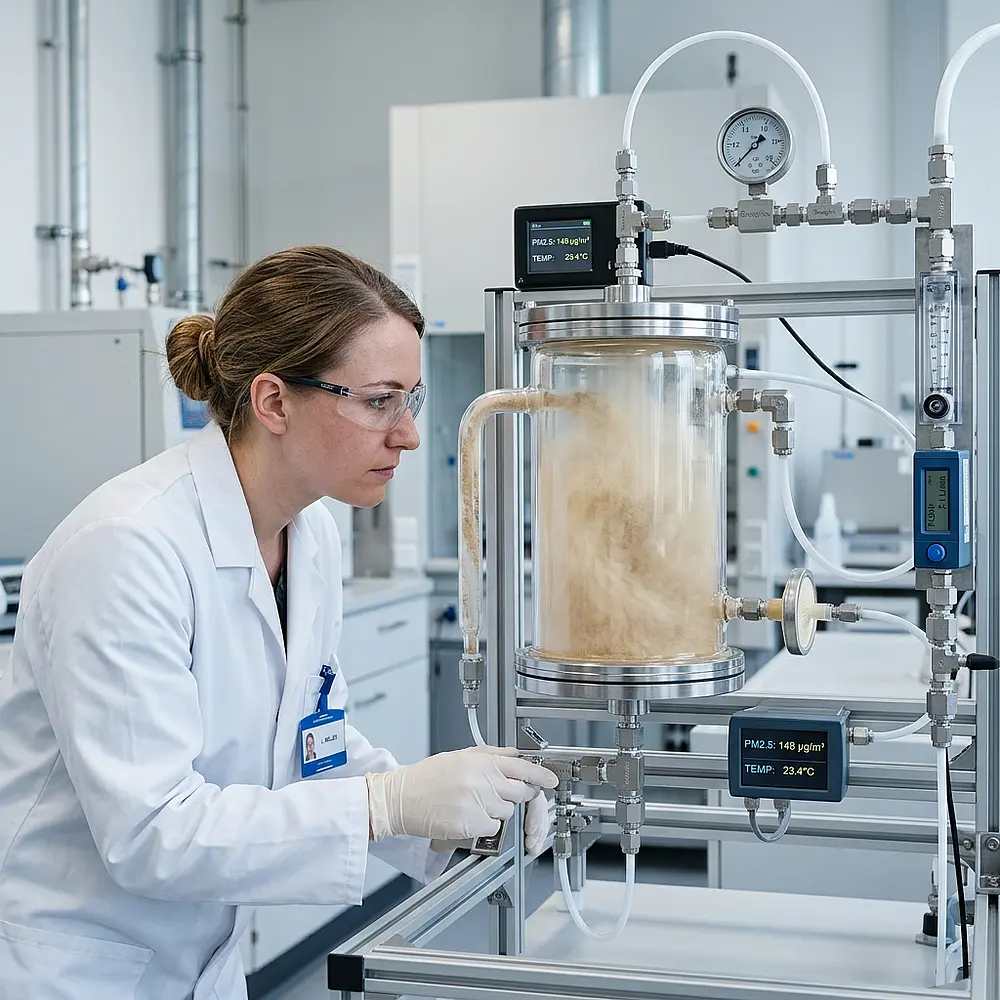
Anyone who finds the code on a label and searches for it arrives at this question within two clicks. Two hazard assessments stand behind the pigment, and only one is still legally live. IARC places titanium dioxide in Group 2B, possibly carcinogenic to humans, on the basis of inhalation studies of poorly soluble dust (Monographs Vol. 47 and Vol. 93); the evidence in humans was considered insufficient, and the assessment addresses workplace dust exposure — the route distinguished above — not dermal use of a finished cosmetic. The same concern drove the European review: the SCCS assessed cosmetic safety expressly against a possible classification as Carcinogen Cat. 2 (inhalation) in Annex VI to Regulation (EC) No 1272/2008.
That harmonized CLP entry no longer exists. The EU General Court annulled the Carc. 2, H351 classification on 23 November 2022; the Court of Justice dismissed the appeals of France and the Commission on 1 August 2025 in joined cases C-71/23 P and C-82/23 P; an Official Journal notice of 10 December 2025 formalized the removal, and the labeling statements EUH211 and EUH212 for titanium dioxide ceased to apply. Titanium dioxide currently has no harmonized EU carcinogen classification. One clarification is essential: the courts did not rule that inhaled dust is harmless — they annulled the classification decision because of errors of assessment, and occupational exposure limits are unaffected.
For the reader in front of a shelf this resolves into something narrow. A cosmetic containing the pigment carries no hazard pictogram, no supplemental EUH statement and no warning traceable to that annulled entry, and the colorant remains declarable exactly as before — as CI 77891 on an EU panel. How the underlying studies were weighed is examined in the safety discussion in depth.
The Neighbouring CI Numbers in the Same Bracket
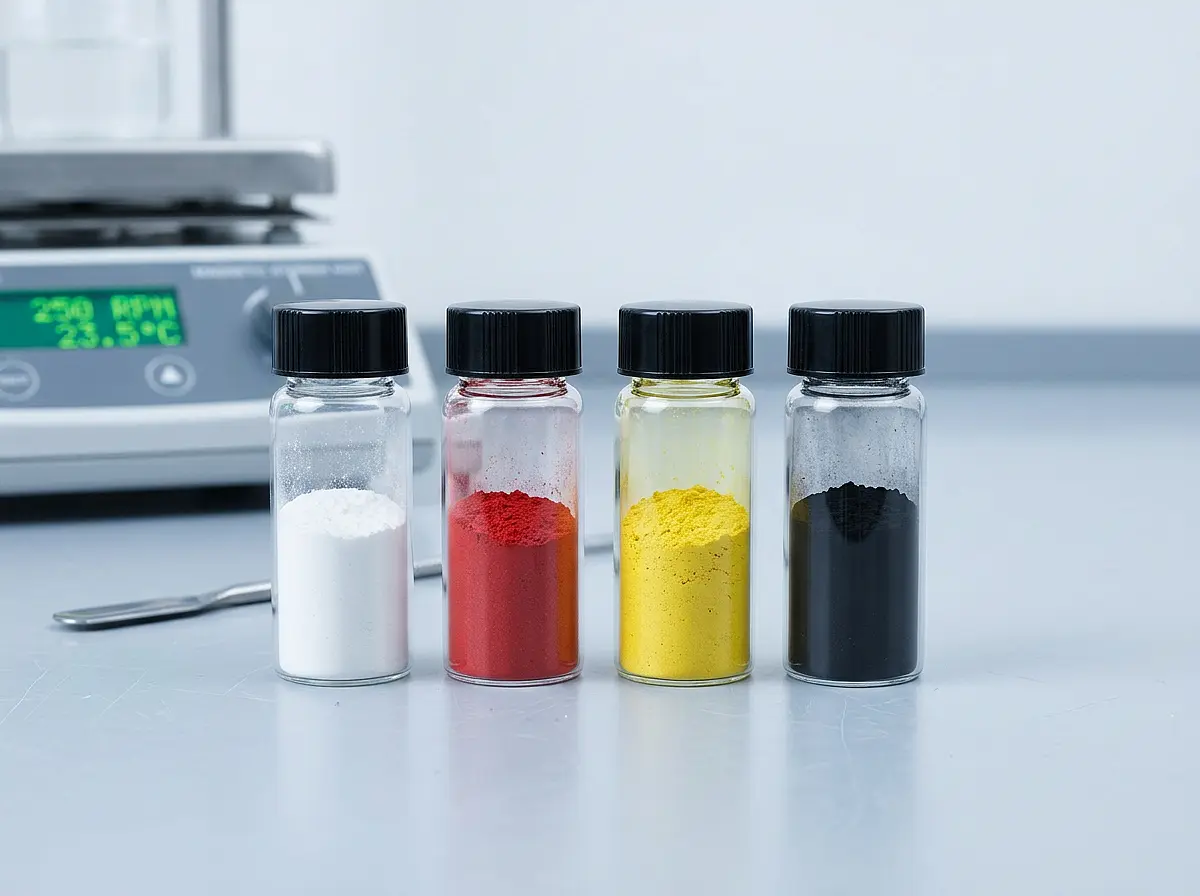
The white code rarely stands alone. On a foundation, concealer or bronzer the bracket typically reads [+/- CI 77891, CI 77491, CI 77492, CI 77499], the plus-minus sign marking the may-contain group. Decoded, CI 77491 is red iron oxide, CI 77492 yellow iron oxide and CI 77499 black iron oxide — the three pigments that between them produce essentially every complexion shade from the palest to the deepest. A fourth number often joins them: CI 77947, zinc oxide, authorized as a cosmetic colorant under Annex IV, entry 144 of Regulation (EC) No 1223/2009.
The division of labor inside that bracket is strict. CI 77891 supplies whiteness and opacity, and therefore governs coverage and how light the finished shade reads; the iron oxides supply the hue, warmth and depth. Neither can substitute for the other, which is exactly why a single beige foundation prints all four codes in one group and why the manufacturer can fill twenty shades from one declaration.
What no Colour Index number reveals is the material behind it in any physical sense: the code names a colorant, not a crystal grade, not a particle size distribution, not a coating. The practical reading rule is worth keeping. All four codes together signal a shaded, opaque color cosmetic; CI 77891 alone usually signals a white or opacified base — soap, toothpaste, a whitened cream, or a mineral sunscreen in which the substance is doing a different job entirely.
How to Verify the Code Yourself, and What It Cannot Tell You
Every statement above traces to a primary document, and these are the access points. Annex IV, entries 143 and 144 of Regulation (EC) No 1223/2009 are readable in full on EUR-Lex and in the Commission's CosIng ingredient database, together with Commission Directive 95/45/EC for the specification cross-reference. Both US listings, 21 CFR 73.2575 and 21 CFR 73.575, are retrievable in the eCFR, and the petition filing appears in the Federal Register issue of 3 May 2023. The Constitution Number itself is held in the Colour Index register. SCCS/1617/20 is published by the Commission's scientific committee. The classification history is documented in the General Court judgment of 23 November 2022, in the Court of Justice ruling of 1 August 2025 in joined cases C-71/23 P and C-82/23 P, and in the Official Journal notice of 10 December 2025. Chemical registry data — including the crystal-form entries CAS 1317-70-0 with EC number 215-280-1 for anatase and CAS 1317-80-2 with EC number 215-282-2 for rutile — are held in PubChem CID 26042 and the NIST WebBook.
What the code cannot tell you is equally definite. A Colour Index number states substance identity and nothing else. It discloses no concentration, no particle size, no crystal form, no surface treatment or coating, no pigment grade, and no information about whether the substance acts in that product as a colorant or as a UV filter. Nanoform status is signaled only by the separate declaration described under reading EU and US ingredient lists, and the substance-versus-sector distinction the code cannot express is the one drawn between the cosmetics and food instruments. For anything beyond identity, the product's own documentation is the only source — not the five digits on the panel.
FAQ
Is CI 77891 banned in the EU?
CI 77891 itself is not banned in the EU. What was withdrawn from the EU market is titanium dioxide used as a food additive, E 171, following the EFSA re-evaluation published on 6 May 2021. That decision only amended food additive law and did not touch Annex IV, entry 143 of Regulation (EC) No 1223/2009, which authorizes titanium dioxide with Colour Index number 77891 as a white colorant in cosmetics. This entry remains in force, so CI 77891 is still a lawful ingredient declaration on EU cosmetic labels, including foundation, powder, lipstick and toothpaste, subject to the concentration limits set out separately for face make-up, loose powder and spray products.
What is the chemical formula and molar mass of CI 77891?
CI 77891 is titanium dioxide, a simple inorganic oxide with the chemical formula TiO2. Its molar mass is 79.87 g/mol. Different commercial grades of the pigment (crystal structure, particle size, surface coating) do not change this basic molecular formula or molar mass, since these are properties of the underlying compound itself rather than of a specific manufacturing grade. This means a 79.87 g/mol figure applies equally whether the material is used as a cosmetic colorant, a food-grade pigment, or an industrial whitening agent, since the molecule itself is unaffected by its end use.
What is the CAS number for CI 77891?
CI 77891 corresponds to titanium dioxide with CAS number 13463-67-7, recorded in databases such as PubChem (CID 26042) and the NIST WebBook. A CAS number identifies chemical identity only; it does not indicate concentration, particle size, coating, crystal form or nanostatus of the specific material used in a product. It is distinct from the Colour Index number, which serves the separate purpose of identifying the substance specifically as a colorant on ingredient labels.
Is CI 77891 the same thing as E171?
CI 77891 and E 171 name the same chemical substance, titanium dioxide, but the two labels belong to different legal categories and are not interchangeable declarations. E 171 is the EU numbering for titanium dioxide used as a food additive, and that food authorization was withdrawn following EFSA's re-evaluation published on 6 May 2021. CI 77891 is the Colour Index number used in cosmetic ingredient lists, where titanium dioxide is authorized as a white colorant under Annex IV, entry 143 of Regulation (EC) No 1223/2009. That cosmetics entry was not affected by the food decision and remains in force. So the substance is identical, but "CI 77891" and "E 171" mark two separate regulatory tracks, one still authorized (cosmetics), one withdrawn (food).
Why do EU labels say "CI 77891" while US labels say "Titanium Dioxide"?
Both labels describe the identical substance, but the naming systems behind them differ. EU cosmetics law under Regulation (EC) No 1223/2009 permits colorants to be declared by their Colour Index number, so the pigment appears as CI 77891 on EU labels. US labeling instead follows INCI word-form naming, so the same pigment is spelled out as Titanium Dioxide rather than printed as a code. This split reflects each market's own labeling conventions rather than any regional difference in the substance, its permitted uses, or its safety status; the underlying material sold under either name is chemically identical.
Is CI 77891 the same ingredient as titanium dioxide?
Yes, CI 77891 and titanium dioxide refer to the same chemical substance, formula TiO2. They are simply two different naming systems for one material: CI 77891 is the Colour Index Constitution Number, while Titanium Dioxide is the INCI name used to declare the same substance by word on ingredient lists. The industrial designation Pigment White 6 refers to the identical material as well. A Colour Index number identifies a substance only; it does not indicate concentration, particle size, crystal form or whether the material functions as a colorant or as a UV filter in that specific product.
What does "CI 77891" mean on an ingredient label?
CI 77891 is a Colour Index number, not an EU invention but an entry from the international colorant register maintained by the Society of Dyers and Colourists and the AATCC. It identifies titanium dioxide (TiO2), also known industrially as Pigment White 6. On EU cosmetic ingredient lists, colorants may legally be declared by their Colour Index number, which is why "CI 77891" appears instead of the INCI name Titanium Dioxide used elsewhere.
Because it strongly scatters visible light, the pigment supplies whiteness, opacity and coverage. That single property explains its wide use in:
- Foundation, concealer and powder
- Eyeshadow and lipstick
- Toothpaste and whitened soap bases
The code itself discloses only substance identity, never concentration, particle size, crystal form or coating.
Why do foundation and concealer labels often list CI 77891 together with iron oxide pigments?
Foundation and concealer shades are built from one white opacifier plus three colored pigments, and CI 77891 supplies only the white part. On its own it cannot mimic skin tone; it can only lighten and add coverage. A single formula is turned into a full shade range by dispersing CI 77891 together with red, yellow and black iron oxides, CI 77491, CI 77492 and CI 77499, in varying proportions. That is why labels group them under one bracket, often written as [+/- CI 77891, CI 77491, CI 77492, CI 77499]:
- CI 77891 governs whiteness, opacity and overall coverage.
- The iron oxides govern hue, warmth and depth.
- Neither pigment can substitute for the other.
- Listing all four together lets one manufacturer fill many shades from a single ingredient declaration.
What is the current status of the EU carcinogen classification (Carc. 2, H351) for titanium dioxide?
Titanium dioxide currently has no harmonised EU carcinogen classification. Delegated Regulation (EU) 2020/217 had classified it as Carc. 2 (H351) for the inhalation of powder mixtures containing at least 1 % titanium dioxide in particles of up to 10 µm, but the EU General Court annulled that entry on 23 November 2022, the Court of Justice dismissed the appeals of France and the Commission on 1 August 2025 (joined cases C-71/23 P and C-82/23 P), and an Official Journal notice of 10 December 2025 formalised the removal, so the labelling statements EUH211 and EUH212 no longer apply to titanium dioxide. Two clarifications matter: the courts did not rule that inhaled titanium dioxide dust is harmless — they annulled the classification decision because of errors of assessment, and occupational exposure limits are unaffected. The entry concerned inhalable powder, never a finished cosmetic product carrying CI 77891 on its label.
Why are spray products subject to lower limits for CI 77891 than creams or powders?
The lower spray limit exists because sprays change the exposure route from skin contact to inhalation. SCCS Opinion SCCS/1617/20, adopted 6 October 2020, considers pigmentary, non-nano titanium dioxide safe up to 25 % in face make-up and up to 25 % in loose powder, but only 1.4 % for general consumers and 1.1 % for professional users in spray products.
On skin, the pigment sits on the surface of the film, and uptake through intact skin is described as negligible. In a spray, the material becomes airborne, and the toxicological concern shifts to what respirable droplets or particles do once inhaled into the lung, a mechanism entirely different from dermal application in creams or powders.
What is the EC number for CI 77891?
CI 77891 is listed under EC number 236-675-5 in the EU inventory of substances, the entry corresponding to titanium dioxide. This EC number identifies the chemical substance itself within EU regulatory registers and is distinct from the Colour Index number, which identifies the same material specifically in its role as a colorant on cosmetic labels. The EC number does not indicate concentration, particle size, or nanoform status; it is purely a registry identifier confirming substance identity, existing alongside other identifiers like the CAS number, INCI name and Colour Index designation that together document the same pigment across different regulatory and labeling systems.
What does "Colour Index" (CI) mean in ingredient naming?
"Colour Index" (CI) refers to an international naming system for colorants, jointly maintained by the Society of Dyers and Colourists and the AATCC. Within this system, each colorant is assigned a unique five-digit number called a Colour Index Constitution Number. This system is not an EU invention; EU cosmetics regulation (Regulation (EC) No 1223/2009) simply permits colorants to be declared using their Colour Index number rather than spelling out the substance name, which is why such codes appear on EU ingredient labels.
Key points about CI naming:
- The number identifies which substance is present, not whether or how it may legally be used
- It carries no information about concentration, particle size, crystal form, or coating
- The same substance may also have a separate INCI name, CAS number, EC number, and industrial pigment designation
Can CI 77891 be used in eye-area cosmetics?
Yes. EU Annex IV, entry 143 authorizes CI 77891 as a cosmetic colorant with no restriction excluding eye-area products, and US rule 21 CFR 73.2575 explicitly permits titanium dioxide "in cosmetics, including cosmetics intended for use in the area of the eye." In practice, eyeshadow falls under the same concentration guidance as other face make-up and loose powder formulas, since SCCS opinion SCCS/1617/20 sets limits by product form rather than by eye-area status specifically. There is no separate, stricter numerical cap applied just because a product is designed for use near the eyes.
What US regulation governs CI 77891 in cosmetics?
In the United States, CI 77891 (titanium dioxide) is regulated as a color additive under Title 21 of the Code of Federal Regulations. The cosmetics provision is 21 CFR 73.2575, distinct from the food color additive rule at 21 CFR 73.575, which carries a 1 percent weight limit that applies only to food. Unlike the food rule, the cosmetics provision sets no numerical percentage ceiling, leaving concentration governed instead by good manufacturing practice. This structural split, separate CFR sections for separate product categories, is why the same pigment faces different regulatory treatment depending on whether it ends up in a lipstick or a food product.
Is CI 77891 legal to use in cosmetics in the United States?
Yes. Under 21 CFR 73.2575, titanium dioxide (Colour Index number CI 77891) may be safely used in cosmetics, including cosmetics intended for use in the area of the eye, when used in amounts consistent with good manufacturing practice. Identity and specifications are taken from 21 CFR 73.575(a)(1) and (b), and batches are exempt from certification. This provision sets no numerical percentage ceiling and applies without restricting rinse-off or leave-on product categories. This cosmetic listing is distinct from the separate food-additive listing at 21 CFR 73.575, which does carry a percentage limit and is currently the subject of an unresolved petition that does not affect the cosmetic use permission.