Titanium Dioxide (TiO₂): The Complete Guide
Few substances are as physically ordinary and economically indispensable as titanium dioxide. It is the white pigment behind countless painted walls, a key mineral UV filter in many sunscreens, a common opacifier in tablets and cosmetics, and—until recently in the European Union—a food whitening additive that most consumers never noticed.[1][2][3][4]
That reach comes from a rare combination of properties: TiO₂ is intensely white, exceptionally good at scattering light, and highly effective at interacting with ultraviolet radiation.[1][2][5] This guide explains what titanium dioxide is, where it occurs, why it is so useful, and why its safety profile cannot be reduced to a single yes-or-no answer. In toxicology and regulation, the central question is not simply what is titanium dioxide, but how is it used, in what form, and by which route is exposure occurring?[4][6][7][8]
Table of Contents
Titanium Dioxide at a Glance
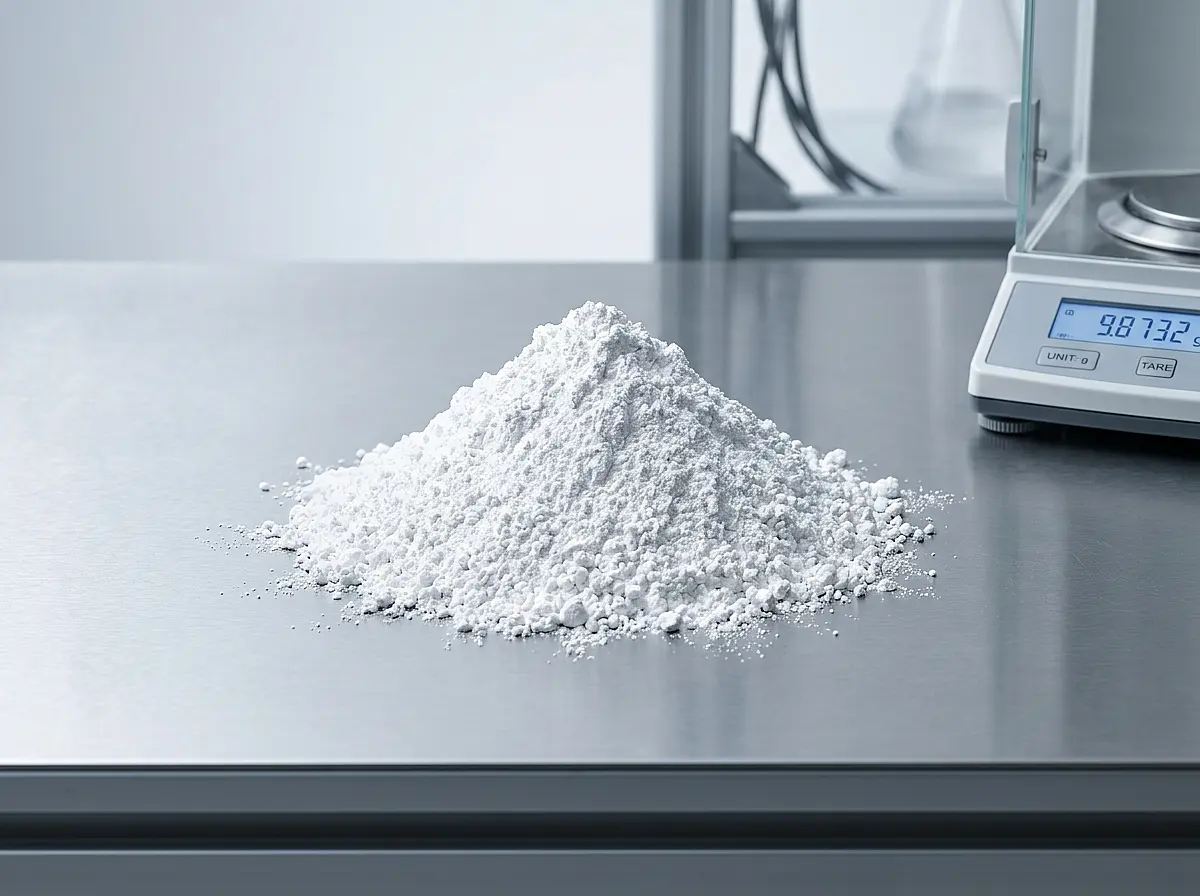
Titanium dioxide, also written as TiO₂ or TiO2, is the inorganic compound titanium(IV) oxide with the CAS number 13463-67-7.[1] It is typically supplied as a bright white powder with extremely low water solubility and unusually strong opacity because its refractive index is higher than that of any other commercially important white pigment.[1][5] Its three main natural crystal forms are rutile, anatase, and brookite.[1][2]
- Chemical formula: TiO₂[1]
- CAS number: 13463-67-7[1]
- Appearance: white powder or white solid[1]
- Main crystal forms: rutile, anatase, brookite[1][2]
- Common names by context: titanium dioxide, titanium oxide, TiO2, CI 77891, Pigment White 6, E171[4][9][10]
- Primary uses: paints and coatings, plastics, paper, cosmetics, sunscreen, pharmaceuticals, and food whitening in jurisdictions where allowed[2][3][4][11]
- US status: permitted in food as a color additive at not more than 1% by weight of the food, and used in cosmetics and OTC sunscreen products under FDA rules[6][9][12]
- EU status: no longer authorized as food additive E171 since 2022, while remaining permitted in cosmetics under separate legislation and SCCS review[4][8][10]
On ingredient labels, the same underlying compound can appear under different naming systems. In cosmetics it commonly appears as Titanium Dioxide or CI 77891; in historical European food labeling it appeared as E171; in technical writing it may simply be called titanium oxide or TiO₂.[4][9][10] A shorter chemistry-focused overview is available in the TiO₂ chemical data overview.
Regulatory Snapshot
Titanium dioxide regulatory snapshot
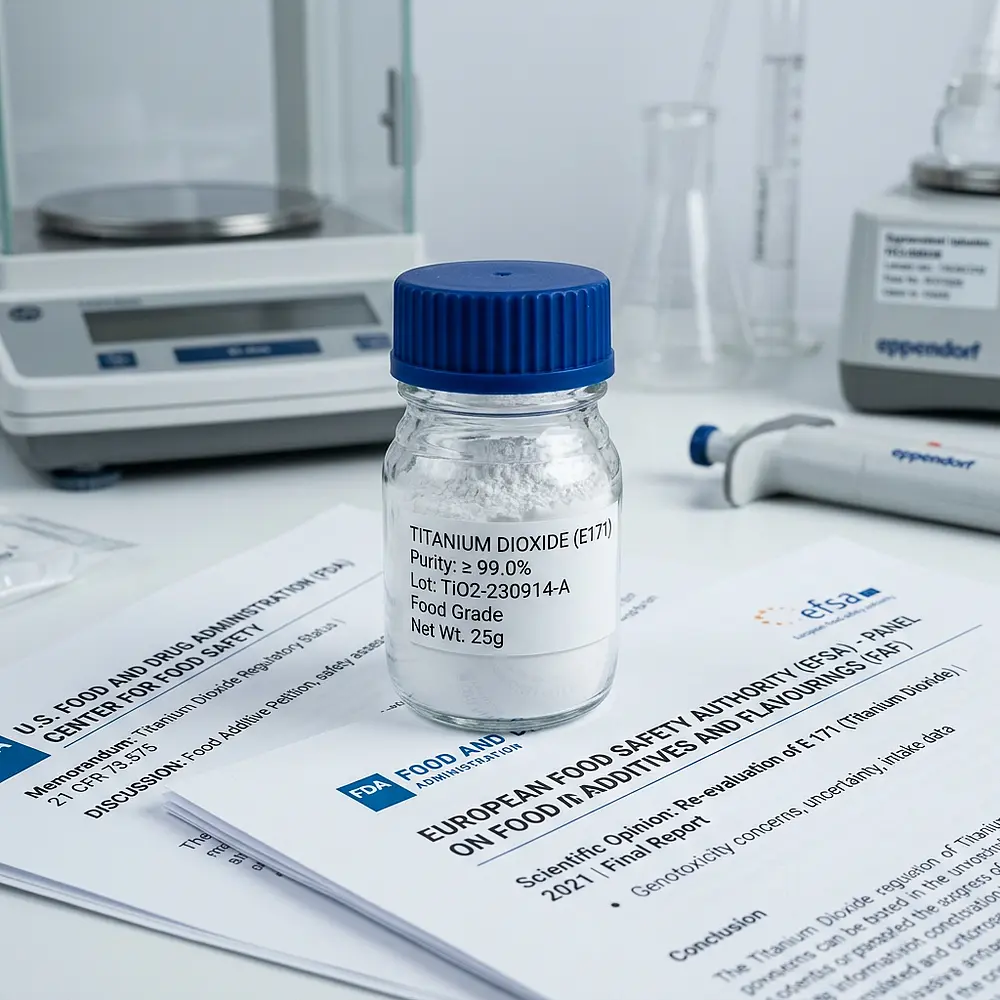
- Food: In the United States, FDA regulations permit titanium dioxide as a color additive in food at levels not exceeding 1% by weight of the food under 21 CFR 73.575; in the European Union, the authorization for E171 was withdrawn after EFSA concluded that a concern for genotoxicity could not be excluded.[4][6][8]
- Cosmetics: In cosmetics, titanium dioxide is used as CI 77891 and remains permitted in both the US and EU, subject in Europe to product-form distinctions and SCCS assessments including opinions on nano forms.[9][10]
- Sunscreen: FDA recognizes titanium dioxide as an OTC sunscreen active ingredient; in Europe it is also used as a UV filter under the cosmetics framework, with safety evaluation depending on form and exposure conditions.[10][12]
- Inhalable particles: IARC classifies titanium dioxide as Group 2B, possibly carcinogenic to humans, on the basis of inhalation evidence; California Proposition 65 likewise addresses airborne, unbound particles of respirable size rather than all finished products containing TiO₂.[7][14]
Everyday Uses
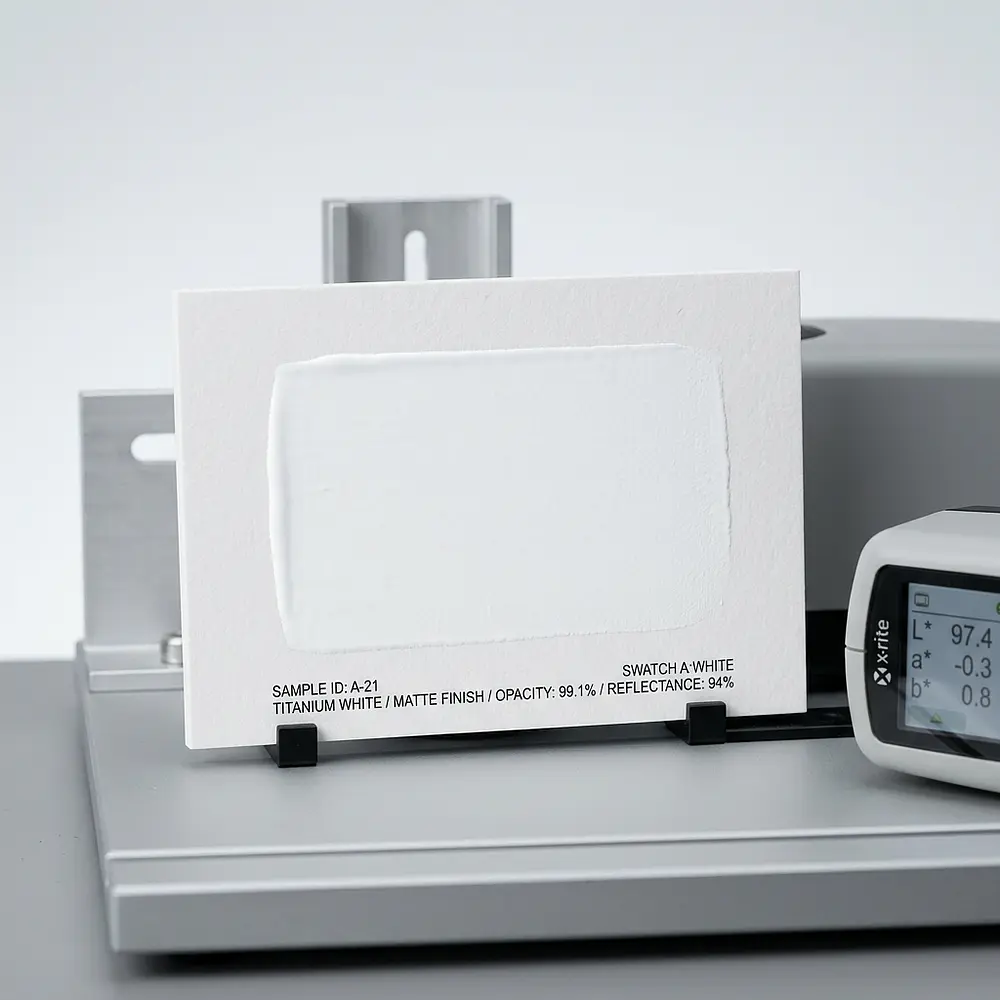
The global importance of titanium dioxide comes from one physical trick: it makes materials look brighter and less transparent than they otherwise would.[2][5] Because TiO₂ scatters visible light so strongly, manufacturers use it whenever whiteness, opacity, or visual cleanliness matters.
That is why it appears in paint, architectural coatings, plastics, and paper, where it creates brightness and hiding power.[2][3] It also appears in cosmetics and sunscreen, where it serves both as a white pigment and as a mineral UV filter.[9][10][12] In pharmaceuticals, it has been used as an opacifier in tablet and capsule coatings; in food, where permitted, it has been used purely for appearance rather than nutrition.[4][11][13]
What makes these uses so different from one another is not the formula TiO2 itself, but the engineering around it. Commercial grades vary by crystal form, particle size, purity, and surface treatment depending on whether the goal is wall-paint coverage, UV screening on skin, tablet opacity, or controlled processing in polymers.[2][3][8][10]
Key Identifiers
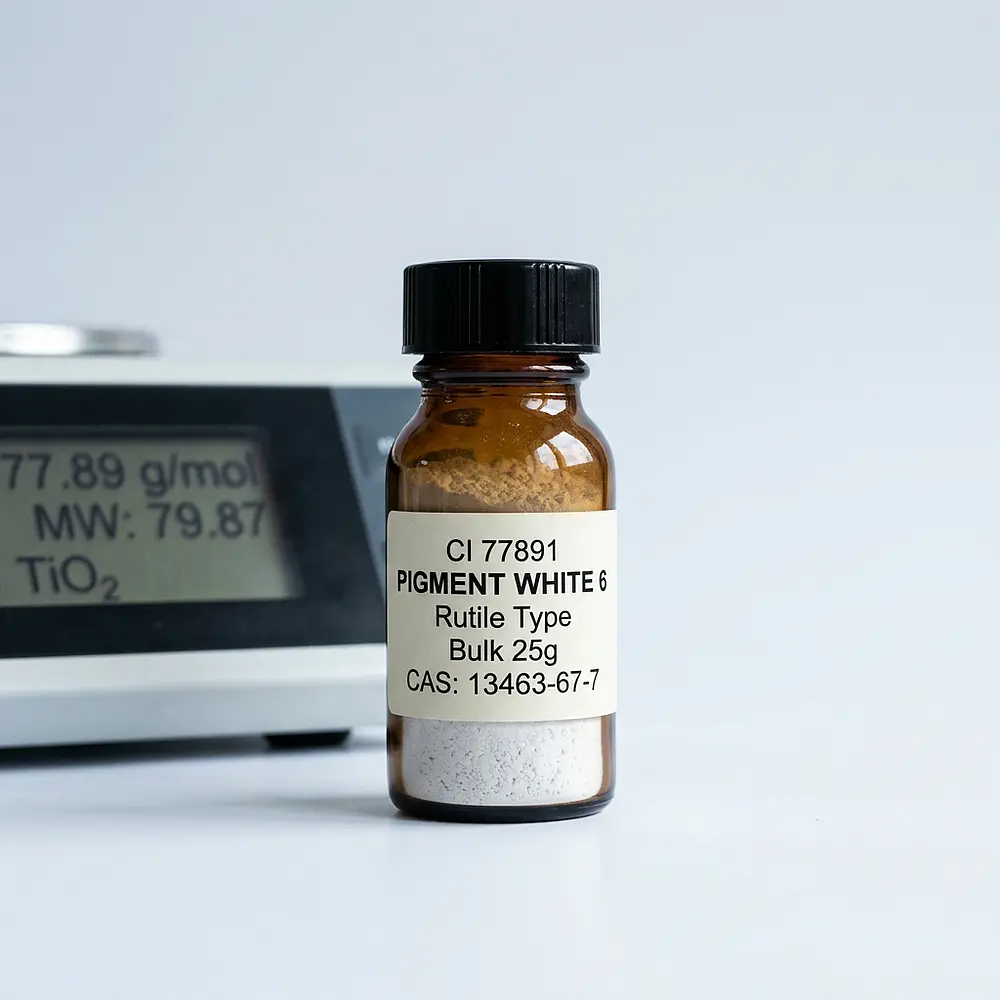
The many names attached to titanium dioxide reflect regulation and industry practice, not different elemental substances. Titanium dioxide, titanium(IV) oxide, and TiO₂ all refer to the same oxide of titanium.[1] In the Color Index system used for cosmetics and personal care products, it is listed as CI 77891; in pigment terminology it is widely known as Pigment White 6.[9][10]
The food term E171 belongs specifically to the former European authorization for titanium dioxide as a food additive.[4] That matters because identical chemistry does not mean identical regulatory treatment. Food additives are evaluated through oral exposure, cosmetic colorants through skin contact and product form, and industrial pigments through performance, handling, and occupational exposure.[4][6][8][10]
Across all of these contexts, the most stable identifier is CAS 13463-67-7.[1] It anchors the chemical identity even when the material is manufactured to very different particle specifications, crystal forms, or surface treatments.
What Is Titanium Dioxide?
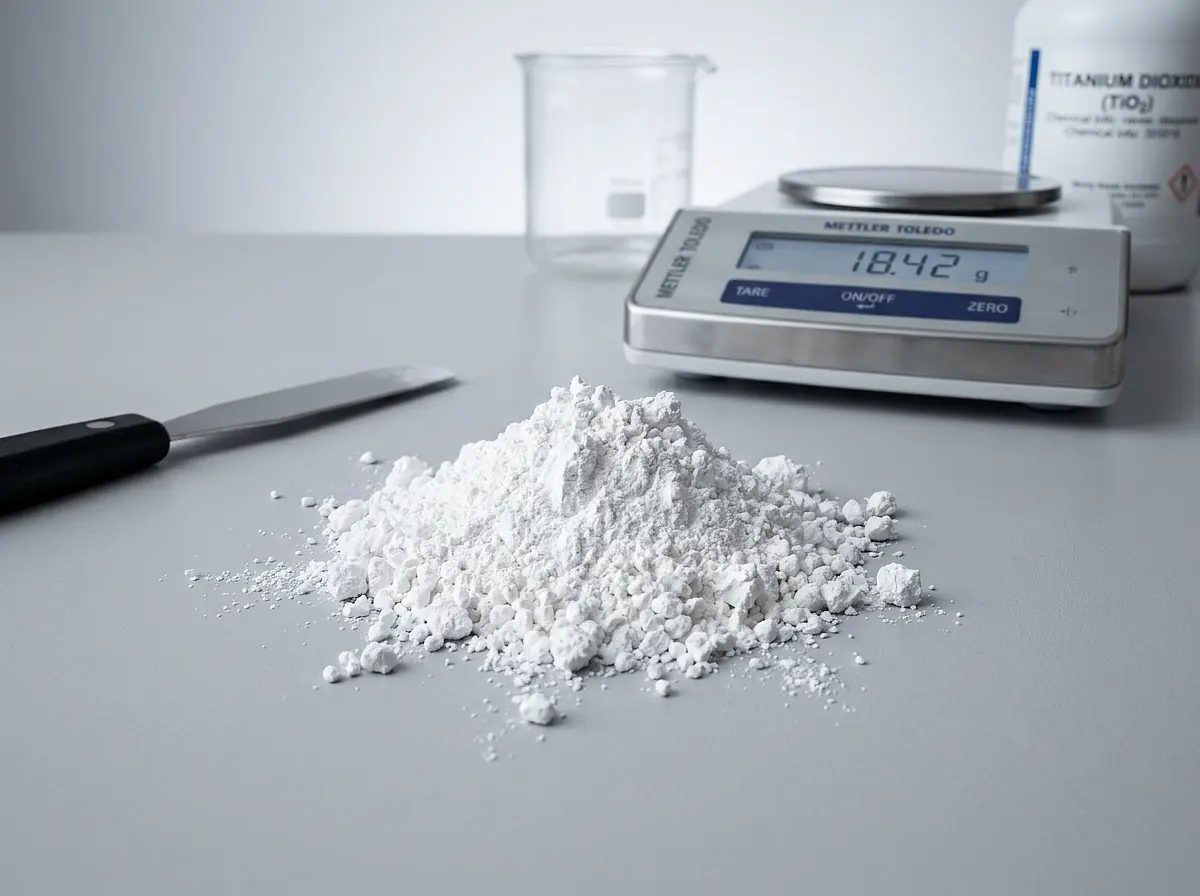
Titanium dioxide is the oxide of titanium in the +4 oxidation state, with the formula TiO₂.[1] In everyday terms, it is a stable, inorganic white solid whose significance comes from its optical behavior. It is chemically durable, practically insoluble in water, and extraordinarily effective at scattering visible light, which is why it has become the dominant white pigment of modern industry.[1][2][5]
The story begins with the discovery of the element titanium in the late eighteenth century. William Gregor described an unknown metallic component in Cornish mineral sands in 1791, and Martin Heinrich Klaproth later identified the same element from rutile and gave it the name titanium.[15] The oxide became industrially transformative only much later, once purification and large-scale manufacturing methods made bright, low-impurity TiO₂ commercially practical.[2][3]
In nature, titanium is found chiefly in minerals rather than as free metal. The main industrial feedstocks are ilmenite (FeTiO₃) and rutile (TiO₂), recovered from hard-rock deposits and heavy mineral sands.[16] These ores are processed into purified titanium dioxide used in pigments, cosmetics, sunscreens, pharmaceuticals, and specialty technical materials.
Natural Occurrence and Feedstocks
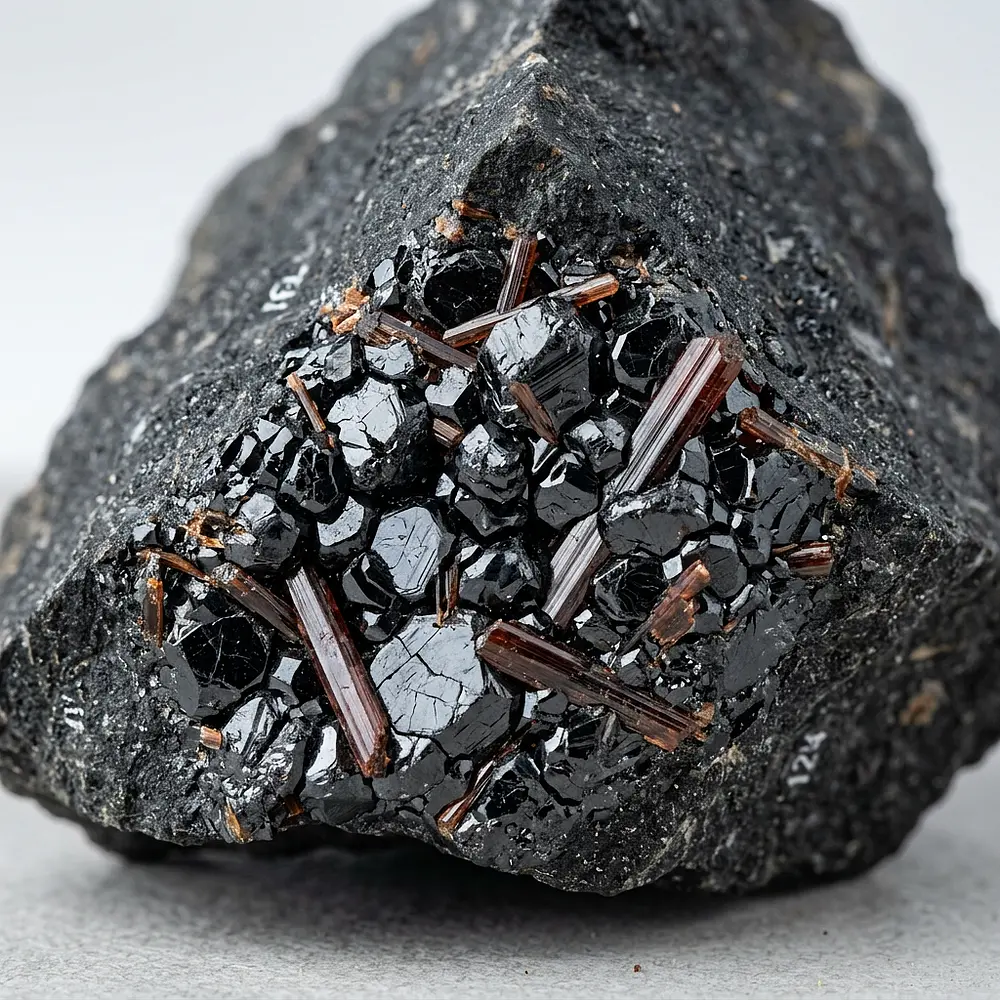
The two most important titanium-bearing raw materials are ilmenite and rutile.[16] Ilmenite is more abundant and therefore central to global supply, while rutile is richer in titanium dioxide content and can be advantageous where a higher-grade feedstock is preferred.[2][16] Weathered ilmenite-derived materials such as leucoxene also contribute to some supply chains.
A large share of commercially valuable titanium minerals comes from heavy mineral sand deposits, where dense grains have been naturally concentrated by erosion and sediment transport.[16] After mining and separation, these feedstocks enter either the sulfate or chloride production route.
Ore quality matters because trace contaminants affect both process efficiency and final color. Pigment-grade TiO₂ must be highly refined: transition-metal impurities can shift tone, reduce brightness, and interfere with end-use performance.[2][3]
Discovery and Industrial Rise
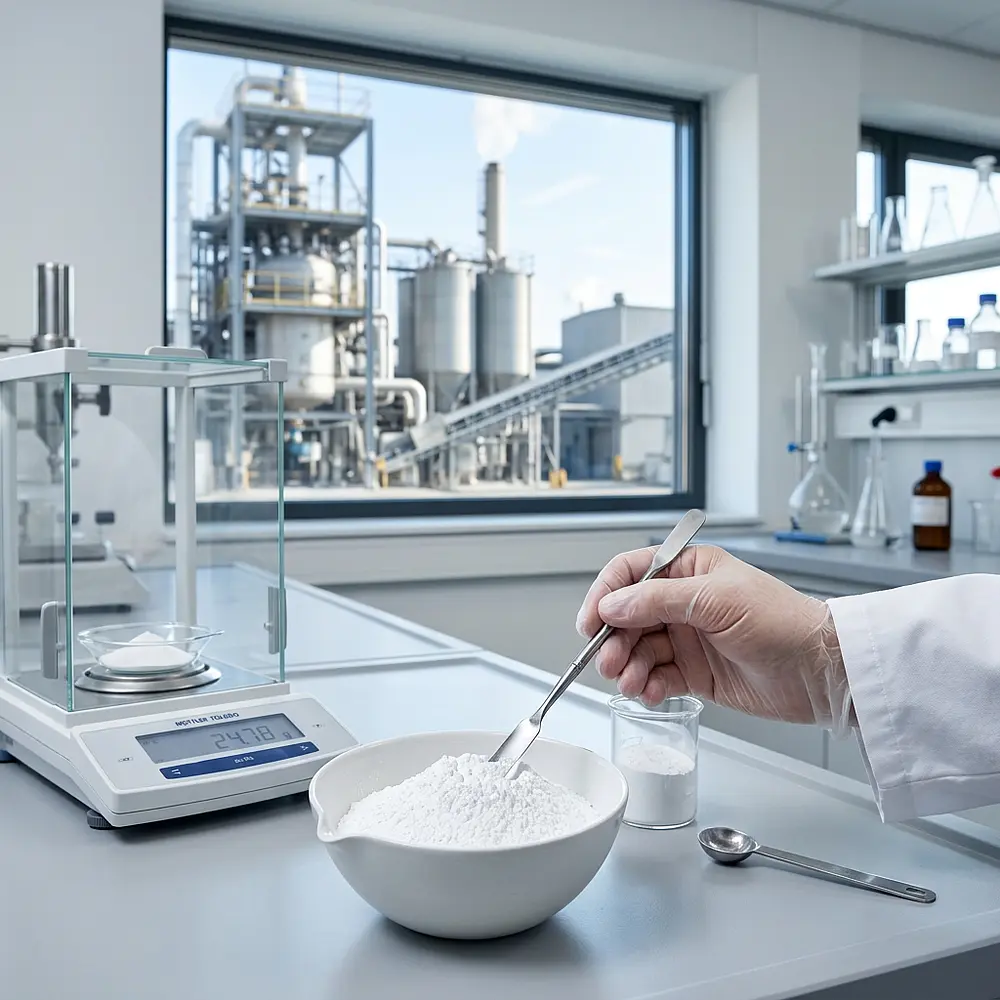
The transition from scientific curiosity to industrial staple depended on one thing: manufacturing control. Early white pigments such as lead white were effective but came with major toxicity concerns; titanium dioxide offered comparable or better opacity without the intrinsic hazards associated with lead-based pigments in ordinary finished-use contexts.[2][3]
During the twentieth century, TiO₂ became the dominant white pigment because it delivered a combination competitors could not match at scale: high brightness, strong hiding power, weather resistance, and compatibility with many different product systems.[2][5] Paints, plastics, paper coatings, inks, and consumer products all expanded alongside the titanium dioxide industry, turning one oxide into a foundation material of modern manufacturing.
Chemical Properties & Structure
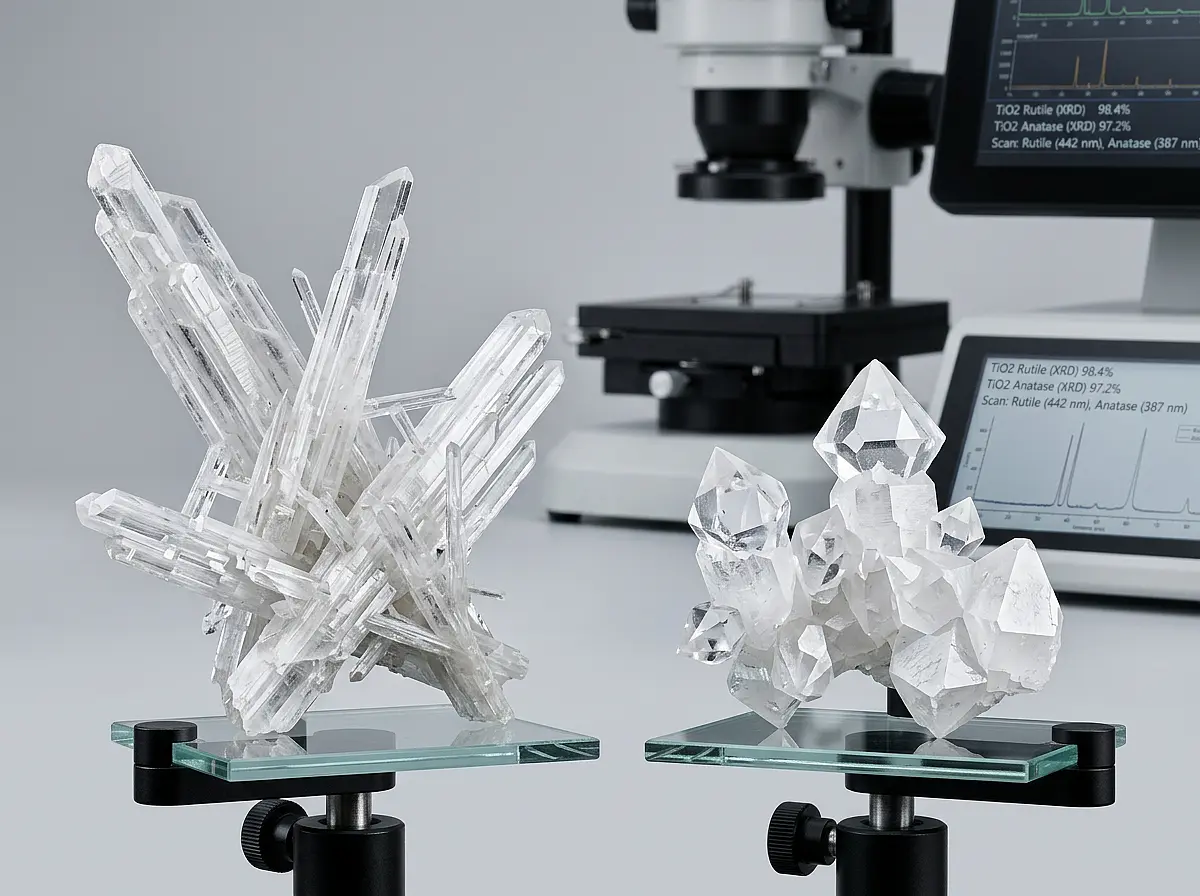
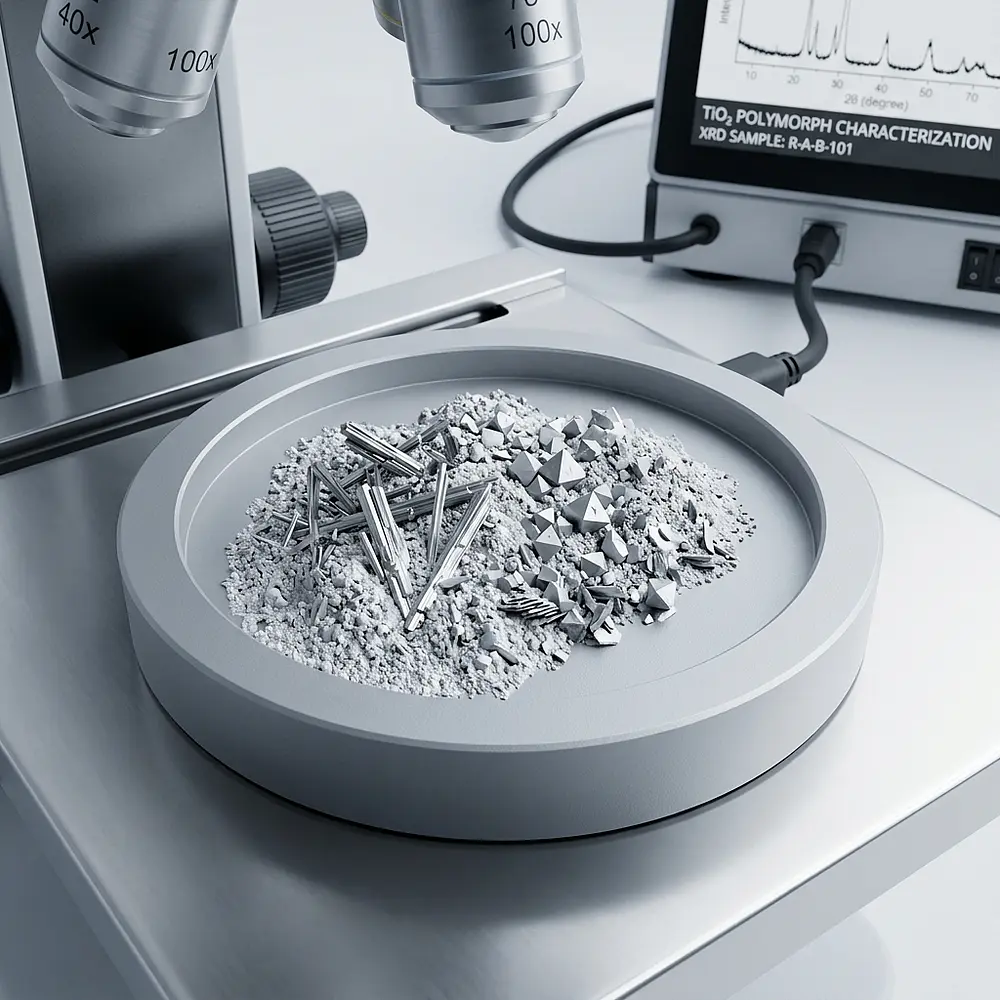
Titanium dioxide is simple in formula and complex in behavior. Its technical importance comes from the way crystal structure controls optical performance, density, stability, and photochemical activity. The three principal naturally occurring polymorphs are rutile, anatase, and brookite.[1][2] Rutile and anatase are tetragonal; brookite is orthorhombic.[1]
For pigment applications, rutile is usually the commercial workhorse because it combines the highest refractive index with strong thermodynamic stability.[1][2][5] Anatase remains important in specialized applications and in photocatalysis research, while brookite is comparatively minor in mainstream manufacturing. A detailed comparison of the two dominant polymorphs is available in rutile vs anatase.
Titanium dioxide is also a semiconductor. Rutile has a band gap of about 3.0 eV, while anatase is around 3.2 eV.[17][18] Those values help explain why TiO₂ interacts strongly with ultraviolet light and why crystal form matters far beyond pigment color. In photocatalytic systems, UV excitation can generate electron-hole pairs that drive surface reactions; in cosmetics and durable polymer systems, unwanted surface reactivity is often suppressed through coatings such as silica or alumina.[10][17][18][19]
Industrial TiO₂ is produced mainly by the sulfate process or the chloride process.[2][3] The sulfate route can process ilmenite and lower-grade ores through acid digestion, hydrolysis, and calcination, while the chloride route typically starts from higher-grade feedstocks, forms titanium tetrachloride, purifies it, and oxidizes it to TiO₂.[2][3] These process differences influence impurity profiles, product consistency, and the kinds of grades manufacturers bring to market — covered in detail under titanium dioxide pigment production.
Crystal Forms: Rutile, Anatase, and Brookite
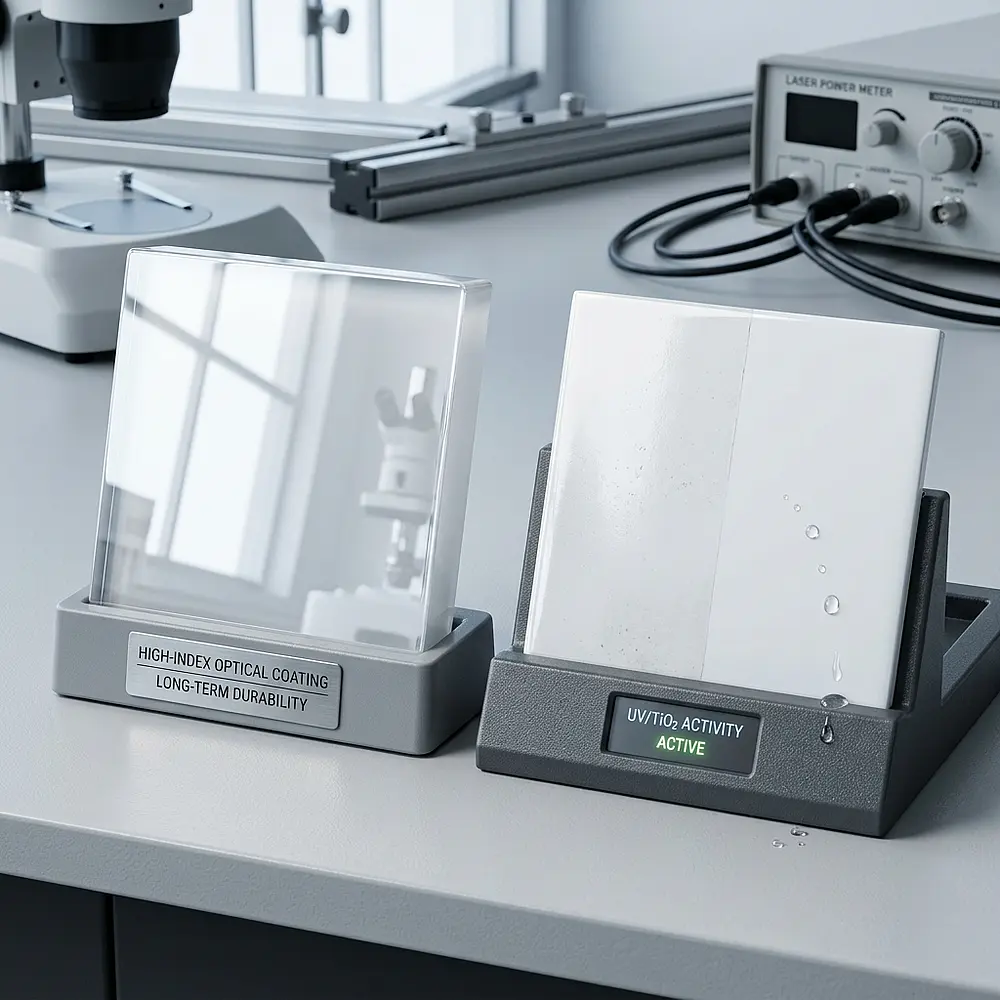
Rutile is the most important commercial form because it offers the highest refractive index and strong long-term stability.[1][2] That makes it the default choice for many paints, plastics, and durable white consumer products.
Anatase has somewhat lower refractive index but often greater photocatalytic activity, which is one reason it appears so frequently in technical literature on self-cleaning surfaces and environmental photocatalysis.[17][18] In products that contain oils, polymers, or other light-sensitive organic materials, that extra reactivity can be a disadvantage unless it is deliberately controlled.
Brookite is scientifically interesting but commercially marginal. It occurs naturally and has its own crystal structure, yet it plays little role in large-scale pigment manufacturing compared with rutile and anatase.[1][2]
Why Titanium Dioxide Is So White
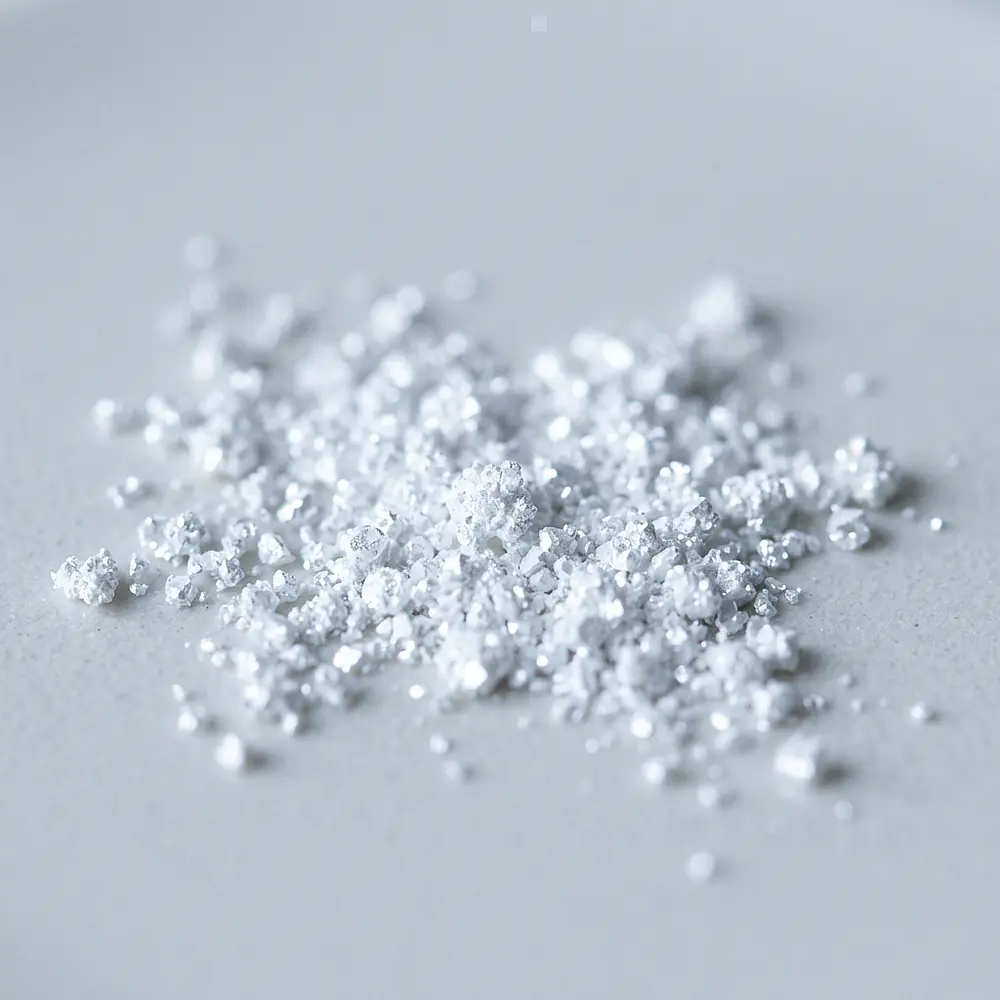
The whiteness of titanium dioxide is an optical phenomenon produced by light scattering, not by a dye-like color mechanism.[5] TiO₂ has an exceptionally high refractive index, so light bends strongly when it passes between a titanium dioxide particle and the surrounding medium. The result is intense opacity and brightness.
That performance is strongest when particle size is carefully engineered. Commercial pigment grades are designed so that particles scatter visible wavelengths efficiently; if the particles are much smaller or much larger than the optimal range, hiding power falls.[2][5] In other words, titanium dioxide works so well not just because it is chemically TiO₂, but because industrial processing tunes the particle geometry that determines how light behaves.
Physical and Chemical Properties Table
Key physical and chemical data for titanium dioxide[1][5][9][10][17]
- Name: Titanium dioxide; titanium(IV) oxide; titanium oxide[1]
- Formula: TiO₂[1]
- CAS number: 13463-67-7[1]
- Molar mass: 79.866 g/mol[1]
- Appearance: white solid / white powder[1]
- Main crystal forms: rutile, anatase, brookite[1][2]
- Crystal systems: rutile and anatase tetragonal; brookite orthorhombic[1]
- Density: approximately 4.23 g/cm³ for rutile and 3.9 g/cm³ for anatase[1][5]
- Melting point: approximately 1843 °C[1]
- Refractive index: about 2.7 for rutile and 2.5 for anatase[1][5]
- Water solubility: practically insoluble[1]
- Band gap: about 3.0 eV for rutile and 3.2 eV for anatase[17][18]
- INCI / cosmetic color name: Titanium Dioxide / CI 77891[9][10]
- Food additive designation: E171[4]
Photocatalysis and UV Reactivity
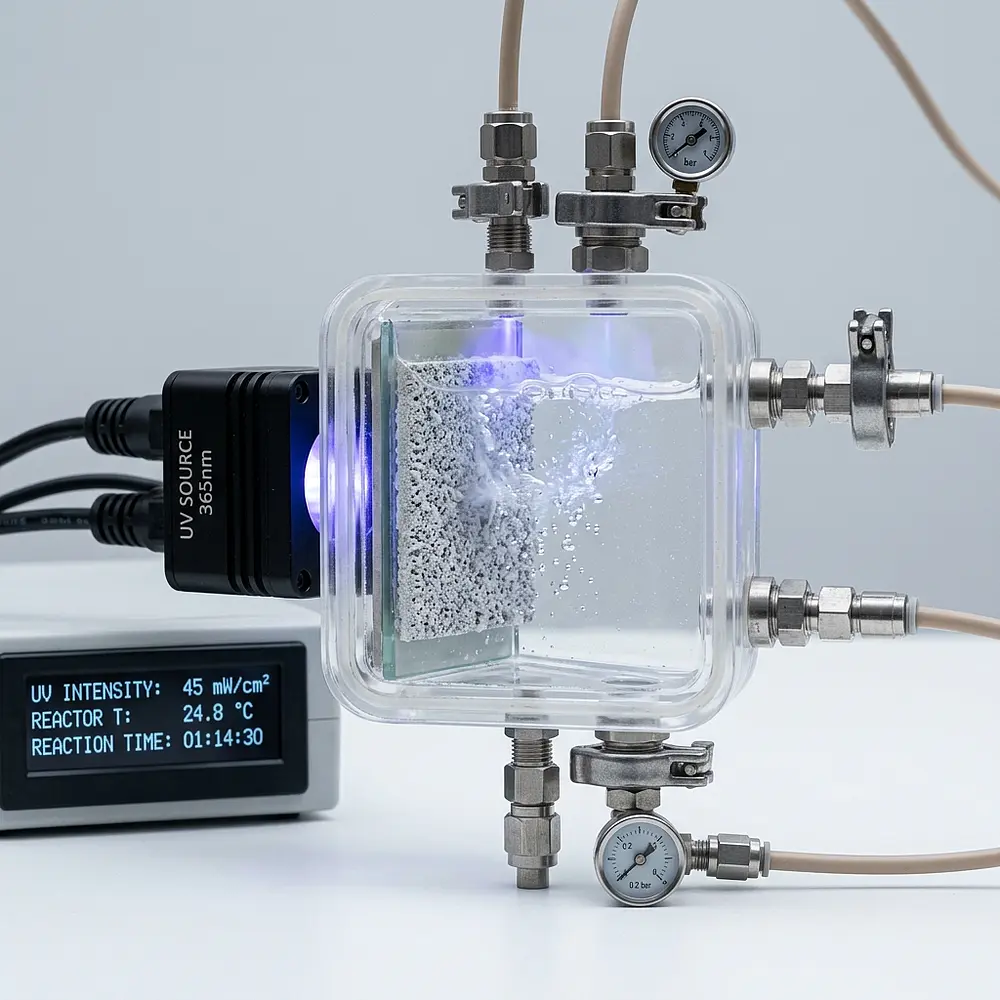
Titanium dioxide is one of the best-known photocatalytic materials because it can convert ultraviolet light into chemical activity at its surface.[17] When sufficiently energetic photons strike TiO₂, electrons can be promoted into the conduction band, leaving positively charged holes behind. These charge carriers can then participate in oxidation and reduction reactions that generate reactive species such as hydroxyl radicals and superoxide-related intermediates.[17][18]
This behavior is useful in self-cleaning glass, pollutant degradation, antimicrobial surfaces, and experimental water- or air-treatment systems.[17][18] It is far less desirable when the surrounding formulation contains polymers, oils, or biological interfaces that should remain chemically quiet. That is why many cosmetic and pigment grades are surface treated: the goal is to preserve whiteness or UV filtering while minimizing photocatalytic side reactions.[10][19]
The reaction mechanism, the real-world applications, and the opposite engineering goal behind pigment grades are set out in full on the titanium dioxide photocatalysis page.
What Is Titanium Dioxide Used For?
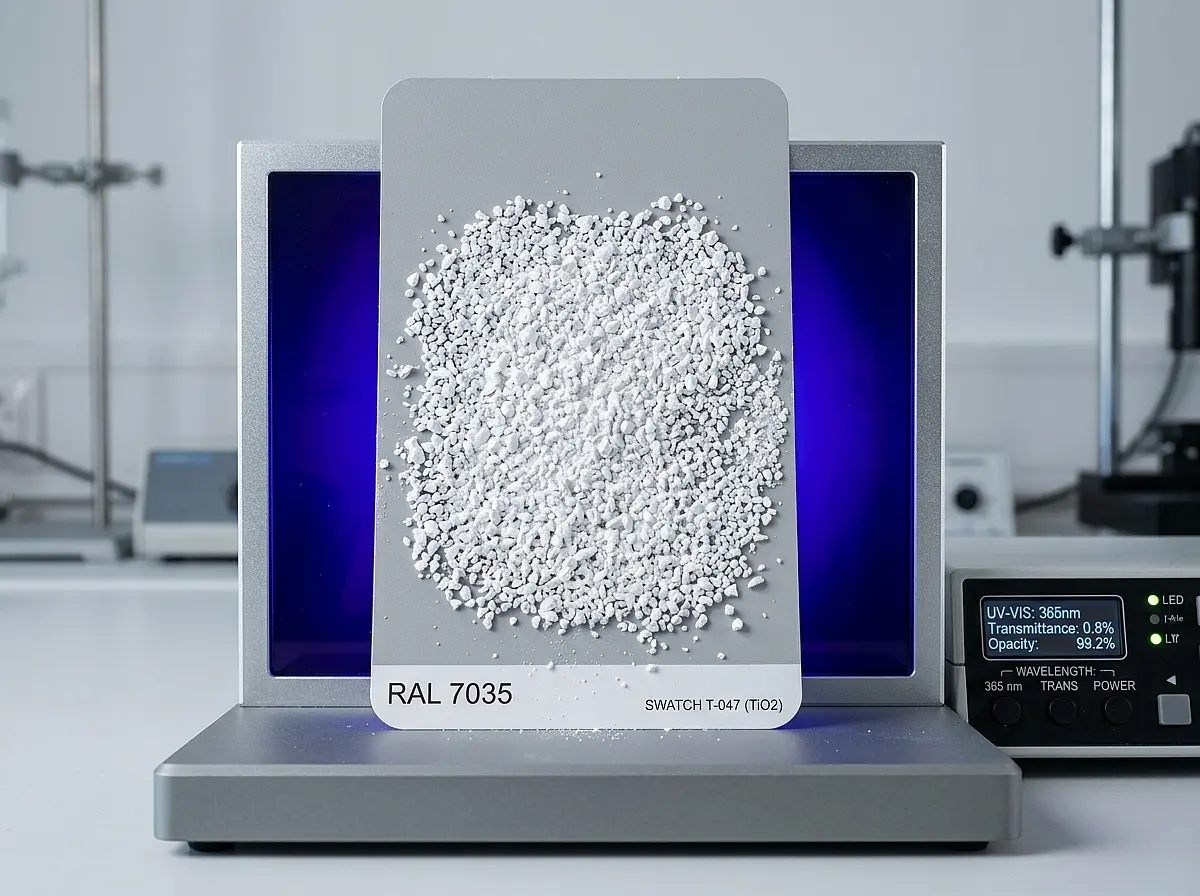
Titanium dioxide is used wherever manufacturers need one or more of three functions: whiteness, opacity, or UV interaction. The same chemistry supports very different industries because light scattering and UV management are useful in everything from house paint to pharmaceuticals. A broader application guide is available under titanium dioxide uses.
Paints and coatings. This is the largest end-use sector and accounts for roughly 60% of global TiO₂ consumption in standard industry estimates.[2][3] In coatings, titanium dioxide provides hiding power, brightness, tint strength support, and exterior durability, especially in rutile pigment grades designed for weather resistance.
Sunscreen and cosmetics. In sunscreens, TiO₂ acts as a mineral UV filter, with protection concentrated in the UVB and short-UVA range; in makeup and personal care products, it also contributes opacity and color control.[10][12] More detail is available under titanium dioxide in sunscreen.
Food additive. As E171, titanium dioxide was used to make products such as confectionery, chewing gum, icings, and some sauces appear brighter and whiter.[4][20] That use remains permitted in the US under FDA limits but is no longer authorized in EU food. See titanium dioxide in food.
Pharmaceuticals. TiO₂ has long been used as an excipient in coatings for tablets and capsules, where opacity can improve product appearance and protect light-sensitive ingredients.[13]
Plastics. Polymer manufacturers use titanium dioxide to create white, opaque products and to reduce UV-driven degradation, particularly in outdoor or light-exposed applications.[2][3]
Paper. In high-opacity papers and coated grades, TiO₂ improves brightness and reduces show-through, making it valuable in premium printing and packaging applications.[2]
Food Additive E171
E171 is the European food-additive designation that was used for titanium dioxide when it was authorized in food.[4] Its purpose was visual only: it made coatings, fillings, sweets, and other products look whiter, more opaque, and more uniform.
The scientific controversy around E171 was never about whether TiO₂ was useful in food processing. It was about whether repeated oral exposure to a particulate additive could still be considered acceptably safe under current evidence standards.[4][20][21]
Sunscreen and Cosmetics
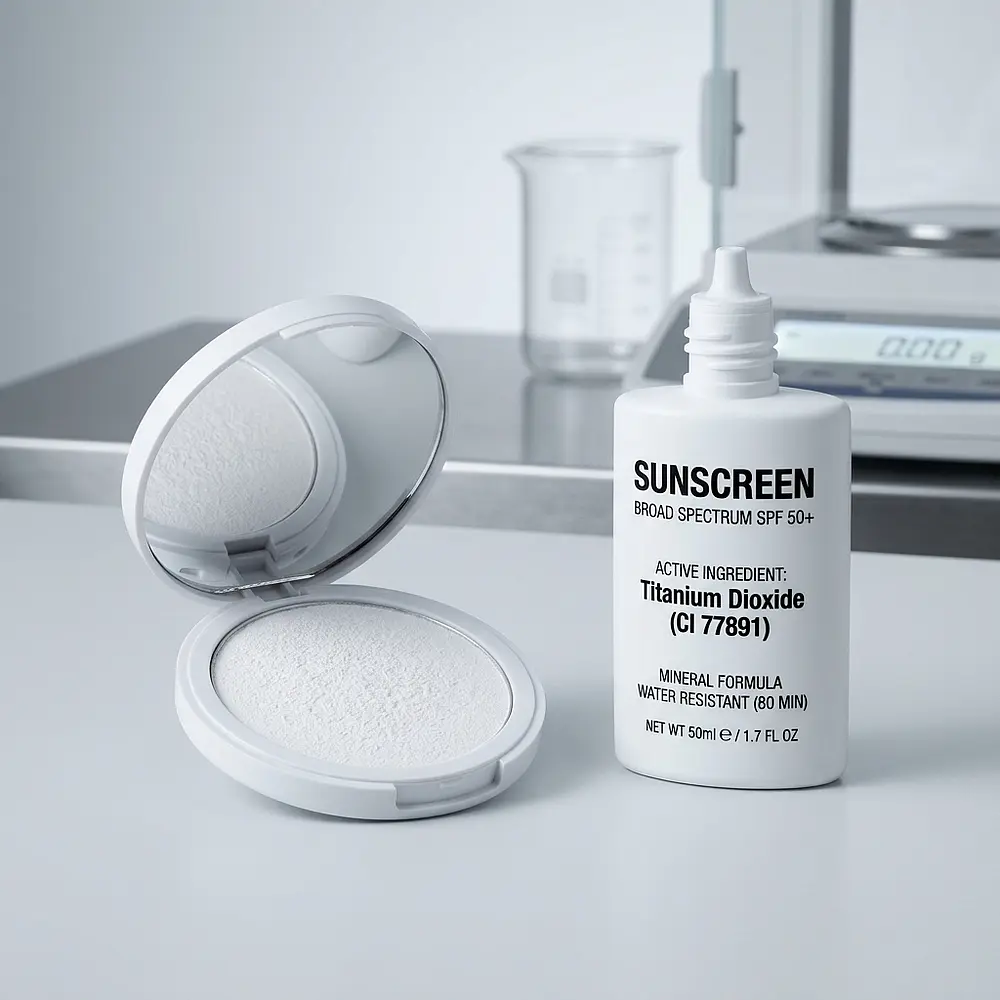
In cosmetics, titanium dioxide does two different jobs. First, it acts as a white pigment and opacifier in products such as foundation, powder, and pressed makeup. Second, in sunscreen and SPF cosmetics, it functions as a mineral UV filter listed on labels as Titanium Dioxide or CI 77891.[9][10][12]
Cosmetic TiO₂ is engineered very differently from raw industrial pigment. Particle size, dispersion behavior, texture, and surface treatment are all selected for skin-contact performance, and many grades are coated with materials such as silica or alumina to reduce photocatalytic activity and improve formulation stability.[10][19]
Paints and Coatings

Paint and coatings remain the economic center of the titanium dioxide industry. A white coating must do more than look white in the can; it must hide the surface beneath it, support clean tint development, and maintain appearance over time. TiO₂ is unrivaled in that role because no other common white pigment combines such high refractive index with comparable industrial maturity.[2][3][5]
Rutile grades dominate this market because they offer strong optical performance and better durability than anatase in most exterior systems.[2] Producers also tailor surface treatments so coating formulators can optimize gloss, weathering, dispersion, and cost-performance balance.
Paper

Titanium dioxide is used in selected paper and paper-coating applications where extreme opacity or brightness is worth the added cost.[2] It reduces show-through, supports crisp print contrast, and creates a cleaner visual base for inks and graphics.
Although paper is not the dominant TiO₂ market, it remains an important specialty application where standard mineral fillers cannot achieve the same optical result.
Plastics
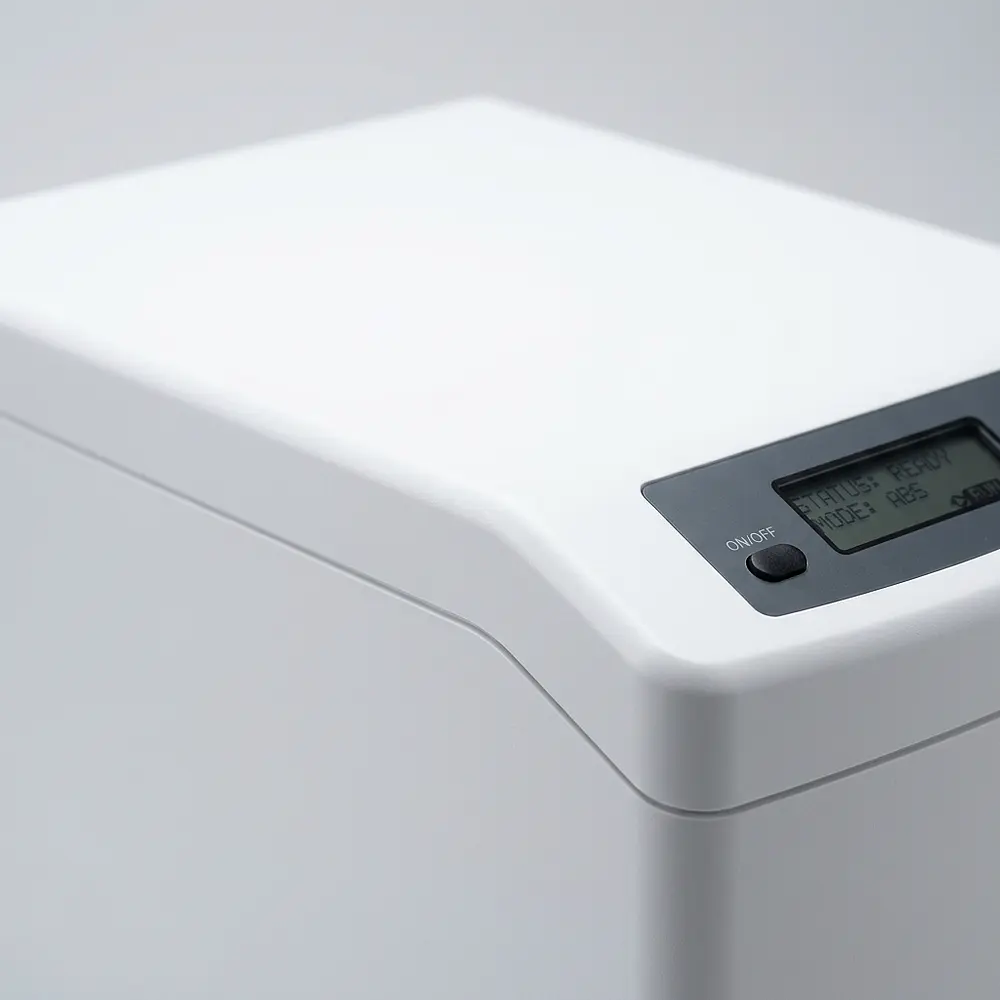
In plastics, titanium dioxide provides brightness and opacity while also helping manage light exposure within the polymer system.[2] Outdoor plastics are especially sensitive to UV-driven aging, including yellowing and embrittlement, so rutile grades are commonly selected to balance color performance with lower photocatalytic risk.[2][3]
The material must be well dispersed within the resin to deliver uniform color and reliable performance. As in coatings, end-use behavior depends on engineered grade design rather than formula alone.
Pharmaceuticals
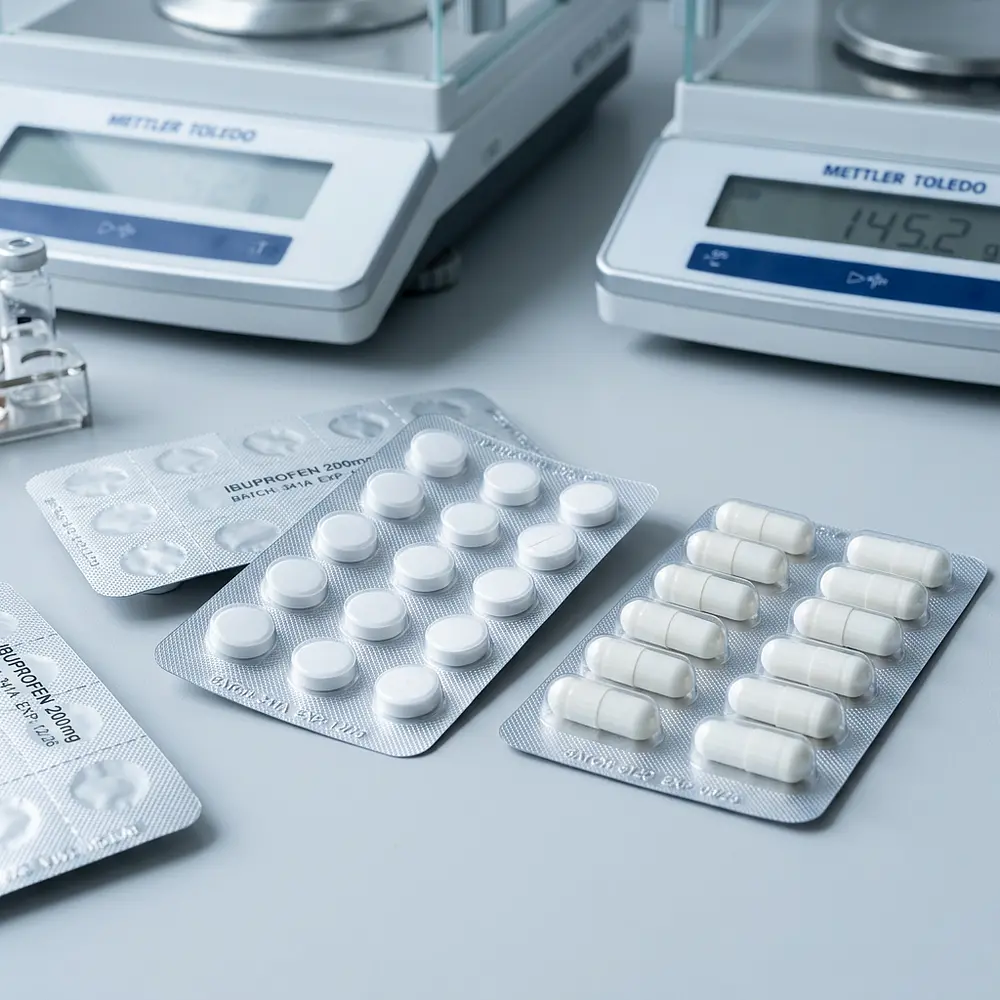
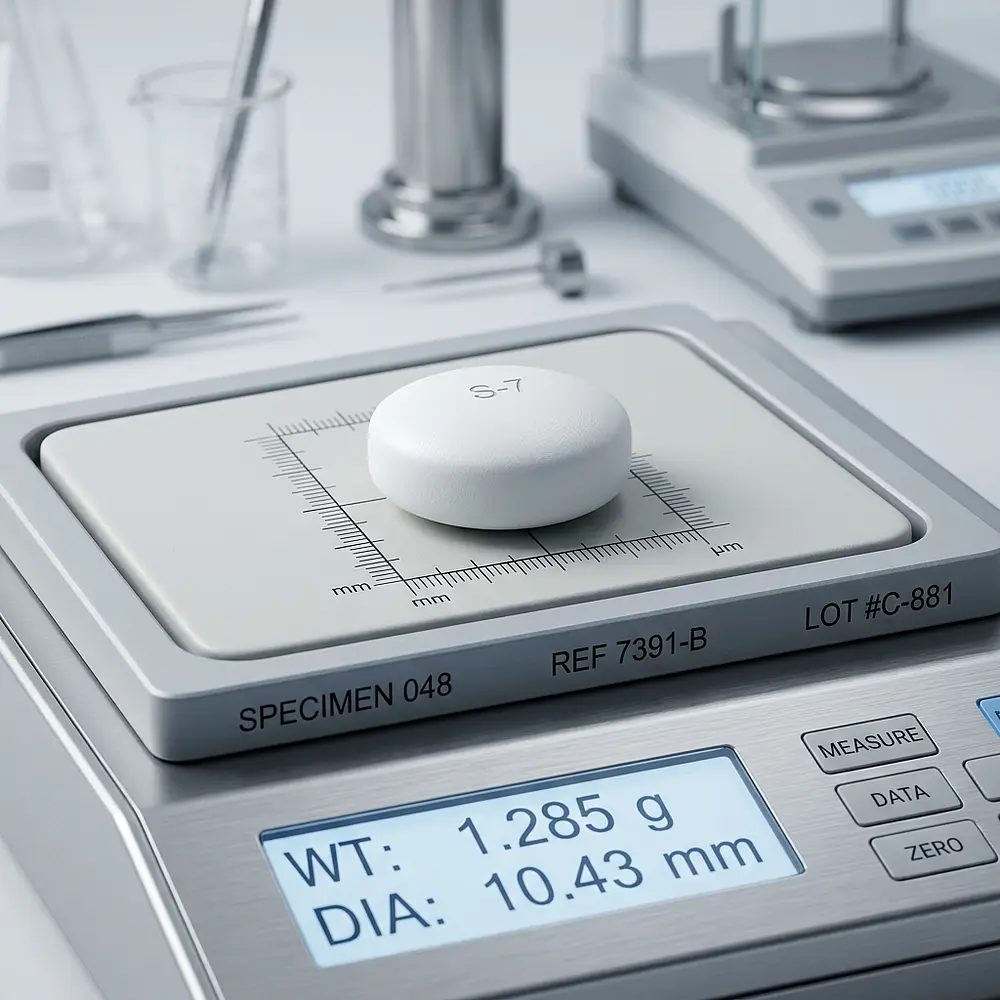
In pharmaceuticals, titanium dioxide is used as an excipient, not an active drug ingredient.[13] Its main role is to make tablets, capsules, and film coatings more opaque and visually consistent, which can help with product identification and with protection of light-sensitive compounds.
These applications depend on tightly specified pharmaceutical grades. The same basic chemical substance is involved, but the manufacturing and quality requirements are not interchangeable with those of paint pigment or food use.
Is Titanium Dioxide Safe?

Titanium dioxide safety depends on exposure route, physical form, and particle characteristics. That is the central principle behind why the same compound can be routine in sunscreen, tightly specified in medicines, still permitted by the FDA in food, and yet banned as E171 in the EU food system.[4][6][7][8][10] A dedicated review is available under is titanium dioxide safe. Which of those uses is permitted in which jurisdiction is mapped at how titanium dioxide is regulated.
Topical use on intact skin. Scientific reviews considered by the SCCS have found negligible dermal penetration of evaluated titanium dioxide forms through intact skin, which is why conventional creams and lotions remain a distinct and generally more reassuring exposure case than ingestion or inhalation.[10][22]
Ingestion. Oral exposure is the most contested use scenario. EFSA’s 2021 reassessment concluded that a concern for genotoxicity could not be excluded for E171, leading to the EU withdrawal of authorization; the FDA has maintained food permission under its own regulatory framework and limit.[4][6][8]
Inhalation. The strongest long-standing hazard concern centers on respirable airborne particles. IARC classified titanium dioxide as possibly carcinogenic to humans (Group 2B) based on inhalation evidence, and California’s Proposition 65 likewise targets airborne, unbound particles of respirable size.[7][14] What that classification does and does not say is set out under titanium dioxide and cancer.
For consumers, the practical implication is straightforward: titanium dioxide in a lotion, in a bound paint film, in a capsule coating, and as loose dust are not the same exposure event and should not be judged as though they were.
Topical Use: Skin and Sunscreen
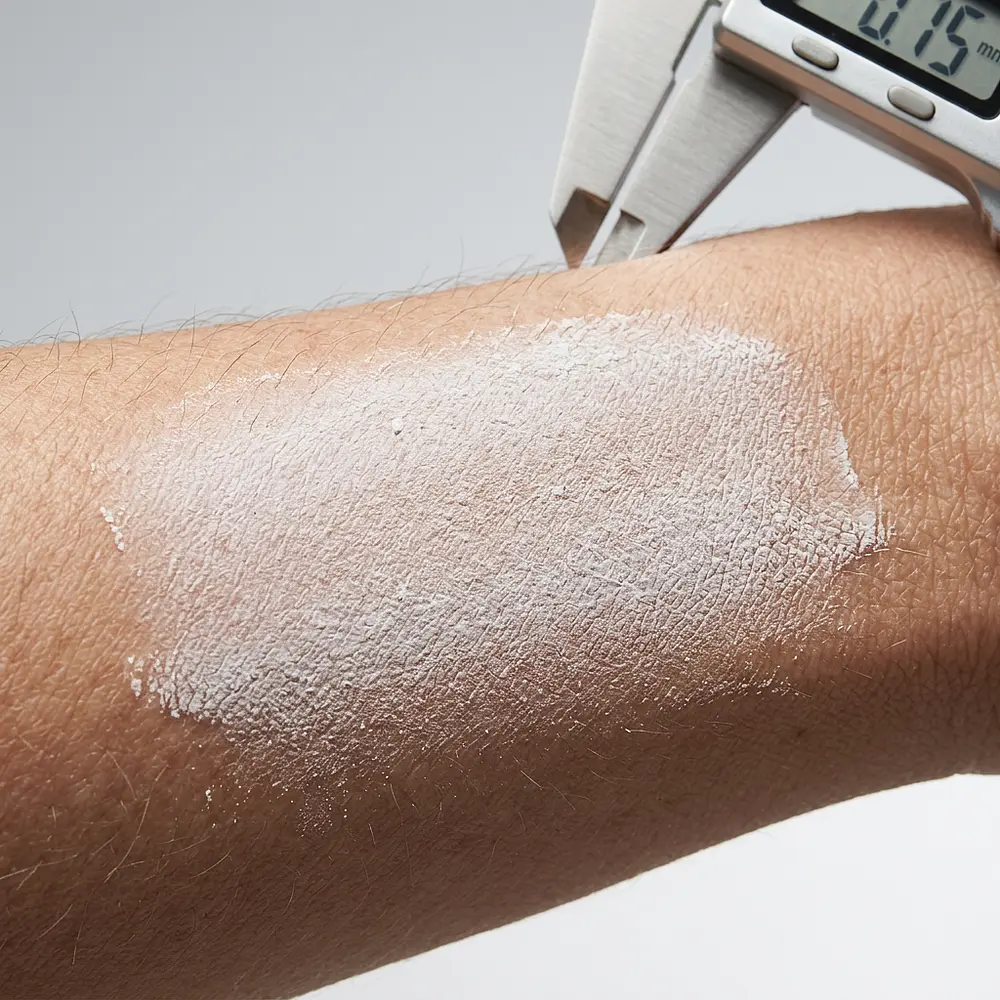
On skin, titanium dioxide is assessed primarily through penetration and local exposure questions rather than the oral toxicology framework used for food. SCCS reviews and underlying studies have generally found that evaluated forms remain on the skin surface or within the outermost stratum corneum, with negligible penetration through intact skin.[10][22]
This helps explain why CI 77891 in cosmetics is regulated separately from E171 in food. Sunscreen and makeup are not ingested under intended use, and commercial skin-contact grades are commonly surface treated to improve stability and suppress undesirable photoreactivity.[4][10][19]
Ingestion: Food and Oral Exposure
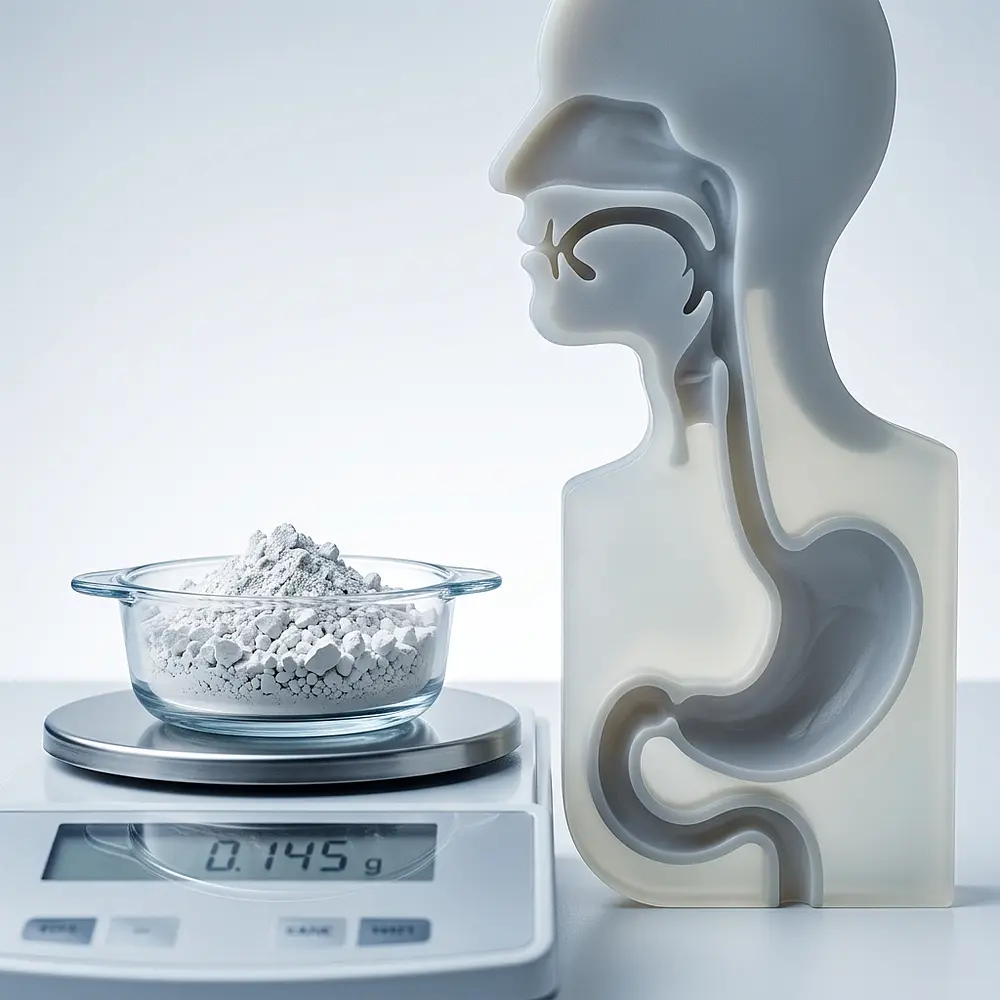
Oral exposure to titanium dioxide raises a different scientific problem than dermal or industrial use because the material remains particulate rather than dissolving in the way many food additives do.[4][21] That has focused attention on particle size distributions, tissue interaction, persistence, and genotoxicity-related questions.
EFSA’s 2021 opinion did not claim that ordinary consumers had been proven to suffer harm from typical diets. Its conclusion was narrower and more consequential: the available evidence no longer allowed the agency to rule out a genotoxicity concern for E171 with the confidence required for food-additive approval.[4]
The FDA has not adopted the same legal outcome in the United States, so titanium dioxide remains permitted in food there at not more than 1% by weight.[6] That divergence is one reason this ingredient remains so publicly debated.
Both assessments are limited to food. EFSA states expressly that exposure to TiO₂ through cosmetics such as toothpaste was not considered in its opinion.[4] Oral-care products are therefore a separate regulatory case, set out under titanium dioxide in toothpaste.
Nanoparticles and Particle Size
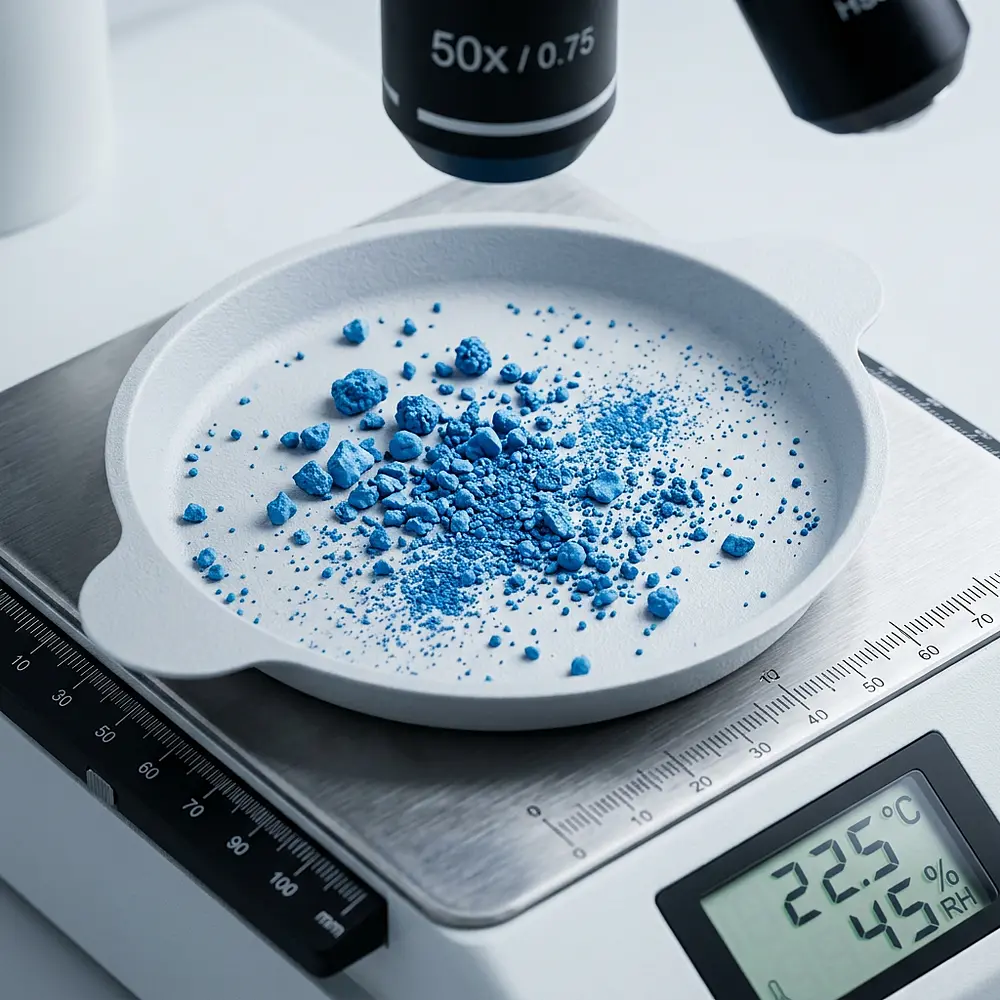
Particle size affects both performance and safety assessment. Many pigment grades used in paints and plastics are engineered near the size range that best scatters visible light and are not simply interchangeable with nano-sized technical materials.[2][5] Some cosmetic and specialty grades, however, may include particles or aggregates relevant to nano-specific regulatory review.[10]
Smaller particles have higher surface area relative to mass, which can change surface reactivity and biological interaction potential.[17][21] That is one reason regulators and scientific committees distinguish carefully among food-grade E171, sunscreen-grade materials, and inhalable powders rather than treating all TiO₂ particles as a single exposure category.
Inhalation: Dust and Airborne Particles
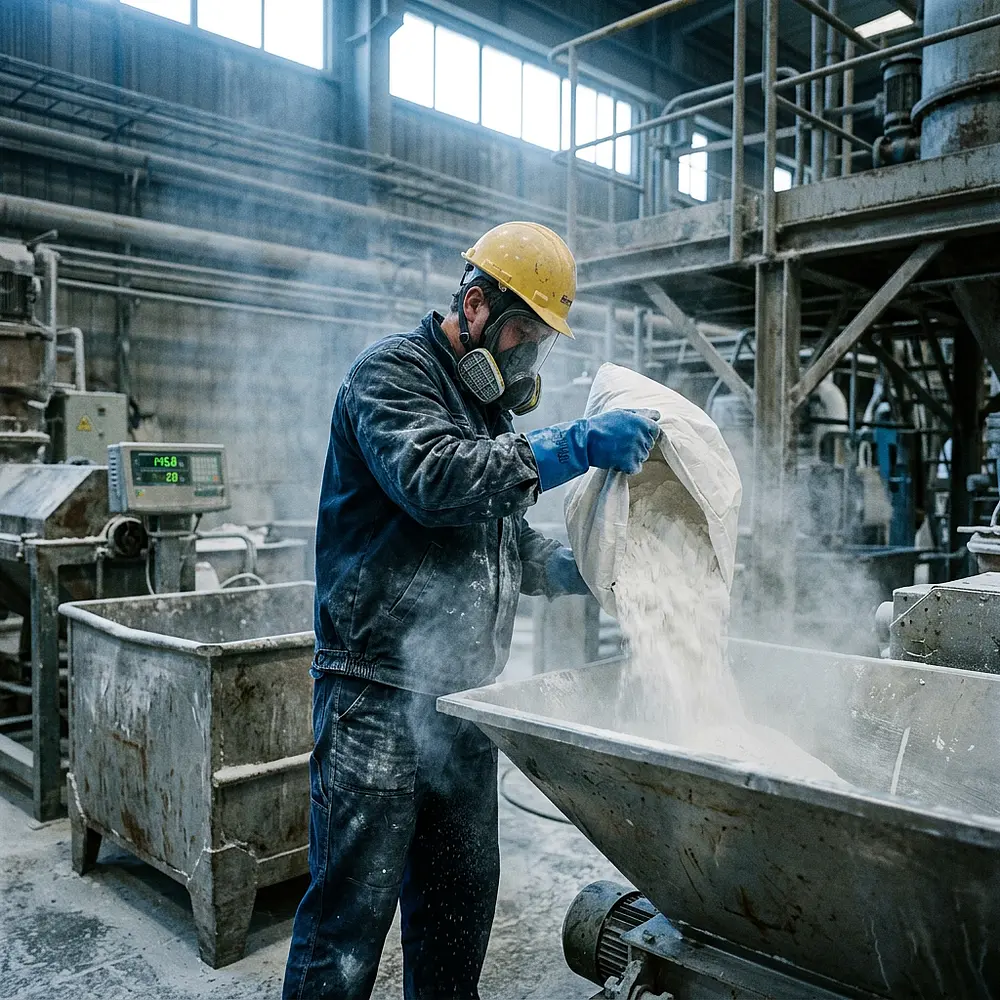
The inhalation issue is the most important context for cancer-related discussion of titanium dioxide. IARC’s Group 2B classification is based mainly on studies involving inhaled particles, especially high concentrations of respirable dust in experimental settings.[7]
That matters because hazard statements can sound broader than the underlying exposure scenario. Loose powders, workplace dust, and particle-generating processes raise a very different risk profile from creams, molded plastics, or cured coatings in which TiO₂ is fixed within a matrix.[7][14]
Titanium Dioxide in Food
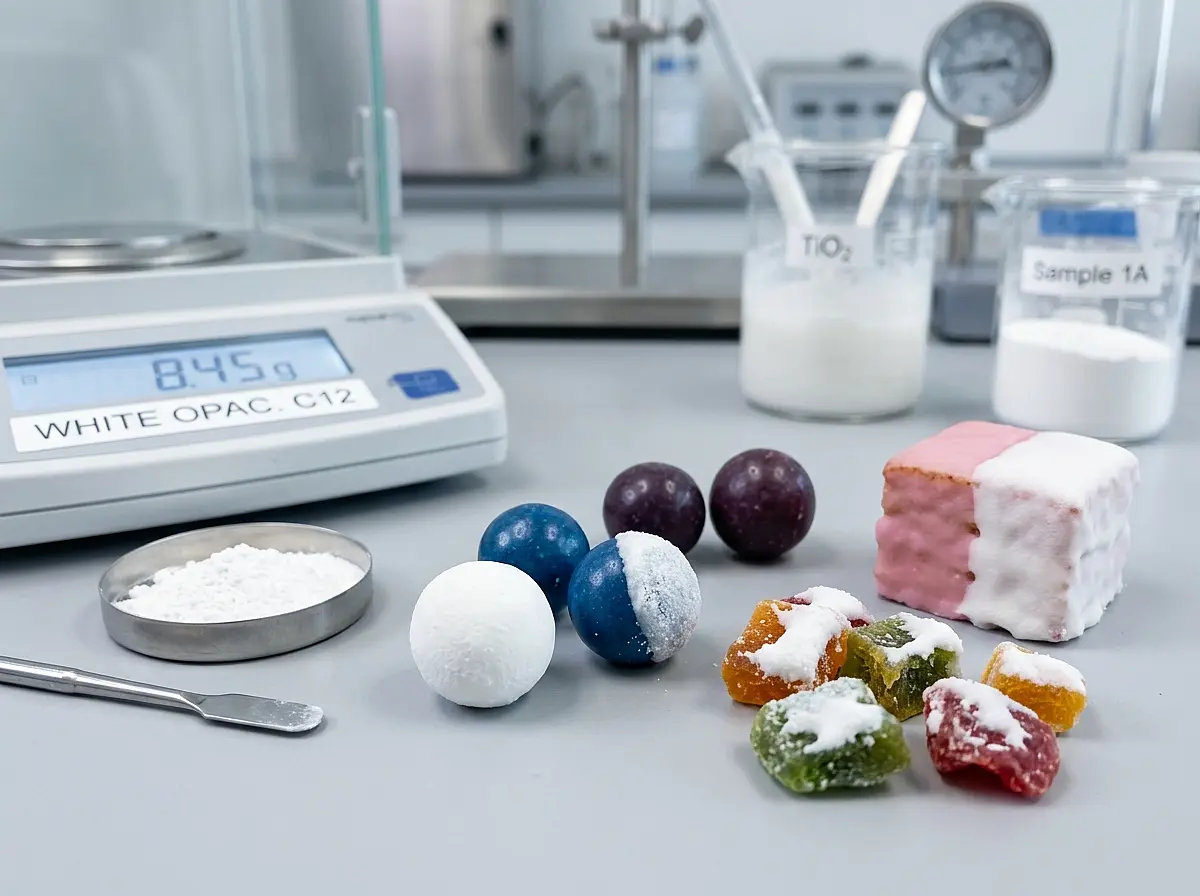
Titanium dioxide in food has historically been used as a whitening and opacifying additive in products such as candy, chewing gum, icings, fillings, and some sauces.[4][20] It contributed appearance only; it had no nutritional purpose.
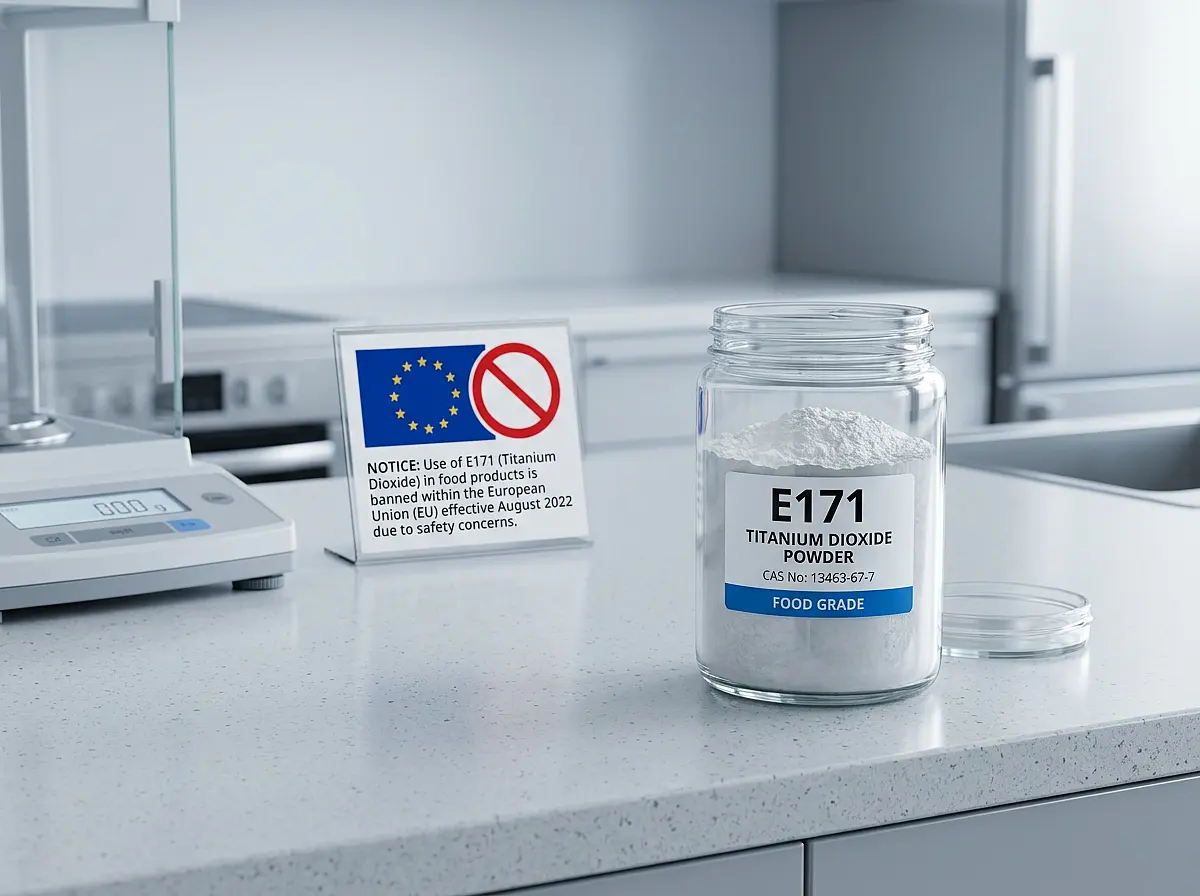
Today, the key fact is regulatory geography. In the United States, FDA rules still allow titanium dioxide as a color additive in food up to 1% by weight.[6] In the European Union, the authorization for E171 was withdrawn after EFSA’s 2021 safety reassessment, and the ban took effect in 2022.[4][8] More detail is available under titanium dioxide in food.
What E171 Means
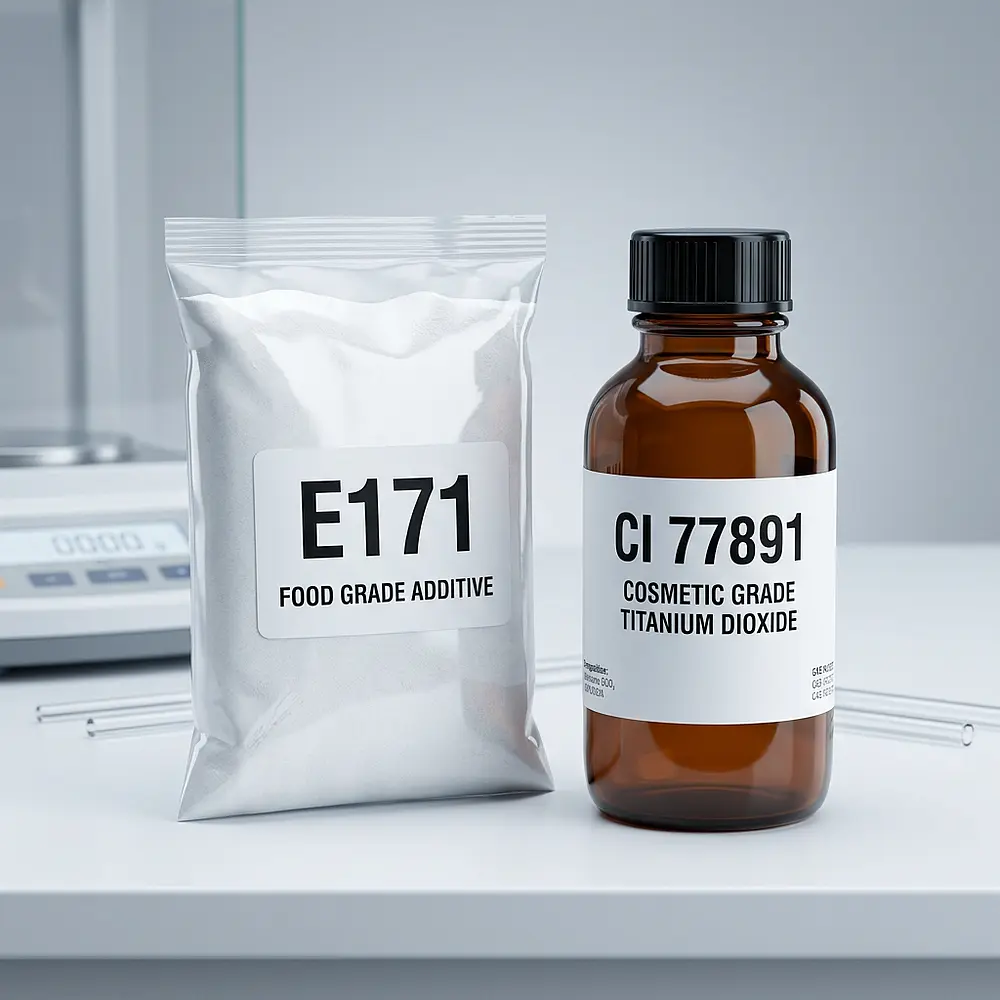
E171 is the former European additive number for titanium dioxide in food.[4] It identifies a food-use regulatory category, not a different chemical formula.
That distinction is essential for readers comparing ingredient labels. E171 belongs to food law; CI 77891 belongs to cosmetic labeling; TiO₂ is the chemical shorthand. The underlying substance is titanium dioxide, but the legal meaning changes with product type and route of exposure.[4][9][10]
What Foods Have Contained It?
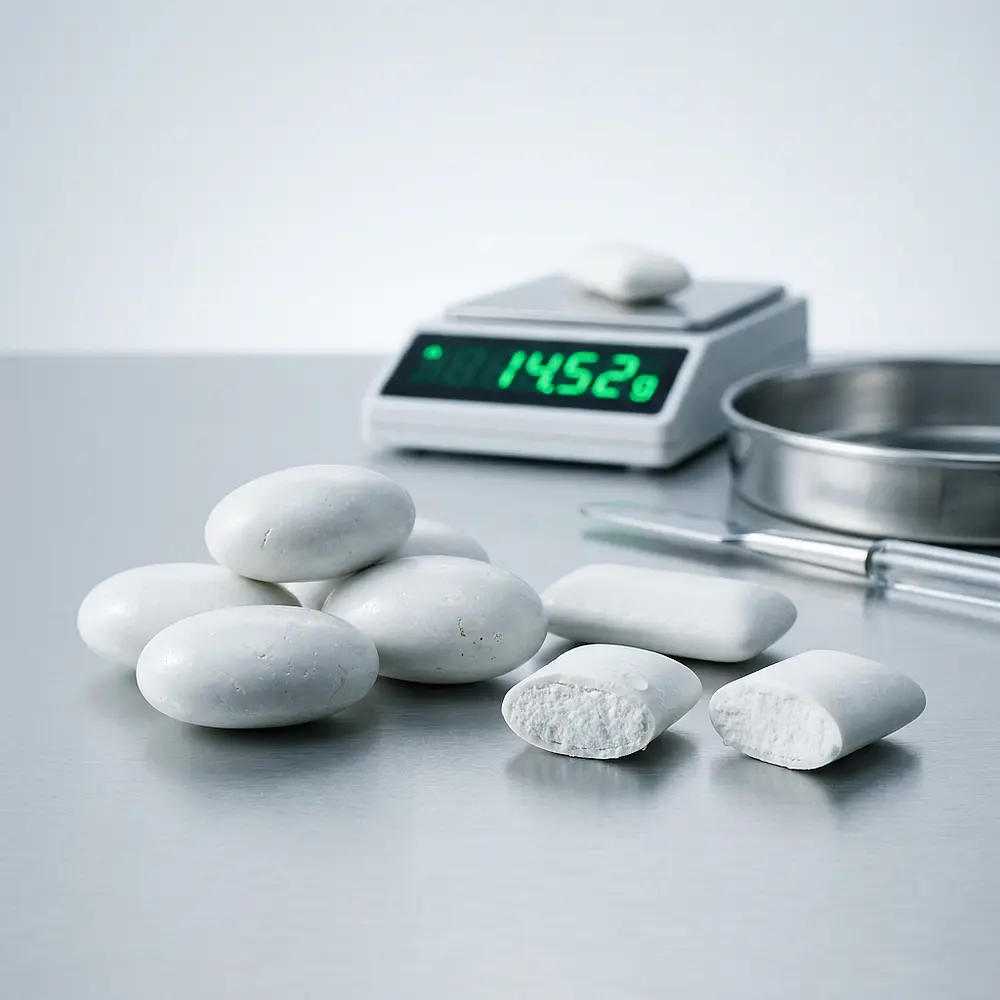
Historically, titanium dioxide appeared most visibly in confectionery and chewing gum, where bright white coatings and fillings were commercially attractive.[20] It has also been used in bakery decorations, frostings, and some sauces or processed foods that benefit from a cleaner white appearance.
Because reformulation now varies by market, the same brand may have used titanium dioxide in one jurisdiction and removed it in another. Product labels and local regulations therefore matter more than general assumptions.
Current FDA Position
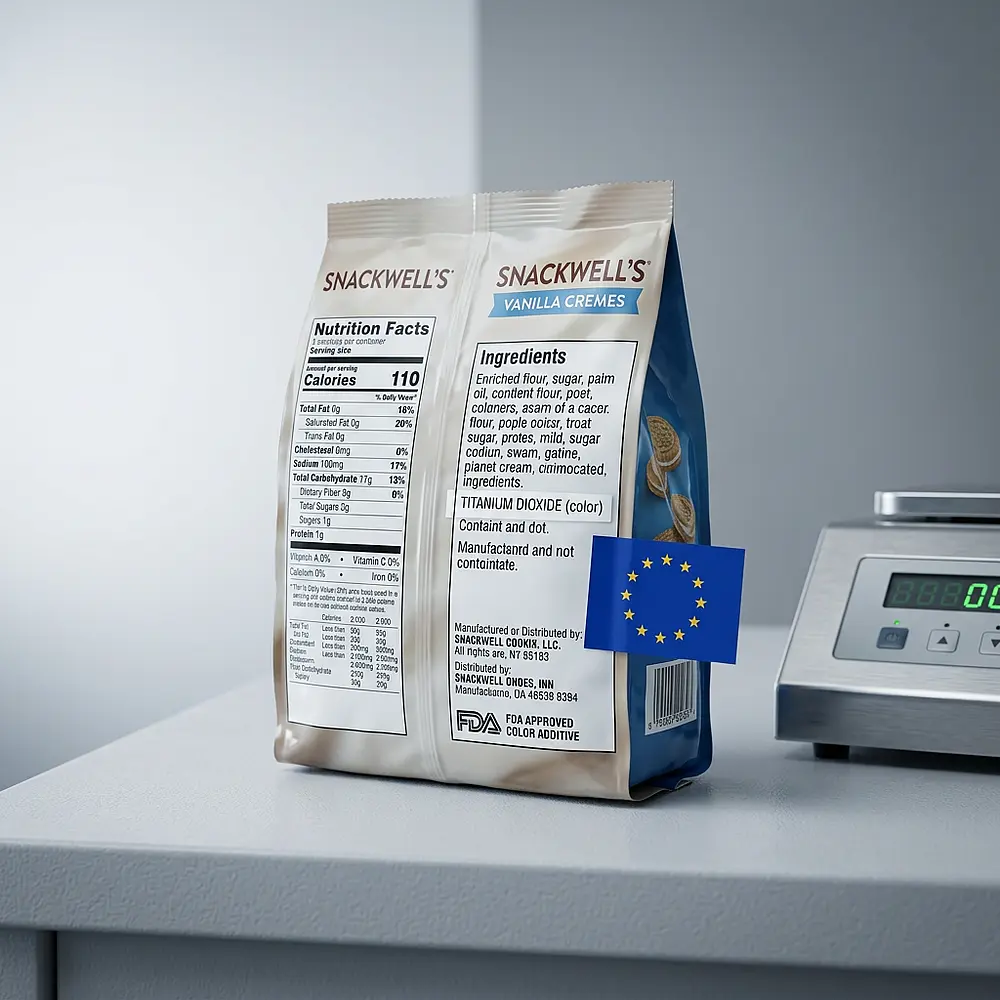
The US FDA continues to permit titanium dioxide as a food color additive under 21 CFR 73.575, provided it does not exceed 1% by weight of the food.[6] FDA also recognizes titanium dioxide for use in cosmetics and as a sunscreen active ingredient within applicable federal frameworks.[9][12]
As a result, a product sold in the United States may legally contain titanium dioxide in food even though the same use would not be allowed in the European Union.
Why the EU Banned E171
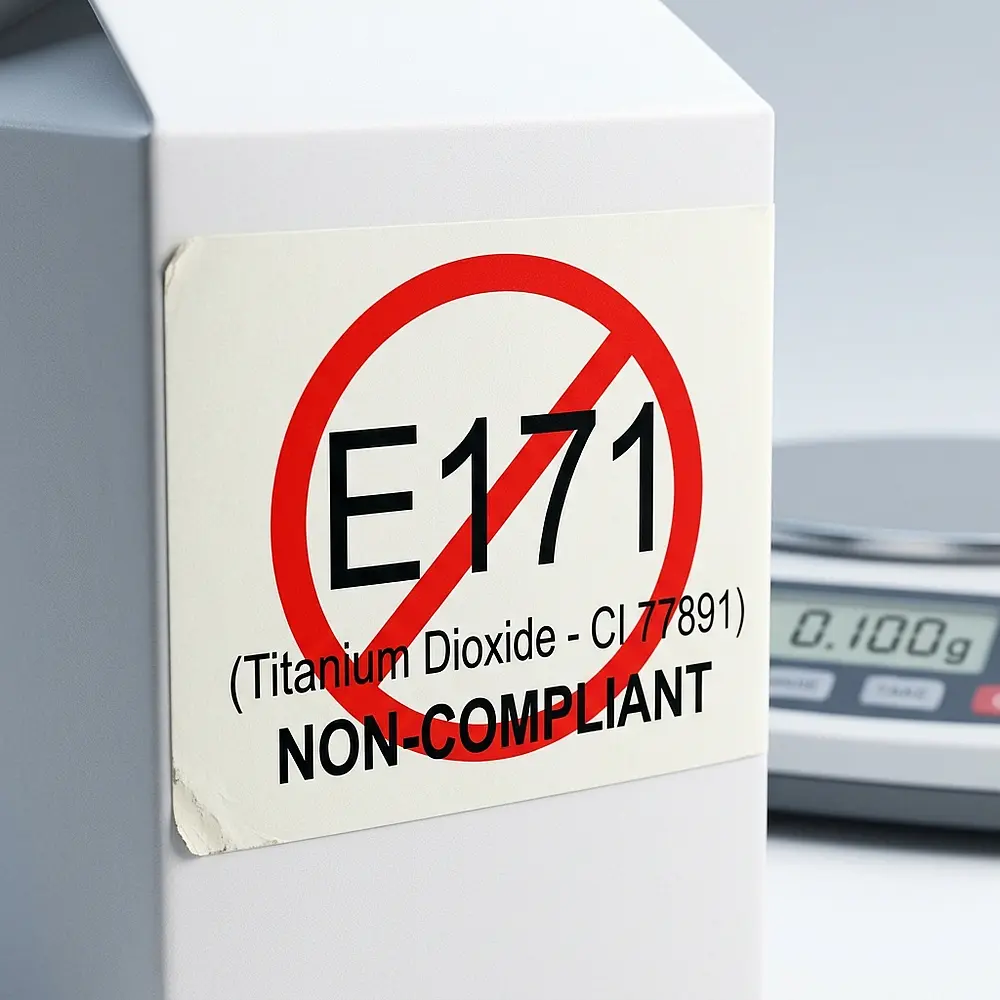
The EU ban followed EFSA’s 2021 scientific opinion that titanium dioxide could no longer be considered safe as a food additive because a concern for genotoxicity could not be excluded.[4] The European Commission then removed E171 from the Union list of authorized food additives, with the measure applying from 2022.[8]
The scope of that decision was specific to food. It did not create a blanket European ban on titanium dioxide across cosmetics, medicines, paints, or industrial applications.
Titanium Dioxide in Sunscreen
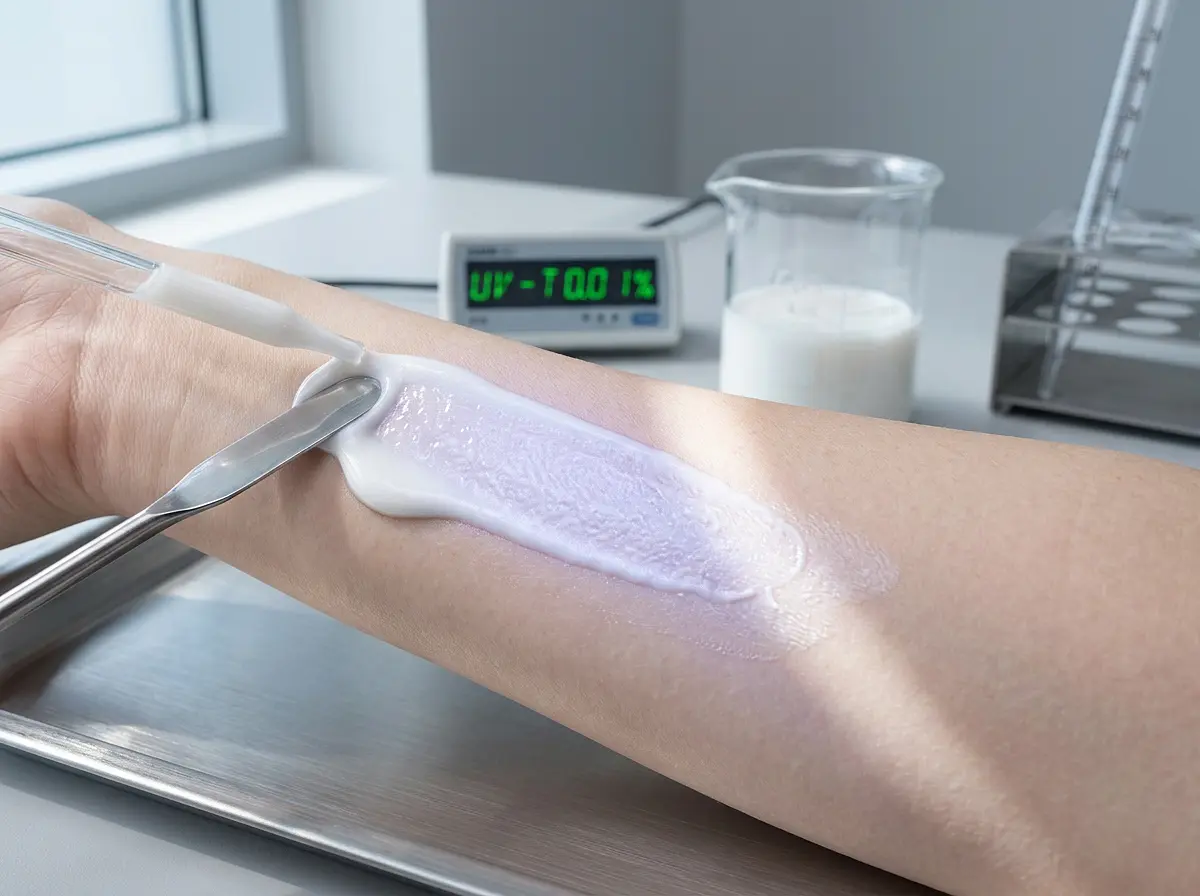
Titanium dioxide in sunscreen functions as a mineral UV filter that protects mainly through a combination of UV absorption and scattering, with the strongest performance in the UVB and short-UVA range.[10][12][17] That is why TiO₂ is often paired with other filters, especially when formulators want stronger long-wave UVA coverage. A dedicated guide is available under titanium dioxide in sunscreen.
Modern sunscreen grades are typically surface treated to improve dispersion and reduce photocatalytic activity within the formula.[10][19] The ingredient used in commercial sunscreens is therefore not well represented by raw industrial powder.
Titanium dioxide is often compared with zinc oxide because both are mineral filters, but they do not provide identical spectral coverage. For that comparison, see zinc oxide vs titanium dioxide. In color cosmetics the same pigment is used for opacity rather than UV protection, which is covered under titanium dioxide in makeup.
Why Mineral Sunscreens Use It
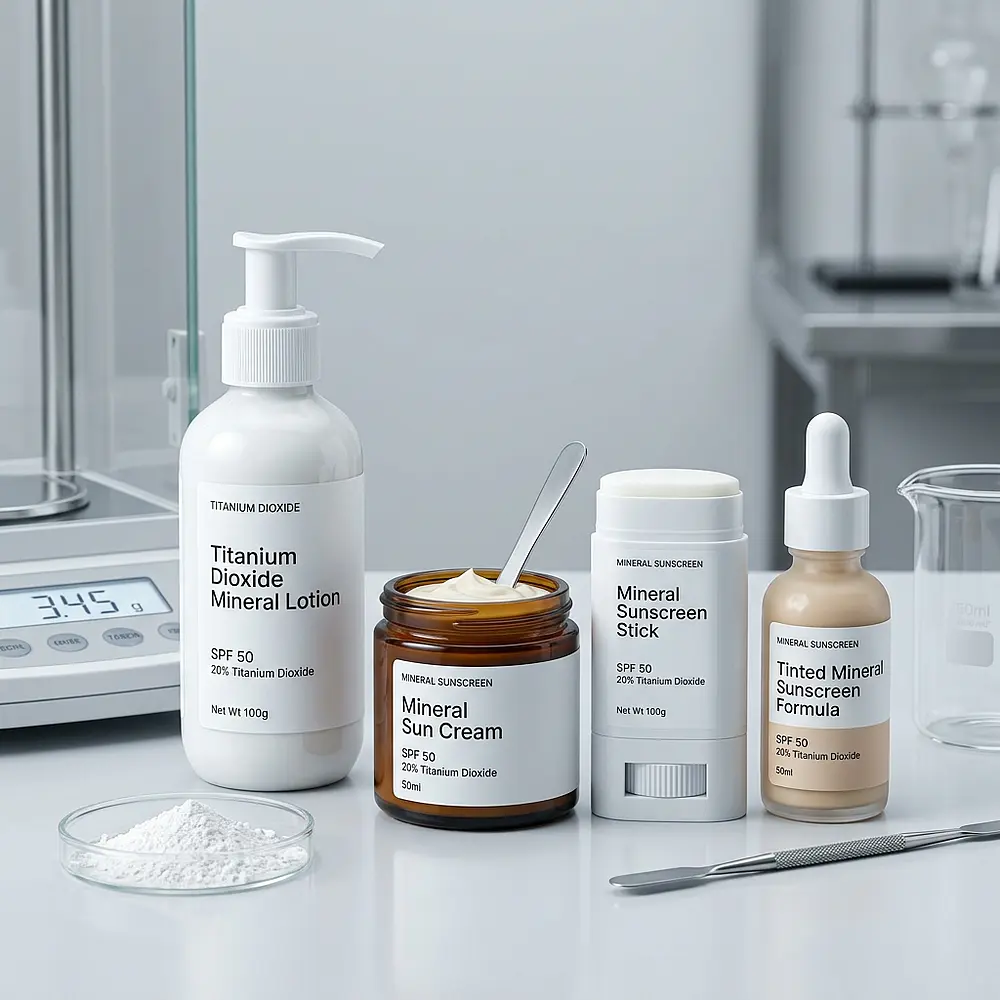
Mineral sunscreens use titanium dioxide because it combines UV protection with established regulatory history and broad formulation utility.[10][12] It can be incorporated into creams, lotions, sticks, tinted products, and hybrid makeup-SPF formulas, where it contributes both sun protection and optical coverage.
Its continued relevance also reflects consumer demand. Many people actively seek mineral sunscreens, and TiO₂ remains one of the two key ingredients that make that category possible at scale.
Titanium Dioxide vs. Zinc Oxide

Titanium dioxide and zinc oxide are the two best-known mineral sunscreen actives, but they emphasize different parts of the UV spectrum.[10] Titanium dioxide is particularly strong in UVB and shorter-wave UVA, while zinc oxide generally extends further into long-wave UVA coverage.
That is why many broad-spectrum mineral sunscreens use both filters together. Beyond spectral coverage, formulators also weigh whiteness, transparency, texture, dispersion, and regulatory considerations when choosing between them. A side-by-side comparison of the two mineral filters is available under zinc oxide vs titanium dioxide.
How It Protects Against UV
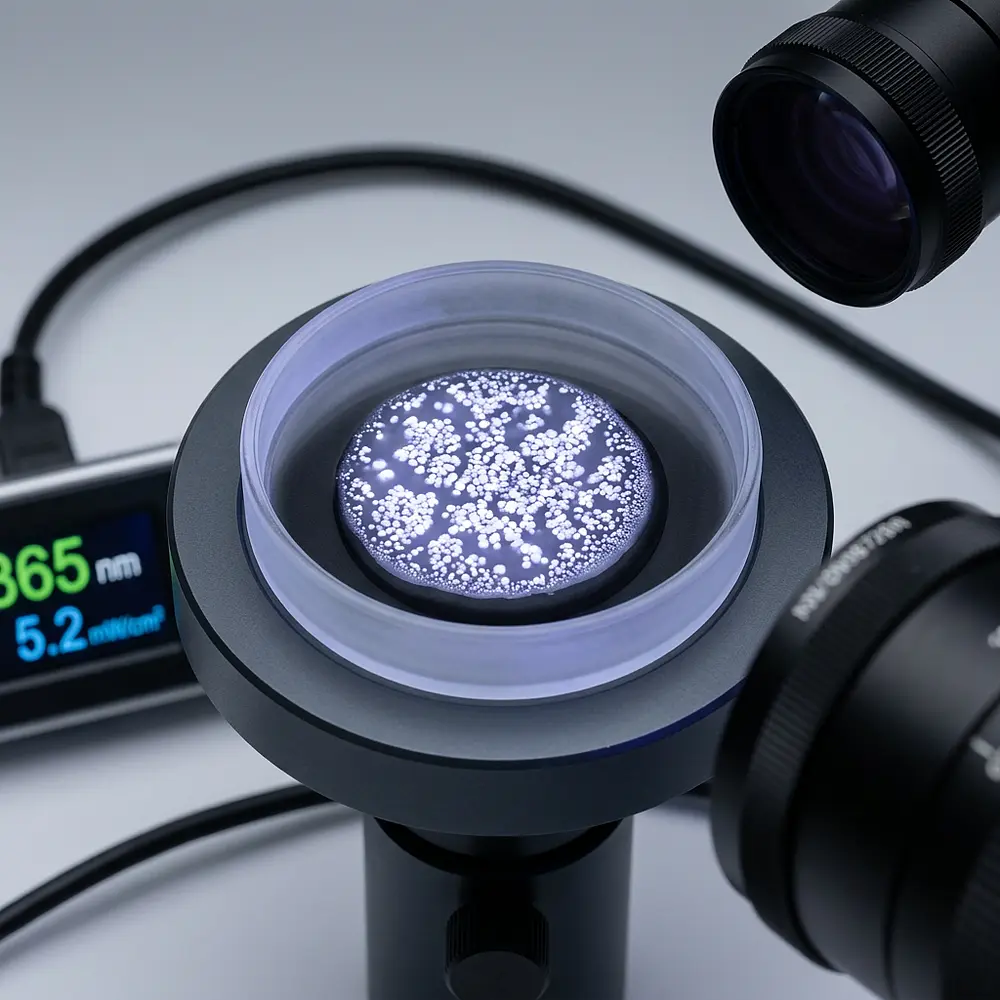
The old idea that mineral sunscreens work mainly by reflecting sunlight like tiny mirrors is incomplete. In modern formulations, titanium dioxide protects chiefly by absorbing ultraviolet photons and scattering part of the incoming radiation.[10][12][17]
Because TiO₂ is a semiconductor, it can absorb UV light whose energy matches its band-gap-related thresholds. At the same time, its high refractive index contributes to scattering. The final protection profile depends on particle size, coating, aggregation state, and how well the sunscreen film forms on skin.
Regulation & Safety Status
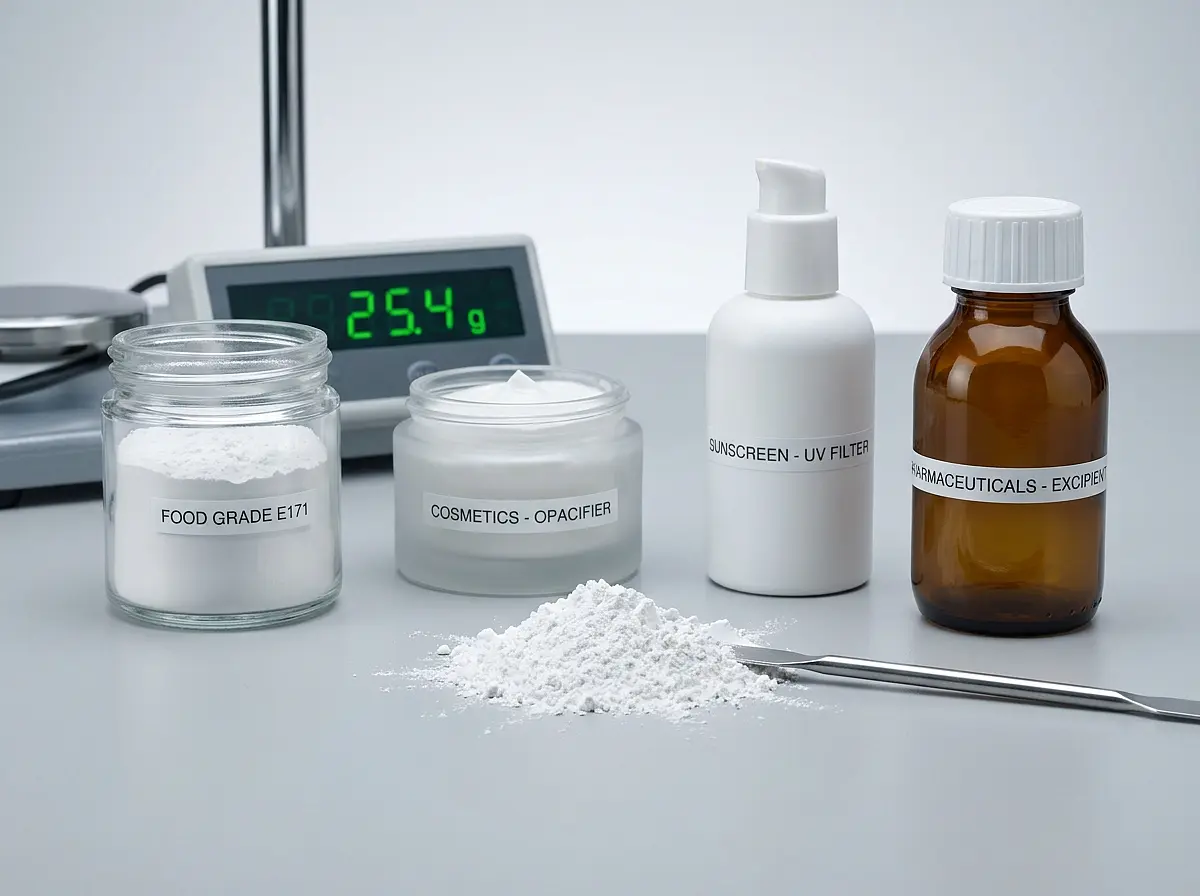
Titanium dioxide regulation is divided by use case because food, cosmetics, sunscreens, pharmaceuticals, and inhalable particles do not raise the same scientific questions.[4][6][7][10] How the different regulators weigh the same underlying data is set out under titanium dioxide and cancer.
FDA. In food, FDA permits titanium dioxide as a color additive at not more than 1% by weight of the food under 21 CFR 73.575.[6] FDA also lists titanium dioxide as a color additive in cosmetics and as an OTC sunscreen active ingredient.[9][12]
EFSA and the EU. EFSA’s 2021 opinion concluded that a concern for genotoxicity could not be excluded for E171, and the European Commission subsequently removed titanium dioxide from the EU list of authorized food additives effective 2022.[4][8] Cosmetic use remains governed separately.[10]
IARC. IARC classifies titanium dioxide as Group 2B, possibly carcinogenic to humans, based on inhalation evidence rather than all possible exposure routes.[7]
California Proposition 65. California’s listing applies to airborne, unbound particles of respirable size, not to every product that contains titanium dioxide in any form.[14]
EFSA and the European Union
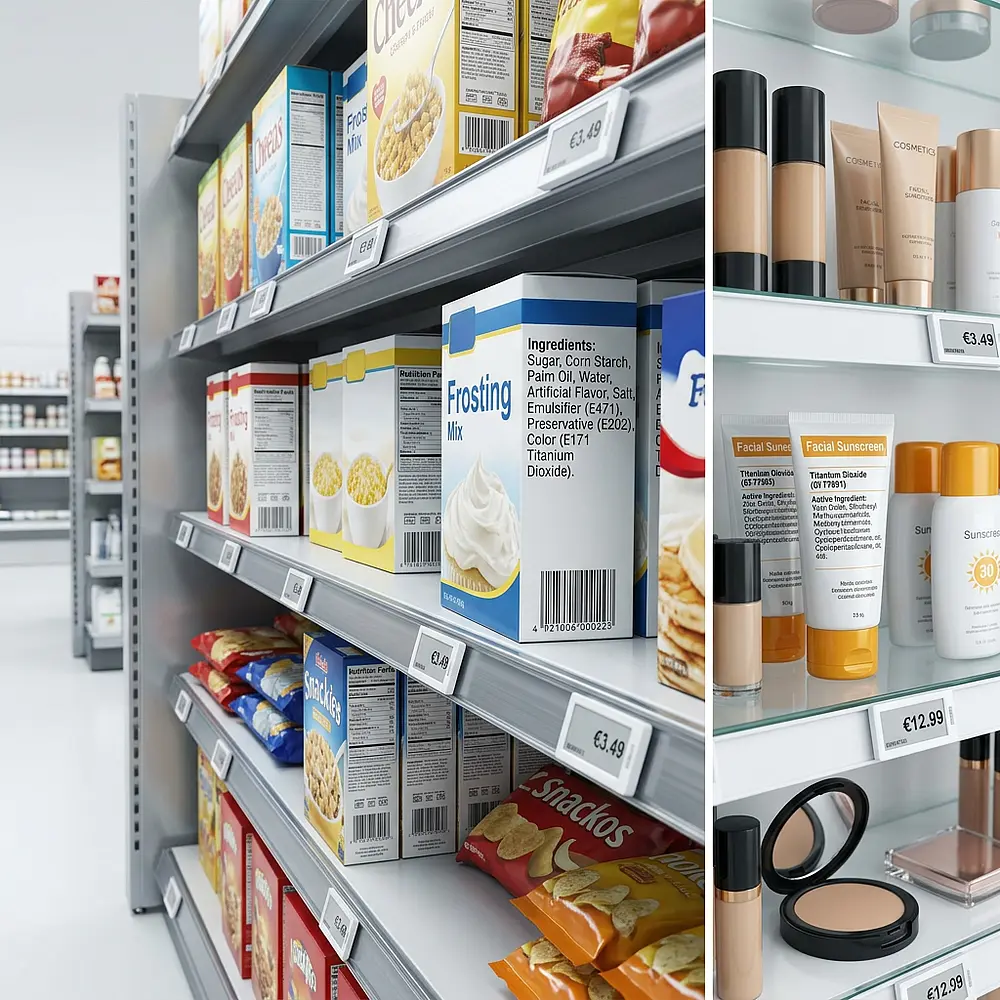
In the EU, the major recent change concerns food rather than titanium dioxide as a whole. EFSA’s reassessment of E171 found that a genotoxicity concern could not be excluded, and the European Commission followed by removing the additive from the authorized Union list for food use.[4][8]
That outcome does not mean titanium dioxide disappeared from all European products. Cosmetic use continues under separate legislation and SCCS safety opinions.[10]
FDA in the United States
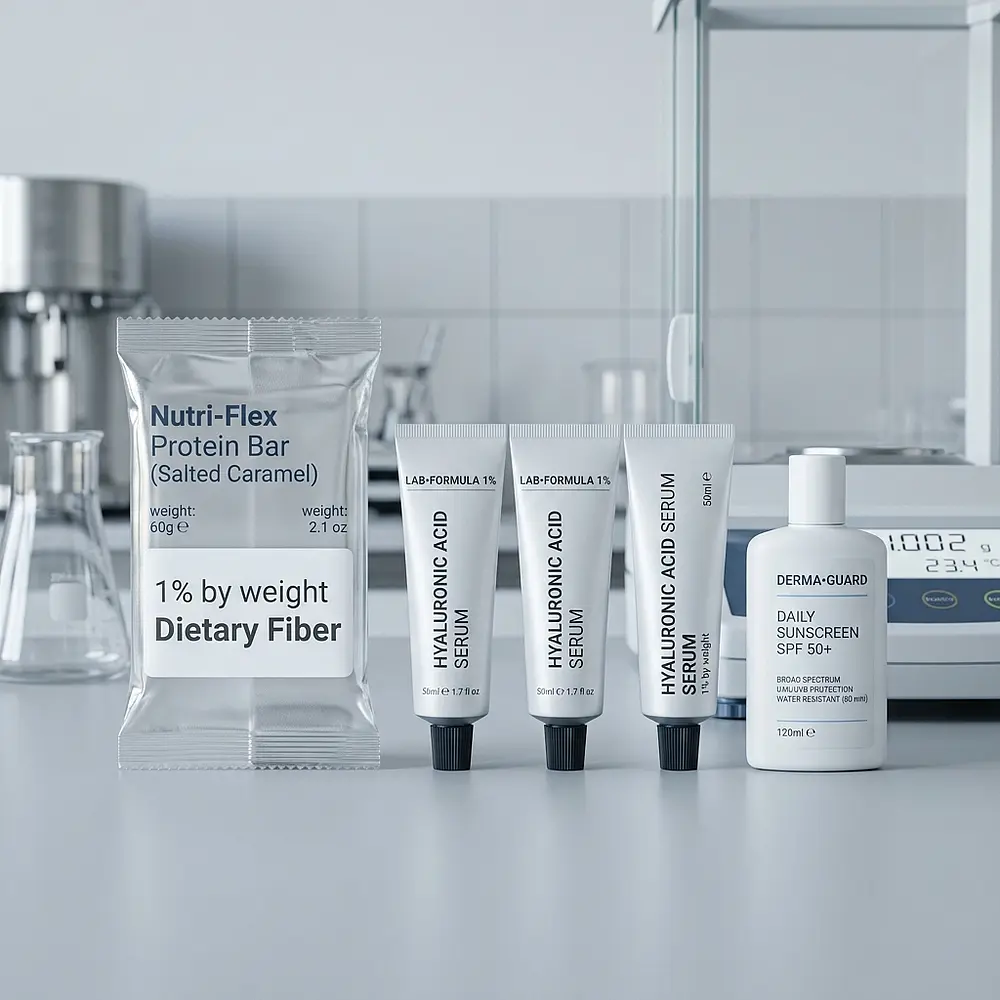
FDA regulation of titanium dioxide is product-specific. The clearest numerical rule is the food limit: not more than 1% by weight of the food under 21 CFR 73.575.[6] In cosmetics, titanium dioxide is used as a color additive, and in sunscreens it is recognized as an active ingredient within the OTC framework.[9][12]
California Proposition 65
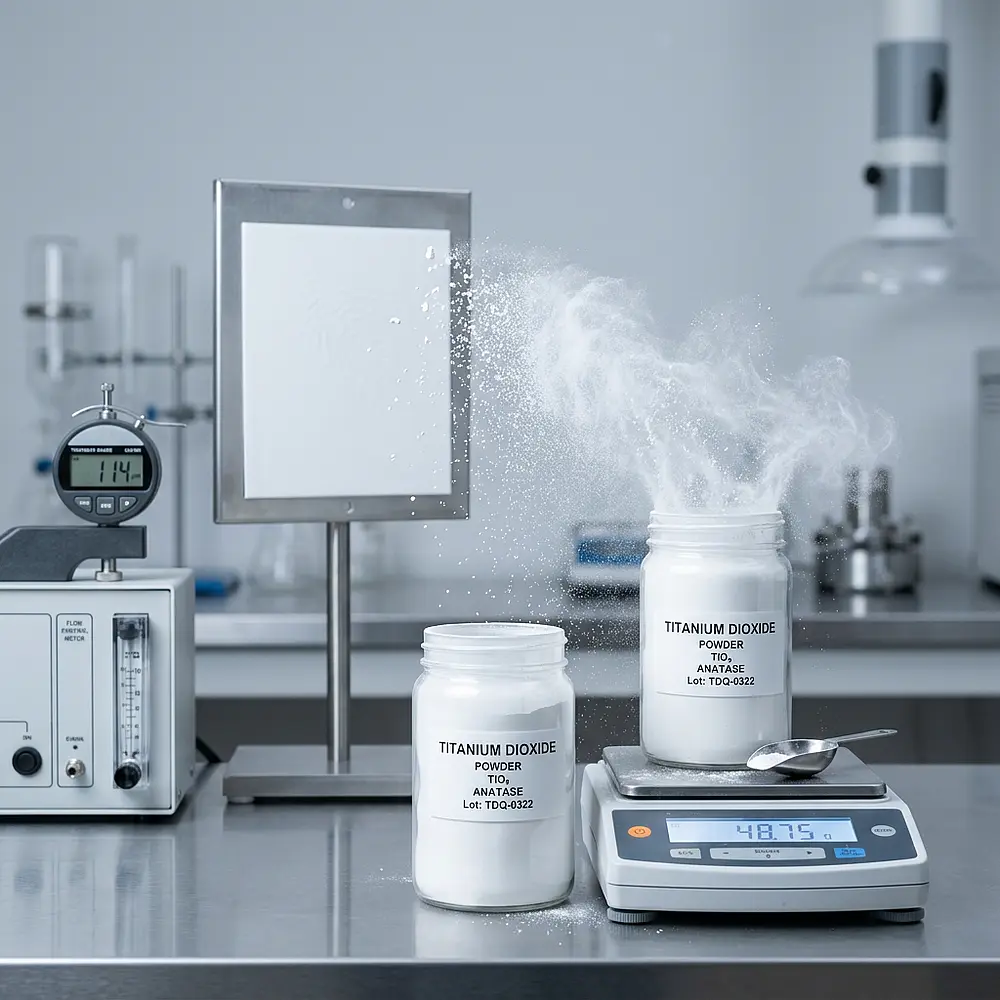
California Proposition 65 lists titanium dioxide specifically as airborne, unbound particles of respirable size.[14] This wording is crucial because it limits the warning context to inhalable particulate exposure, not to all finished goods containing titanium dioxide in a bound form.
As a result, a dust-generating powder and a cured coating are not treated as equivalent cases under the logic of the listing.
IARC Group 2B
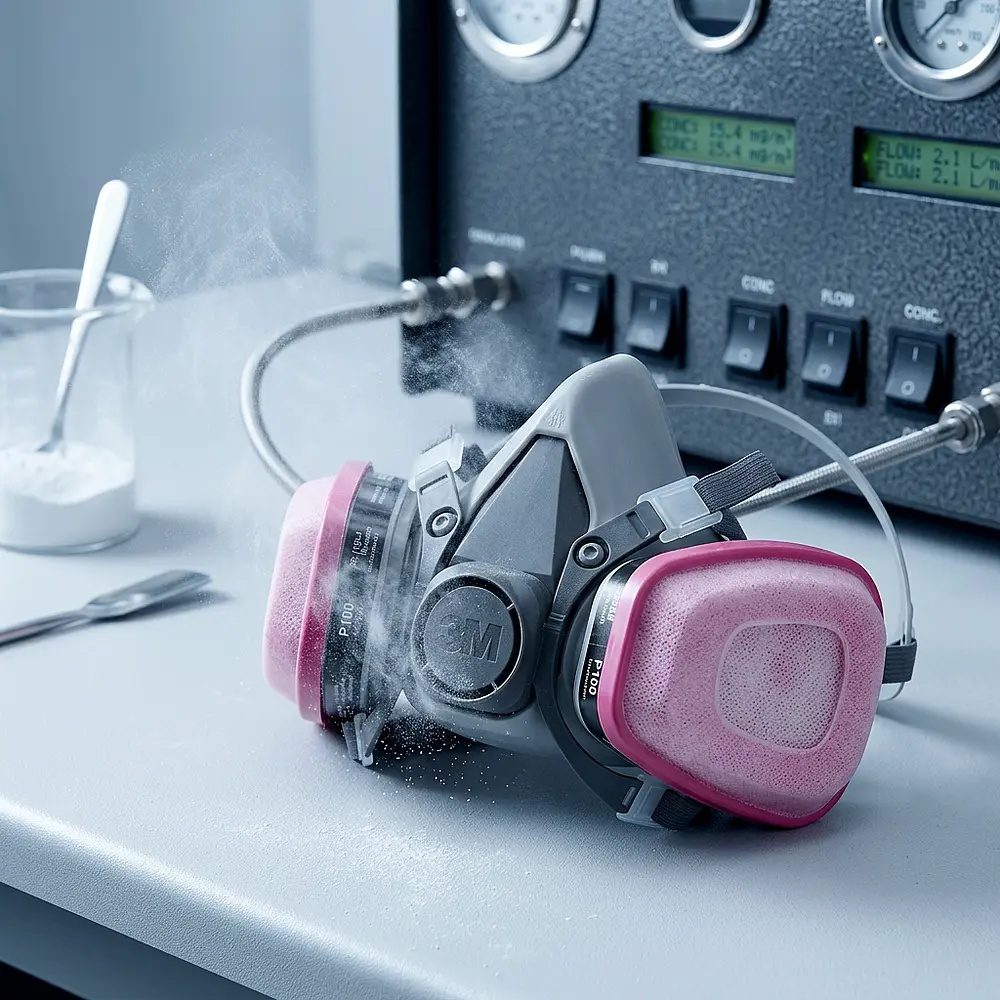
IARC Group 2B means “possibly carcinogenic to humans.” For titanium dioxide, this classification is tied to inhalation exposure to particles, particularly evidence from studies involving airborne material.[7]
It is a hazard classification, not a universal statement about the real-world risk of every lotion, tablet, or paint containing TiO₂. The relevant exposure scenario is inhaled particulate matter.
Frequently Asked Questions
Implement FAQPage schema with exactly the six questions below.
Is titanium dioxide safe to eat?
In the US, FDA still permits titanium dioxide in food at up to 1% by weight, but EFSA concluded in 2021 that a genotoxicity concern for E171 could not be excluded, which led to the EU ban.[4][6][8]
Why was titanium dioxide banned in Europe?
It was banned in EU food because EFSA said titanium dioxide could no longer be considered safe as a food additive after concluding that a genotoxicity concern could not be excluded.[4][8]
Is titanium dioxide a carcinogen?
Titanium dioxide is classified by IARC as Group 2B, possibly carcinogenic to humans, in relation to inhalation exposure to particles, not as a blanket judgment covering every use route.[7]
What products contain titanium dioxide?
Titanium dioxide is used in paint, coatings, plastics, paper, sunscreen, cosmetics, pharmaceutical tablet and capsule coatings, and—where legally permitted—some foods.[2][4][9][13]
Is titanium dioxide safe in sunscreen?
Current cosmetic safety reviews support titanium dioxide in conventional sunscreen products on intact skin, with negligible dermal penetration reported for evaluated forms; inhalable product formats require separate consideration.[10][12][22]
What is CI 77891?
CI 77891 is the Color Index name for titanium dioxide in cosmetics and personal care products.[9][10]
Is titanium dioxide a carcinogen?
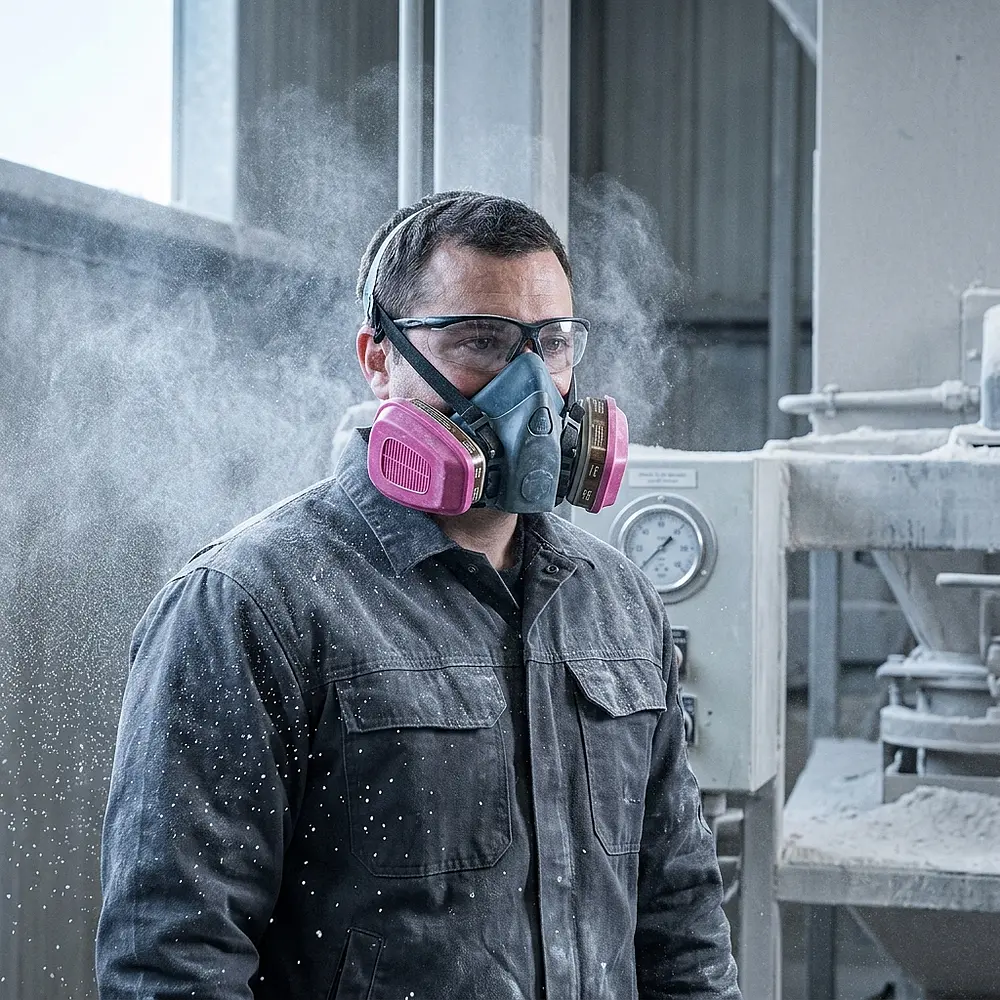
Under IARC, titanium dioxide is classified as possibly carcinogenic to humans (Group 2B).[7] In this case, that classification is specifically linked to inhalation of particulate material rather than to all consumer uses or all exposure routes.
Why was titanium dioxide banned in Europe?

The European ban applies to food, not to every use of titanium dioxide. EFSA’s 2021 opinion concluded that titanium dioxide could no longer be considered safe as a food additive because concerns about genotoxicity could not be ruled out, and the European Commission then removed E171 from the authorized list effective 2022.[4][8]
Is titanium dioxide safe to eat?
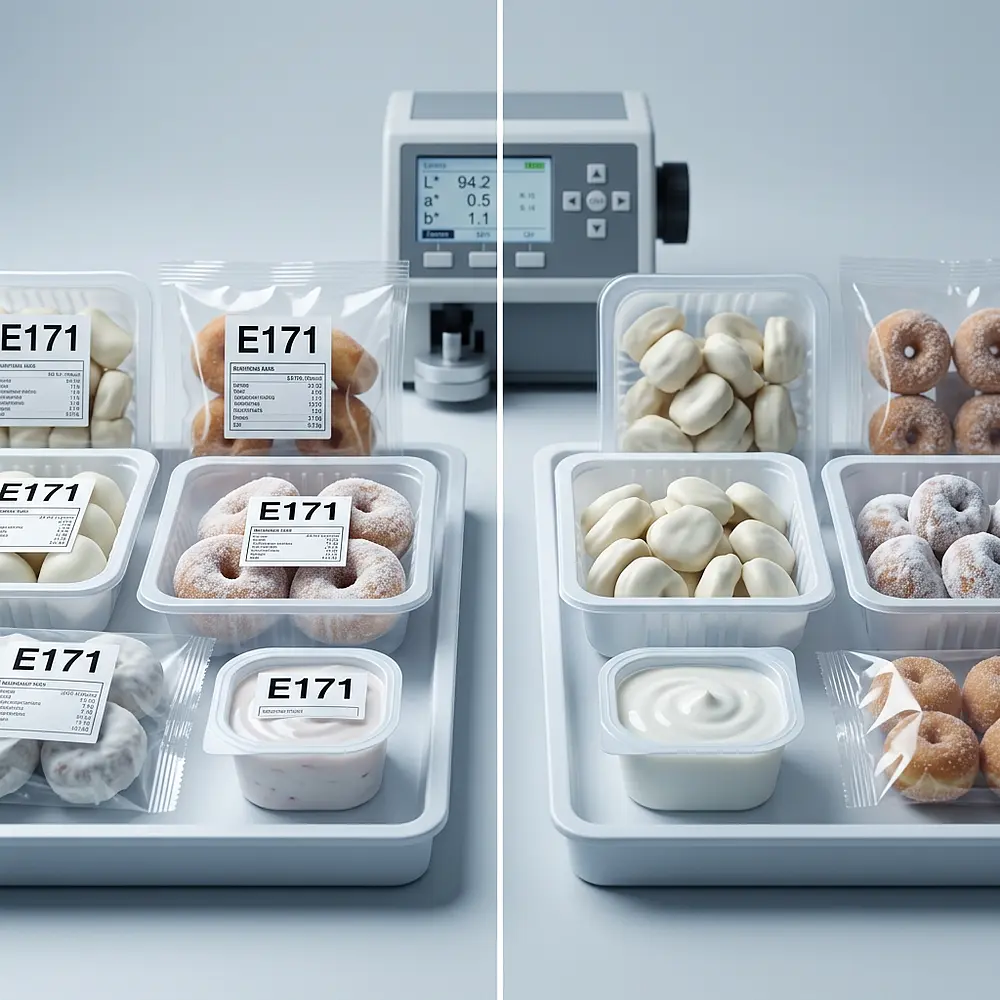
Titanium dioxide in food remains one of the few major use cases where top regulators have reached different legal conclusions. FDA continues to allow it within a defined concentration limit, while the EU withdrew authorization for E171 after EFSA determined that a genotoxicity concern could not be excluded.[4][6][8]
So the most accurate short answer is not a universal yes or no. It is that oral safety remains scientifically contested and regulatorily split.
What is CI 77891?
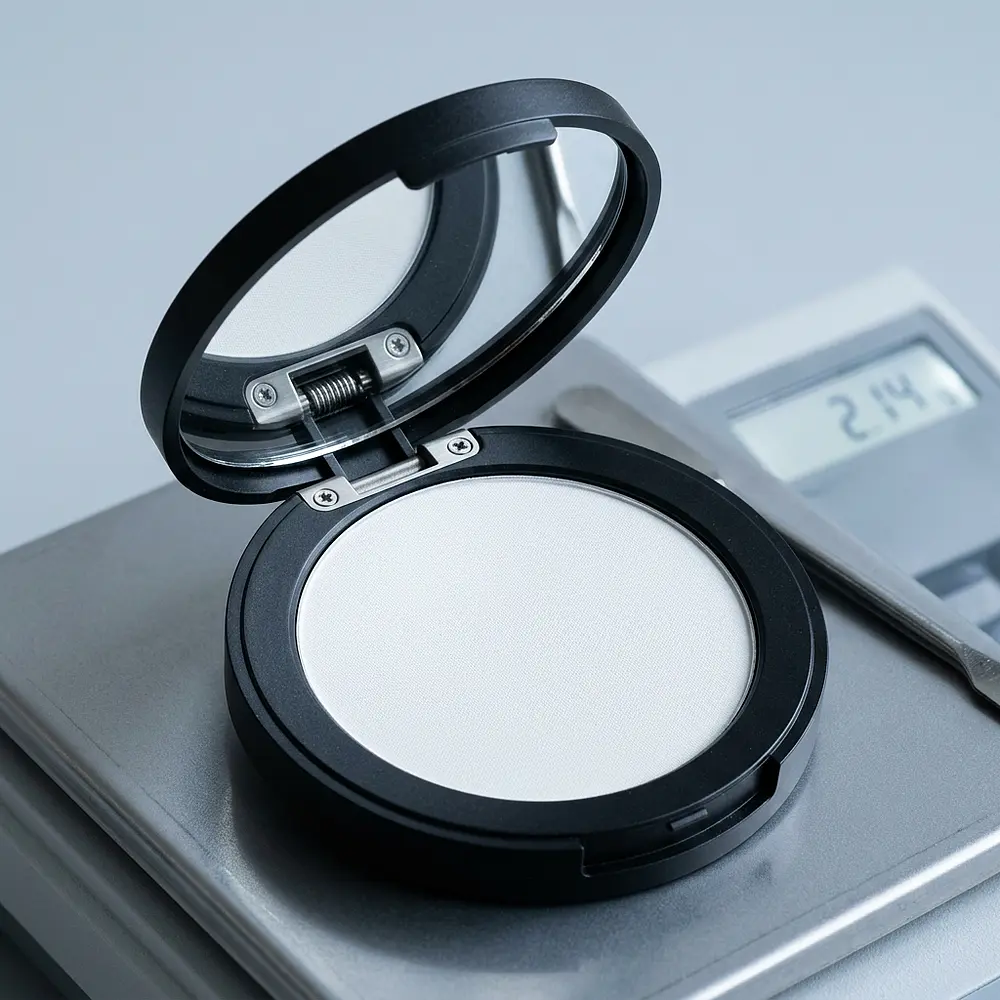
CI 77891 is the Color Index designation for titanium dioxide in cosmetics and personal care products.[9][10] If you see CI 77891 on a sunscreen, powder, foundation, or similar product, it means the formula contains titanium dioxide identified under the cosmetic color-naming system.
A dedicated reference page explains why CI 77891 is not the same designation as E 171 or Pigment White 6, and how to read the code on an INCI ingredient list.
Is titanium dioxide safe in sunscreen?
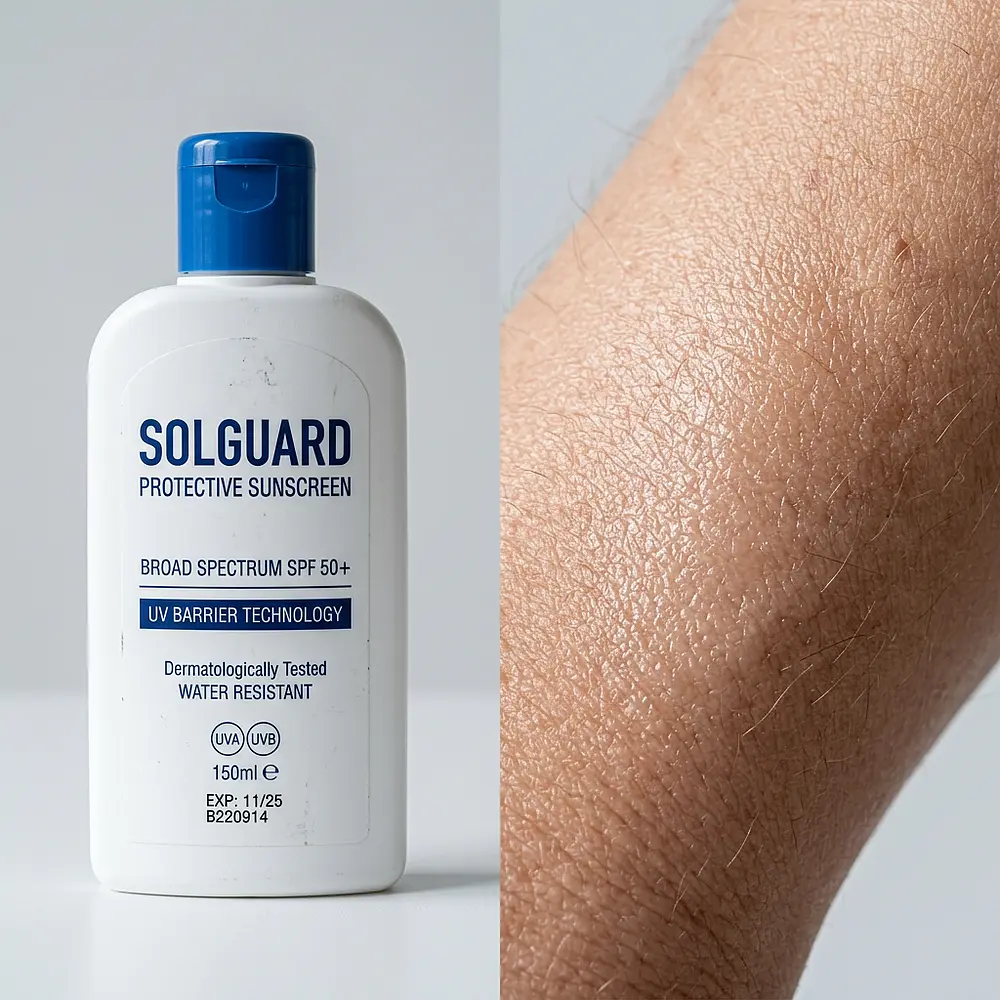
Current evidence reviewed by cosmetic regulators supports titanium dioxide in sunscreen when used in appropriate forms and product types.[10][12] For evaluated grades, studies reviewed by the SCCS indicate negligible penetration through intact skin, which is why standard creams and lotions are treated differently from inhalable powders or sprays.[10][22]
What products contain titanium dioxide?
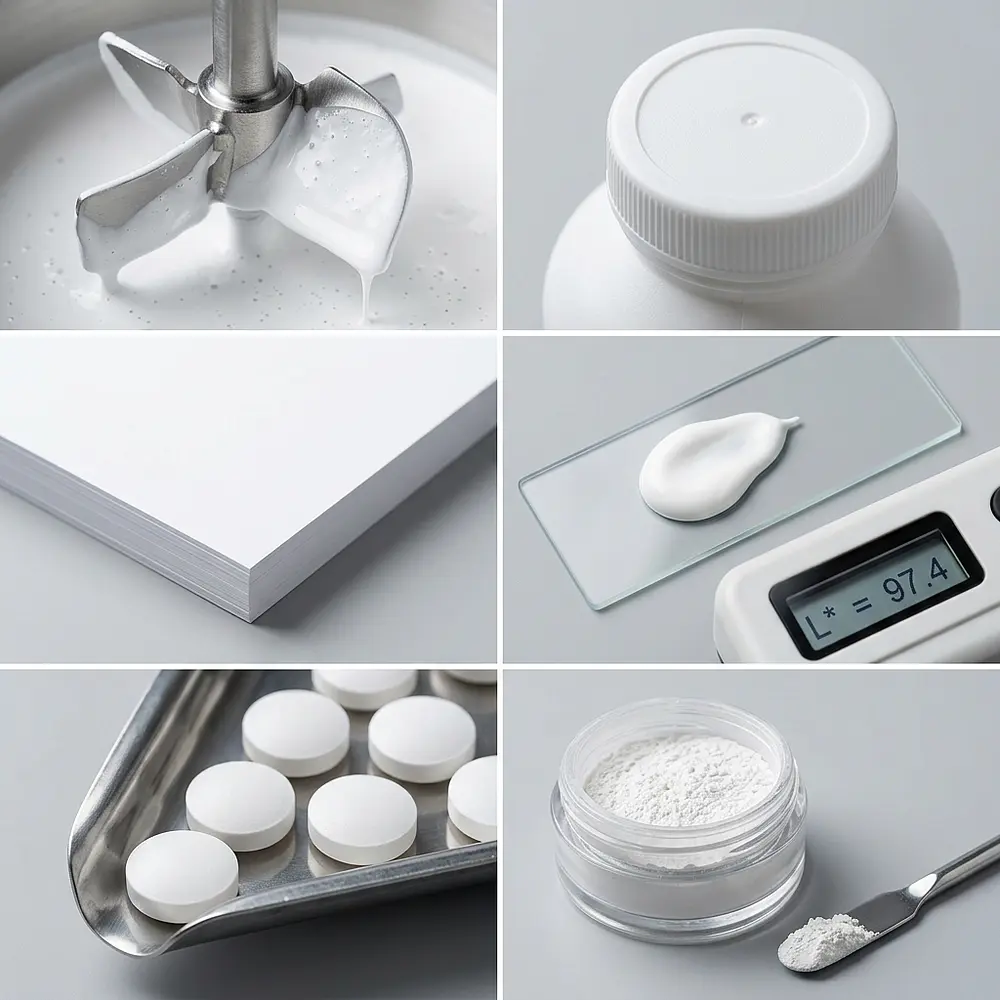
Titanium dioxide appears in paints, architectural and industrial coatings, plastics, paper, sunscreens, makeup, and pharmaceutical coatings.[2][9][13] In markets where allowed, it may also appear in food products as a whitening additive.[4][6]
Where Titanium Dioxide Research Is Headed Next
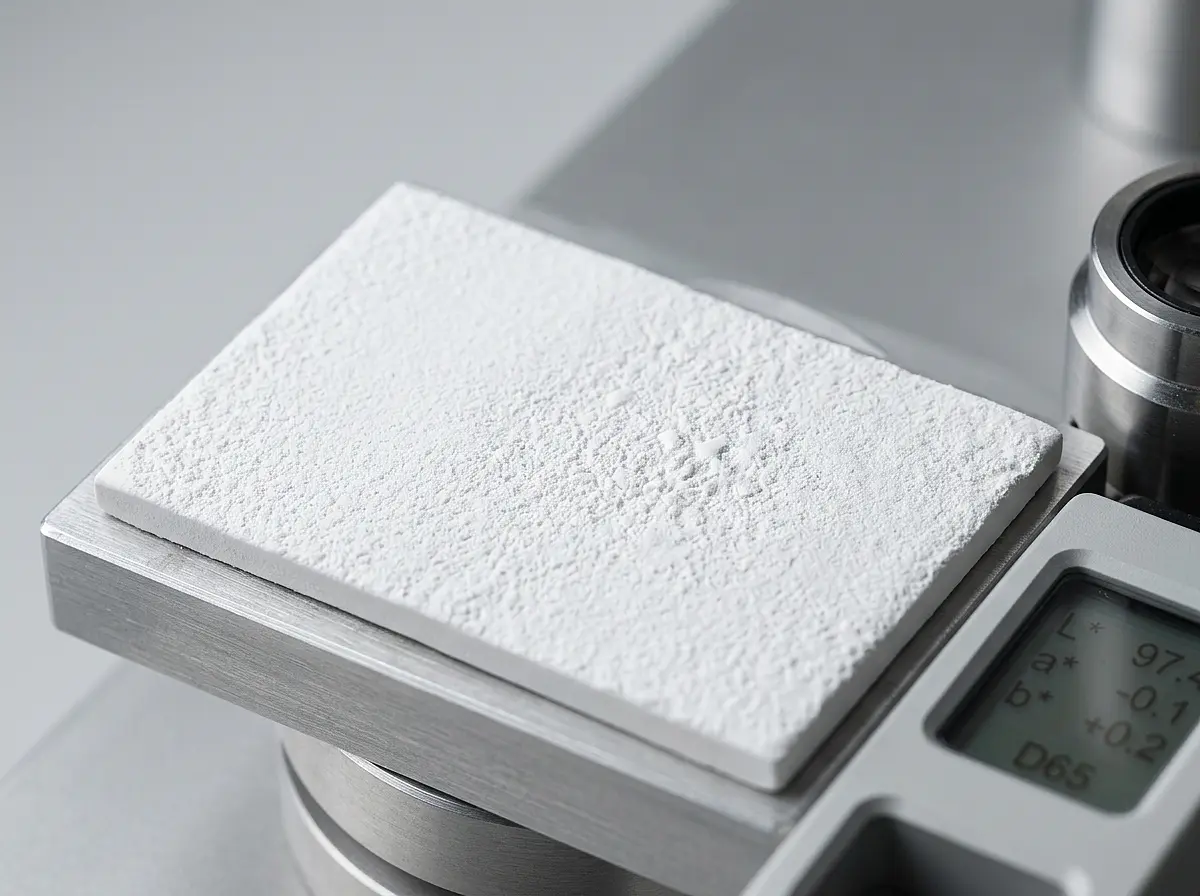
Titanium dioxide is already indispensable as a pigment, but research increasingly focuses on what it can do beyond making materials white. One major frontier is photocatalysis, where scientists are trying to improve TiO₂ performance under visible light rather than only UV illumination.[17][18] Another is surface engineering: better coatings and interfaces can preserve opacity or UV protection while further suppressing unwanted reactivity in consumer products.[10][19]
A third area is the use of titanium oxide in functional surfaces, including self-cleaning materials, antimicrobial coatings, sensors, and energy-related devices.[17][18] That broader picture is what makes titanium dioxide so compelling. It is not only the material behind white paint and mineral sunscreen; it is also a platform material at the intersection of optics, surface chemistry, and applied materials science.
To explore the subject in more detail, continue to titanium dioxide uses, pigment grades and production, the safety overview, the cancer classification question, titanium dioxide in food, sunscreen, makeup, zinc oxide vs titanium dioxide, rutile vs anatase, and the TiO₂ data overview.
References
[1] PubChem. Titanium dioxide (CID 26042), NCBI.
[2] USGS and industrial materials literature on titanium dioxide properties, production, and end uses.
[3] Reviews of TiO₂ pigment manufacturing and commercial applications in the scientific literature.
[4] EFSA Journal (2021). Safety assessment of titanium dioxide (E171) as a food additive.
[5] Literature on refractive index, light scattering, and pigment performance of titanium dioxide.
[6] FDA, 21 CFR 73.575: Titanium dioxide as a color additive exempt from certification.
[7] IARC Monographs. Carbon Black, Titanium Dioxide, and Talc.
[8] European Commission regulation removing E171 from the Union list of food additives, applicable from 2022.
[9] FDA and cosmetic ingredient references for Titanium Dioxide / CI 77891.
[10] SCCS scientific opinions on titanium dioxide in cosmetic products, including nano forms and dermal exposure.
[11] Literature on food and pharmaceutical uses of titanium dioxide.
[12] FDA sunscreen monograph and related OTC sunscreen regulatory materials covering titanium dioxide.
[13] Pharmaceutical excipient literature on titanium dioxide in tablets and capsules.
[14] California Proposition 65 listing for airborne, unbound particles of respirable size of titanium dioxide.
[15] Historical sources on the discovery of titanium by William Gregor and Martin Heinrich Klaproth.
[16] USGS mineral commodity and feedstock references for ilmenite and rutile.
[17] Reviews on TiO₂ photocatalysis and semiconductor behavior in NCBI/PMC literature.
[18] Phase-dependent photocatalysis literature on anatase and rutile.
[19] Studies and reviews on coated titanium dioxide grades and suppression of photocatalytic activity.
[20] Literature on historical use of E171 in confectionery and other foods.
[21] Reviews on oral exposure and particle toxicology for ingested titanium dioxide.
[22] Skin penetration studies reviewed by SCCS for topical titanium dioxide.
FAQ
What is CI 77891?
CI 77891 is the Colour Index designation for titanium dioxide (Titanium Dioxide, TiO₂). In cosmetics, this code stands for a white pigment that gives products color, opacity, and a bright appearance. It is used, for example, in make-up, powder, toothpaste, and sunscreen. There it can serve not only as a colorant but also as a mineral UV filter. On INCI lists it usually appears as Titanium Dioxide, while CI 77891 is the colorant classification. Important: CI 77891 in cosmetics is not the same as the former food labeling E171, which is no longer permitted in the EU for food. Oral care is covered separately under TiO₂ in toothpaste.
What is E171?
E171 is the food additive designation for titanium dioxide (TiO₂), a white pigment with high opacity. Chemically, it is titanium(IV) oxide; in other contexts it is also called Titanium Dioxide, and in cosmetics CI 77891. It occurs in various crystal forms, mainly rutile, anatase, and brookite. E171 was formerly used to make foods such as candy, chewing gum, or coatings appear whiter and brighter. In the EU, E171 has no longer been approved in food since 2022, because safety questions—particularly regarding particle uptake—could not be fully clarified. In cosmetics and technical applications, titanium dioxide continues to be used.
What products contain titanium dioxide?
Titanium dioxide is found in many everyday products because it is a bright white pigment and effective UV filter. Common examples include paints, coatings, varnishes, plastics, paper, printing inks, and adhesives. In cosmetics, it appears as Titanium Dioxide or CI 77891 in sunscreen, foundation, powder, concealer, toothpaste, and some soaps. It is also used in pharmaceuticals as a coating or colorant for tablets and capsules. Historically, it was used in foods as E171, for example in candy or chewing gum, but this use is no longer permitted in the EU. Overall, it is mainly associated with whitening, opacity, and UV protection.
Is titanium dioxide a carcinogen?
Titanium dioxide is not generally classified as a human carcinogen in all uses, but the key concern is inhalation of respirable dust. The EU had classified titanium dioxide as suspected of causing cancer by inhalation in certain powdered forms, but that classification was annulled by the EU courts and definitively struck down by the Court of Justice on 1 August 2025 — it no longer applies. Internationally, IARC continues to list titanium dioxide in Group 2B (“possibly carcinogenic to humans”) on the basis of inhaled dust, and US occupational exposure limits for respirable and ultrafine dust remain in force. None of this means that solid materials, pressed products, or normal skin application pose the same risk. In cosmetics, Titanium Dioxide / CI 77891 is still allowed and widely used as a white pigment and mineral UV filter. The decisive distinction is therefore how exposure happens — breathing in dust versus external use.
Is titanium dioxide approved by the FDA?
Yes—titanium dioxide is approved by the FDA, but the approval depends on how it is used. In the U.S., it is permitted as a color additive in certain foods within specific limits and is also allowed in many drugs and cosmetics. In sunscreens, titanium dioxide is recognized as an approved mineral UV filter and is widely used for broad-spectrum protection. However, “FDA approved” does not mean unrestricted use in every form or product type. The safety assessment can differ by route of exposure, concentration, and particle form, especially for powders that could be inhaled. So the short answer is: yes, with conditions.
Why was titanium dioxide banned in Europe?
Titanium dioxide was not banned across Europe in general. The key EU ban concerns its use as the food additive E171. European authorities concluded that a genotoxicity risk could not be ruled out, meaning there was uncertainty about possible damage to DNA after ingestion, especially because very small particles may accumulate in the body. As a result, E171 was no longer considered safe for food and was banned in the EU from 2022. However, titanium dioxide is still allowed in other uses such as cosmetics (INCI: Titanium Dioxide, CI 77891) and many industrial products, where the safety assessment depends on the route of exposure, especially inhalation versus skin contact.
Is titanium dioxide safe to eat?
Titanium dioxide is not considered safe to eat in the EU when used as a food additive. It was previously known as E171, but its use in foods has been banned because concerns could not be ruled out, especially about very small particles and possible effects on genetic material after long-term ingestion. That does not mean titanium dioxide is universally unsafe in every context. It is still widely used outside food, for example as a white pigment and in some cosmetics as Titanium Dioxide / CI 77891. The main safety concerns differ by use: for food, ingestion is the issue; for powders, inhalation matters more.
Is titanium dioxide safe for humans?
Titanium dioxide is generally considered safe for humans in many approved uses, but safety depends on how it is used. On intact skin, for example in cosmetics and sunscreen, it is widely regarded as safe and effective as a white pigment and mineral UV filter. The main concern is inhalation: breathing in fine titanium dioxide dust or spray particles over time may pose health risks, especially in occupational settings. That is why powders and aerosols need particular caution. In food, titanium dioxide (E171) is no longer approved in the EU. So overall: skin use is generally acceptable, inhalation is the bigger concern.
What is TiO₂ used for?
TiO₂ (Titanium Dioxide, Titandioxid) is mainly used as a bright white pigment and opacifier. Because it scatters light very effectively, it gives strong whiteness, brightness, and covering power in paints, coatings, plastics, paper, inks, and building materials. In cosmetics, listed as Titanium Dioxide or CI 77891, it is used to whiten products and as a mineral UV filter in sunscreens and makeup. Certain forms are also used in technical applications for photocatalytic or self-cleaning surfaces. Formerly, TiO₂ was also used as food additive E171, but this use is no longer permitted in the EU.
What is titanium dioxide?
Titanium Dioxide, also known in German as Titandioxid, is the chemical compound titanium(IV) oxide (TiO₂). It is mostly a white, crystalline pigment with very high opacity and brightening power. Known forms include rutile, anatase, and brookite. In products it appears, among other names, as INCI "Titanium Dioxide", CI 77891, or formerly in the food sector as E171. It is used mainly in paints, coatings, plastics, and paper as a white pigment, as well as in cosmetics and sunscreen as a mineral UV filter. Important: in the EU, E171 is no longer approved in food, while titanium dioxide may still be used in cosmetics.
How is titanium dioxide regulated in the US and EU?
In the US and EU, titanium dioxide is regulated differently depending on how it is used. In the US, it is generally permitted as a color additive in foods, drugs, and cosmetics within specific conditions, and it is also widely used in paints, plastics, and sunscreens. In the EU, titanium dioxide remains allowed in cosmetics as CI 77891 and as a UV filter in sunscreens under defined limits, but its use as the food additive E171 has been banned since 2022 due to unresolved safety concerns. In both regions, inhalation risks are treated more strictly, especially for powders and respirable particles in workplace settings.
Does titanium dioxide contain nanoparticles?
Titanium dioxide can contain nanoparticles, but it does not have to. This depends on the specific application and particle size. In many industrial applications, titanium dioxide is used as a pigment with larger particles. In cosmetics, especially in sunscreen products, nanoscale forms are sometimes used as well, because they filter UV radiation effectively and leave less white cast on the skin. On the ingredient list, this is usually labeled as Titanium Dioxide (nano). It is important to note that titanium dioxide is not automatically "nano." So there are both conventional and nanoparticulate variants, and this distinction is mainly relevant for safety and regulatory questions.
Is titanium dioxide the same as titanium oxide?
No. Titanium dioxide is a specific titanium oxide, namely titanium(IV) oxide (TiO₂). The broader term titanium oxide can refer to different oxygen compounds of titanium, so it is not always identical to titanium dioxide. In everyday product labeling, however, people often use the terms loosely to mean TiO₂. This substance is a white pigment widely used for opacity and brightness, and in cosmetics it appears as INCI: Titanium Dioxide, also known as CI 77891. It exists in crystal forms such as rutile, anatase, and brookite. In food, E171 referred to titanium dioxide, which is no longer permitted in the EU.
Why is titanium dioxide so white?
Titanium dioxide appears so white because it reflects and scatters visible light extremely efficiently. The key reason is its very high refractive index, especially in the rutile form, which creates a strong contrast to the surrounding material. When light hits TiO2 particles of the right size, the particles scatter nearly all wavelengths of visible light rather than absorbing them. Since all visible colors are scattered together, our eyes perceive the result as bright white. This strong light-scattering power also gives titanium dioxide its excellent opacity and covering ability, which is why it is widely used as a white pigment in paints, plastics, paper, and cosmetics.
What are the chemical properties of titanium dioxide?
Titanium dioxide (TiO2), also called titanium(IV) oxide, is a white, chemically very stable inorganic compound. It occurs mainly in the crystal forms rutile, anatase, and brookite; rutile is the most stable, while anatase is more photoactive. TiO2 is insoluble in water, has a high refractive index, and provides strong opacity and brightness, which explains its use as a white pigment. It is amphoteric, meaning it can react with both acids and bases under certain conditions. Chemically, it is also a semiconductor: under UV light, especially anatase, it can generate reactive species, giving it photocatalytic properties. In products, it appears as Titanium Dioxide, CI 77891, and formerly also as E171.
Where does titanium dioxide come from?
Titanium dioxide occurs naturally as a titanium-oxygen mineral found in ores such as ilmenite, rutile, and anatase. For industrial use, it is extracted from these minerals and refined into very pure titanium(IV) oxide (TiO2), usually as a fine white powder. Most commercial material is made via the sulfate or chloride process, which remove impurities and control particle size. The final product is used mainly as a white pigment because of its strong brightness and opacity. In cosmetics, it appears as Titanium Dioxide or CI 77891; in the food debate, it was also known as E171, though no longer permitted in EU foods.
Is titanium dioxide a natural mineral?
Yes. Titanium dioxide occurs naturally as a mineral—mainly in the crystal forms rutile, anatase, and, more rarely, brookite. Chemically, it is titanium(IV) oxide (TiO2). For industrial and cosmetic applications, however, it is usually technically processed or manufactured to achieve very high purity, defined particle size, and consistent quality. Therefore, "naturally occurring" does not automatically mean "used directly from the rock." Titanium dioxide is best known as a white pigment and is used, for example, in paints, plastics, and cosmetics; in cosmetics it often appears as Titanium Dioxide / CI 77891.
What is the difference between rutile and anatase titanium dioxide?
Rutile and anatase are two crystal forms of titanium dioxide (TiO2). Rutile is the more stable form and is used mainly as a white pigment in paints, plastics, paper, and cosmetics because it has a very high refractive index, strong opacity, and lower photoreactivity. Anatase is less stable and generally more photocatalytically active, meaning it reacts more under UV light and can help break down dirt or pollutants. Because of this, anatase is often preferred in self-cleaning surfaces or environmental applications. In sunscreens and coatings, rutile is usually favored, often with surface treatments, because it is more UV-stable and gentler in formulations.
What is the difference between titanium dioxide and zinc oxide?
Titanium dioxide and zinc oxide are both mineral ingredients used as white pigments and UV filters, but they differ in performance. Titanium dioxide (TiO2) provides very strong whitening and opacity and is especially effective at blocking UVB and short-wave UVA. Zinc oxide (ZnO) is usually more transparent on skin and offers broader UVA coverage, making it popular in sunscreens for sensitive skin. Titanium dioxide is often chosen for bright white color and high covering power, while zinc oxide is favored when wider UV protection is needed. Both can be surface-coated in cosmetics to improve stability and reduce unwanted reactivity.
How does titanium dioxide work in sunscreen?
Titanium dioxide works as a mineral UV filter in sunscreen. It sits on the skin’s surface and helps protect against UVA and UVB rays by mainly scattering, reflecting, and partly absorbing ultraviolet light before it can damage the skin. This reduces sunburn risk and helps prevent long-term effects like premature skin aging. In cosmetics, it appears as Titanium Dioxide (also known as CI 77891) and is often used in the rutile form, sometimes with coatings to reduce photoreactivity and improve stability. It can also give sunscreen a white cast, especially in non-nano or higher concentrations.